Day of the Week Calculator
Enter any date, past, future, or today, and this free day-of-the-week calculator names the weekday instantly. It uses the Gregorian calendar for every date, so results are accurate for modern dates and consistent for historical ones (see the Julian calendar note below).
The output goes beyond one word. You can see full or short day names in 10 languages (English, Spanish, French, German, Italian, Portuguese, Arabic, Hindi, Japanese, and Korean), check several dates at once, and view a month calendar for the date you entered.
Most people open a day of the week calculator with one question: what day of the week was I born? Then they stay for the extras. Results pair famous birthdays with historical events, which makes the tool perfect for scrapbooking and settling family birthday debates. For your exact age in years, months, and days, try our age calculator.
How People Actually Use a Day of the Week Calculator
The questions people bring are refreshingly ordinary. One user wanted the weekday of a coworker’s birthday to plan a surprise lunch. Another mapped New Year’s Eve from 2025 to 2035: Wednesday in 2025, Monday in 2035, and plenty of weekdays in between.
Gamers and collectors look up launch dates. Many products hit shelves late in the week to catch weekend shoppers, and Nintendo’s Game Boy fits the pattern: it launched in Japan on April 21, 1989, a Friday.
What the Day of the Week Calculator Shows and How It Works
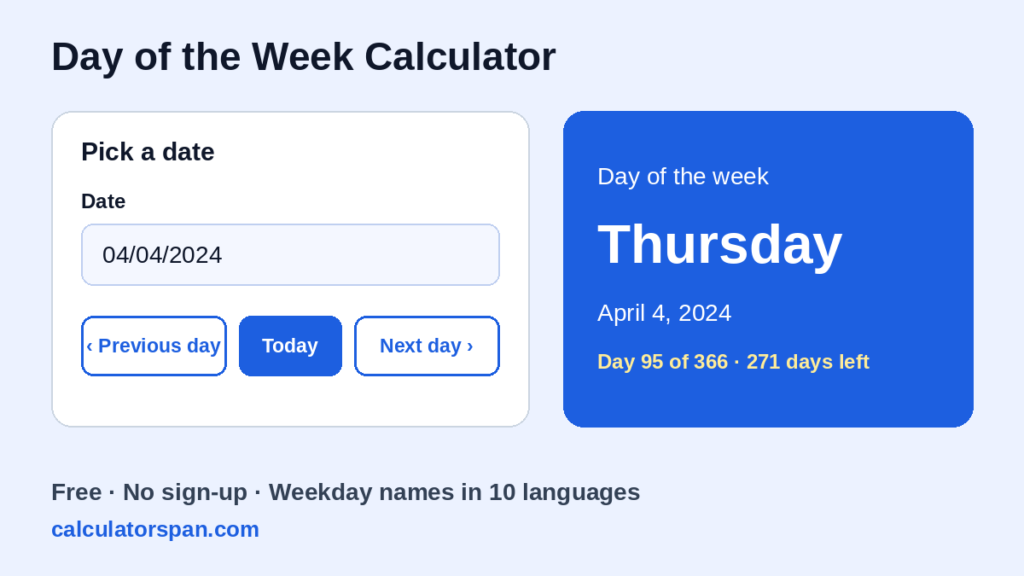
Every lookup starts simply. Pick a date from the date picker or type it in YYYY-MM-DD format, then tick the optional checkbox if you want extra facts beyond the weekday.
Take 2024-04-04. The result is Thursday, shown in whichever of the 10 languages you choose (jueves in Spanish, for example). It’s day 95 of 2024, a leap year with 366 days, which leaves 271 days until year-end. For a live count from today, see our days left in the year page.
The month view adds more. April 2024 has 30 days, 22 of them weekdays, and April 4 is the first Thursday of the month. Flip the calendar forward, and May 2024 shows a fifth Wednesday on the 29th.
For bulk use, paste one date per line. If you prefer compact labels, switch to short names such as Mon and Sun. Developers can also pass dates through a URL query parameter, which makes bookmarking specific results painless.
Zodiac, Birthstones, and the History Behind Every Date
Switch on the extras and a plain date turns personal. April 4 shows its zodiac sign (Aries), the modern birthstone for the month (diamond), and the mystical birthstone (opal), which most date tools never mention.
Below that sit historical events and famous people born that day. I lean on this for client anniversaries, because couples love seeing their wedding weekday beside a slice of history. One tap lets you share results instantly.
Where the Day Names Come From
Here’s what most calendars skip: weekday names in dozens of languages trace back to seven visible sky objects, not kings or saints. The system took shape during the Hellenistic period, roughly 323 BC to 31 BC.
Romans tied each day to a planet and its god. Sol, the Sun, gave us Sunday, and Luna, the Moon, gave us Monday. Saturn still lives on in Saturday.
Romance languages kept the other Roman gods: Mars in martes, Mercury in miércoles, Jupiter (Jove) in jueves, and Venus in viernes. English swapped in Germanic equivalents instead: Tiw for Tuesday, Woden for Wednesday, Thor for Thursday, and Frigg for Friday. The planetary order survived either way.
The pattern crosses cultures. Japanese calls Tuesday the fire day, since Mars links to fire. In Indian languages, Thursday is Guruvara, honoring Brihaspati, the guru of the gods and Jupiter’s counterpart.
Days of the Week in 10 Languages
Portuguese is my favorite outlier. Instead of honoring gods, it numbers the weekdays, so Monday becomes “second day.” Arabic counts too, starting its week with Sunday as “the first.” Hindi, Japanese, and Korean keep the planetary logic intact.
| English | Spanish | French | German | Italian | Portuguese | Arabic | Hindi | Japanese | Korean |
| Monday | Lunes | Lundi | Montag | Lunedì | Segunda-feira | الاثنين Al-Ithnayn | सोमवार Somvār | 月曜日 Getsuyōbi | 월요일 Woryoil |
| Tuesday | Martes | Mardi | Dienstag | Martedì | Terça-feira | الثلاثاء Ath-Thulāthāʼ | मंगलवार Mangalvār | 火曜日 Kayōbi | 화요일 Hwayoil |
| Wednesday | Miércoles | Mercredi | Mittwoch | Mercoledì | Quarta-feira | الأربعاء Al-Arbiʻāʼ | बुधवार Budhvār | 水曜日 Suiyōbi | 수요일 Suyoil |
| Thursday | Jueves | Jeudi | Donnerstag | Giovedì | Quinta-feira | الخميس Al-Khamīs | गुरुवार Guruvār | 木曜日 Mokuyōbi | 목요일 Mogyoil |
| Friday | Viernes | Vendredi | Freitag | Venerdì | Sexta-feira | الجمعة Al-Jumuʻah | शुक्रवार Shukravār | 金曜日 Kin’yōbi | 금요일 Geumyoil |
| Saturday | Sábado | Samedi | Samstag | Sabato | Sábado | السبت As-Sabt | शनिवार Shanivār | 土曜日 Doyōbi | 토요일 Toyoil |
| Sunday | Domingo | Dimanche | Sonntag | Domenica | Domingo | الأحد Al-Aḥad | रविवार Ravivār | 日曜日 Nichiyōbi | 일요일 Iryoil |
The day of the week calculator above shows these names in whichever language you choose.
Why Old Dates Trip People Up
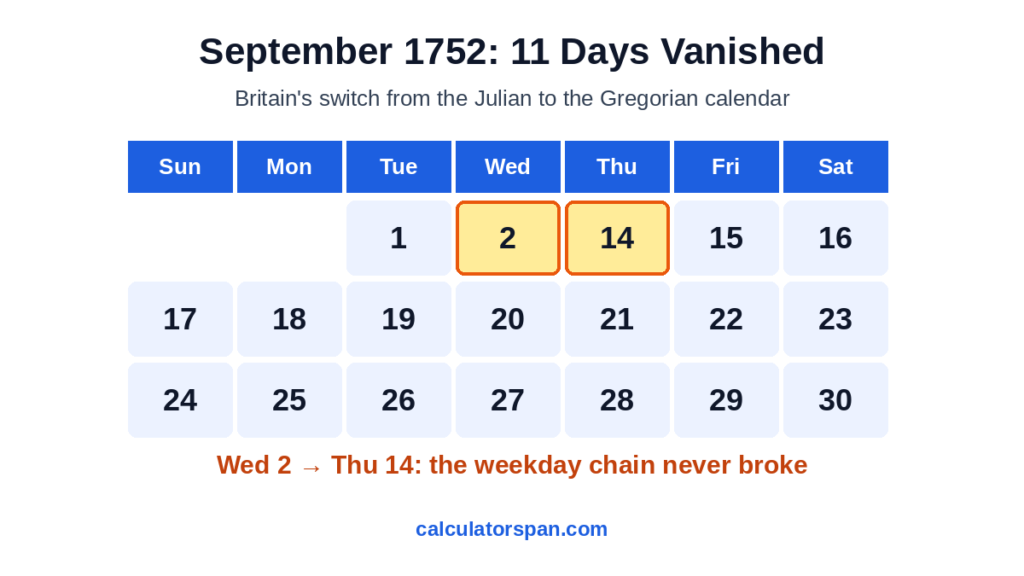
Switching calendars never broke the week. When Britain and its colonies switched in 1752, Wednesday, September 2 was followed by Thursday, September 14. Eleven days vanished, yet the weekday chain stayed perfectly intact.
The reform came from Pope Gregory XIII. His Gregorian calendar of 1582 corrected the Julian calendar’s slow drift against the Sun. Catholic European countries moved first, while others took centuries to adopt it. Russia waited until 1918 and Greece until 1923, and each dropped 13 days.
This matters for calculations, because dates recorded before a country’s switch may be Julian. This day of the week calculator applies the Gregorian calendar to every date, so if a historical weekday looks off, the skipped days are usually the reason. I always check the country’s switch year first.
First Day of the Week and the ISO 8601 Standard
Ask ten people for the first day of the week, and you’ll get a debate. For date and time data, the international standard ISO 8601 settles it: Monday is day one, and days 1–7 run through Sunday.
That numbering keeps data exchange clean between systems. Still, North America prints calendars starting on Sunday, while Europe and most other countries treat Monday as the first day of the week and the first workday.
| Region | First Day of the Week | Typical Weekend |
| Europe (ISO 8601) | Monday | Saturday–Sunday |
| North America | Sunday | Saturday–Sunday |
| Parts of the Middle East | Saturday | Friday–Saturday |
To count business days between two dates under your own weekend rules, use our working days calculator.
How to Calculate the Day of the Week Manually
Every day of the week calculator, including this one, relies on built-in date libraries, but you can find any weekday by hand. One classic method is Zeller’s congruence, published by Christian Zeller in the 1880s:
h = \left( q + \left\lfloor \frac{13(m+1)}{5} \right\rfloor + K + \left\lfloor \frac{K}{4} \right\rfloor + \left\lfloor \frac{J}{4} \right\rfloor + 5J \right) \bmod 7
- q is the day of the month.
- m is the month, with March as 3 through December as 12. January and February count as months 13 and 14 of the previous year.
- K is the last two digits of the year, and J is the first two.
- h is the result: 0 = Saturday, 1 = Sunday, 2 = Monday, and so on to 6 = Friday.
Worked example for April 4, 2024: q = 4, m = 4, K = 24, J = 20. That gives 4 + 13 + 24 + 6 + 5 + 100 = 152, and 152 mod 7 = 5, which is Thursday. I’ve hand-checked it against the day of the week calculator, and it matches every time.
Trivia About Each Day of the Week
Monday: Scramble its letters, and you get dynamo, an ironic anagram for the least energetic day. Some surveys suggest people complain most on Mondays. On the U.S. stock market, stocks have historically performed worse on Mondays, a pattern known as the Monday effect.
Tuesday: Tuesday carries two reputations. Black Tuesday, October 29, 1929, brought the stock market crash that deepened the Great Depression. Today, some workplace surveys rank it the most productive day of the week.
Wednesday: In the U.S., midweek earned the nickname Hump Day. Ash Wednesday is a Christian holy day that opens Lent. The name took on a grim second meaning in 1983, when the Ash Wednesday bushfires swept across Victoria and South Australia.
Thursday: Maundy Thursday, also called Holy Thursday, marks the Last Supper in the week before Easter. Campus culture flipped the tone entirely, and Thirsty Thursday became slang for the unofficial start of the weekend.
Friday: No day splits opinion like Friday. Friday the 13th feels unlucky to many, yet others treat Friday as lucky. Good Friday remembers the crucifixion, and in the U.S., Black Friday kicks off the holiday shopping season.
Saturday: In Sweden, children traditionally get candy on Saturdays. Israel keeps Saturday as its official day of rest. Australia and New Zealand both hold national elections on Saturdays.
Sunday: Sunday has long been the Christian day of rest and worship, so in many countries banks are still closed. It’s prime time for sporting events, peaking with Super Bowl Sunday. And any month that starts on a Sunday always has a Friday the 13th.
Frequently Asked Questions
What day of the week was I born?
Enter your date of birth in the calculator above, and it returns the weekday instantly, along with your zodiac sign, birthstones, and famous people who share your birthday.
How do I calculate the day of the week manually?
Use Zeller’s congruence, shown in the manual calculation section above. Plug in the day, month, and year, and the remainder after dividing by 7 tells you the weekday.
Does the day of the week calculator work for dates before 1582?
Yes. It applies the Gregorian calendar to every date, including those before 1582. For records written in the Julian calendar, the two calendars differ by 10 days in the 1600s, rising to 13 days from 1900 onward, so adjust the date before you look it up.
What day of the week is Christmas this year?
Christmas 2026 falls on a Friday. Enter December 25 with any year to check other years, or paste several years at once in bulk mode.
Is Monday or Sunday the first day of the week?
Both are correct depending on where you are. ISO 8601 and most of Europe start the week on Monday, while the U.S. and Canada start calendars on Sunday.