Twice a year, roughly 1.6 billion people across more than 70 countries do the same thing: they change their clocks by one hour—no new law. No emergency. Just a calendar date that tells the world to shift time. And every year, the conversation around daylight saving time (DST) gets louder because, honestly, a lot of people are tired of it.
Here is everything you need to know about daylight saving time in 2026: when it starts, when it ends, how it affects your health and your calculations, which states skip it entirely, and why there is a real chance this might be one of the last times the US does it at all.
When Does Daylight Saving Time Start in 2026?
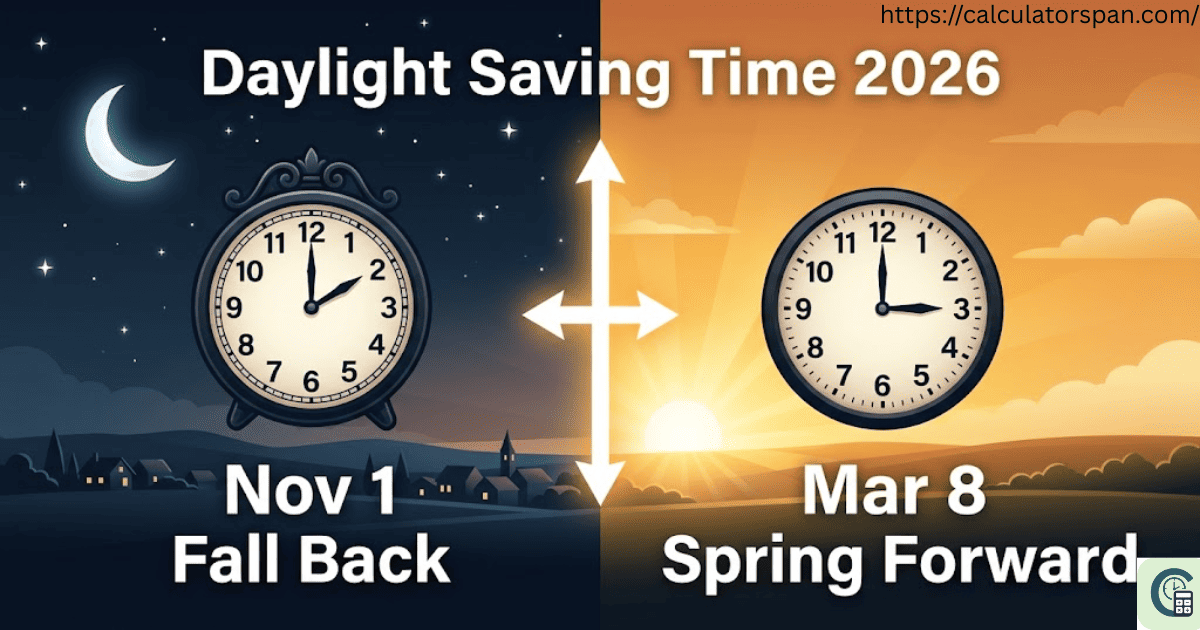
Spring Forward: Sunday, March 8, 2026, at 2:00 A.M. Clocks jump ahead one hour to 3:00 AM. Most people change them before bed on Saturday, March 7.
Fall Back: Sunday, November 1, 2026, at 2:00 AM, clocks go back one hour to 1:00 AM. You gain an hour of sleep.
Most smartphones, computers, and digital devices update automatically. Analog clocks, car clocks, and microwaves still need manual adjustment. You can use our free time calculator to verify time differences before and after the transition quickly.
Why Is Daylight Saving Time 2026 Earlier Than Usual?
March 8 is the earliest date DST can begin; it falls on the second Sunday of March, and 2026 is one of those years where March 1 lands on a Sunday, pushing that second Sunday to the 8th. Same story for November 1, the earliest the fall-back can happen. So 2026 gives you the shortest possible DST observation window in the calendar.
How Daylight Saving Time Works
The concept is simple: by shifting clocks forward one hour in spring, you move an hour of daylight from the morning to the evening. Instead of the sun rising at 6 AM and setting at 6 PM (hypothetically), it rises at 7 AM and sets at 7 PM. You lose morning light, gain evening light.
When clocks fall back in November, that shift reverses. Mornings get brighter earlier, evenings get darker faster.
The phrase “spring forward, fall back” is the easiest way to remember the direction of each change. Spring forward: clocks go forward one hour; you lose an hour. Fall back: clocks go back one hour; you gain an hour.
Want to see exactly how much time has passed since the last DST change? Our hours ago calculator gives you the exact elapsed time in hours, minutes, and seconds.
Why Was Daylight Saving Time Created?
This one has a lot of mythology around it: the Benjamin Franklin story, the farming story, and most of it is not accurate.
Benjamin Franklin gets credited with the idea because in 1784, while living in Paris, he wrote a satirical essay suggesting Parisians could save money on candles if they simply woke up earlier and used natural morning light. He was joking. He never proposed moving clocks forward, and standard time did not even exist in 1784.
The first person to seriously propose what we now know as DST was George Vernon Hudson, a New Zealand entomologist, in 1895. He wanted more daylight after work hours to collect insects. British builder William Willett picked up the idea in 1907 and campaigned for it across the UK, but Parliament rejected the bill twice. Willett died in 1915, never seeing it implemented.
What actually made DST happen was war. Germany and Austria-Hungary adopted it on April 30, 1916, during World War I, as an energy-saving measure to conserve coal. Britain followed weeks later. The US joined in 1918 under President Woodrow Wilson with the Standard Time Act.
After the war, the system became chaotic; states, counties, and even individual cities set their own DST schedules. Congress fixed this with the Uniform Time Act of 1966. The current schedule, the second Sunday in March through the first Sunday in November, was established by the Energy Policy Act of 2005, taking effect in 2007.
The farming connection is actually backwards. Farmers historically opposed DST because it shifted the clock away from their natural work schedule, not toward it.
Which US States Don’t Observe Daylight Saving Time?
Two states sit out entirely:
Hawaii never really needed DST. Its location near the equator means daylight hours don’t fluctuate much between summer and winter; residents get roughly 11 to 13.5 hours of daylight year-round regardless. Hawaii opted out when given the choice under the Uniform Time Act in 1967.
Arizona tried DST once in 196,7 and the state legislature abolished it the very next year. The reason is practical: Arizona summers are brutally hot, and extending evening daylight would push peak temperatures later into the afternoon and evening, increasing energy use rather than reducing it.
The exception within Arizona is the Navajo Nation, which spans parts of Arizona, Utah, and New Mexico. The Navajo Nation does observe DST to stay synchronized with its members across state lines.
Five US territories also skip DST: American Samoa, Guam, the Northern Mariana Islands, Puerto Rico, and the US Virgin Islands.
Daylight Saving Time 2026 by State: Full List
49 states and the District of Columbia observe DST from March 8 to November 1, 2026. Two states do not.
| State | DST 2026 |
| Alabama | 8 Mar – 1 Nov |
| Alaska | 8 Mar – 1 Nov |
| Arizona (Navajo Nation only) | 8 Mar – 1 Nov |
| Arizona (rest of state) | No DST |
| Arkansas | 8 Mar – 1 Nov |
| California | 8 Mar – 1 Nov |
| Colorado | 8 Mar – 1 Nov |
| Connecticut | 8 Mar – 1 Nov |
| Delaware | 8 Mar – 1 Nov |
| District of Columbia | 8 Mar – 1 Nov |
| Florida | 8 Mar – 1 Nov |
| Georgia | 8 Mar – 1 Nov |
| Hawaii | No DST |
| Idaho | 8 Mar – 1 Nov |
| Illinois | 8 Mar – 1 Nov |
| Indiana | 8 Mar – 1 Nov |
| Iowa | 8 Mar – 1 Nov |
| Kansas | 8 Mar – 1 Nov |
| Kentucky | 8 Mar – 1 Nov |
| Louisiana | 8 Mar – 1 Nov |
| Maine | 8 Mar – 1 Nov |
| Maryland | 8 Mar – 1 Nov |
| Massachusetts | 8 Mar – 1 Nov |
| Michigan | 8 Mar – 1 Nov |
| Minnesota | 8 Mar – 1 Nov |
| Mississippi | 8 Mar – 1 Nov |
| Missouri | 8 Mar – 1 Nov |
| Montana | 8 Mar – 1 Nov |
| Nebraska | 8 Mar – 1 Nov |
| Nevada | 8 Mar – 1 Nov |
| New Hampshire | 8 Mar – 1 Nov |
| New Jersey | 8 Mar – 1 Nov |
| New Mexico | 8 Mar – 1 Nov |
| New York | 8 Mar – 1 Nov |
| North Carolina | 8 Mar – 1 Nov |
| North Dakota | 8 Mar – 1 Nov |
| Ohio | 8 Mar – 1 Nov |
| Oklahoma | 8 Mar – 1 Nov |
| Oregon | 8 Mar – 1 Nov |
| Pennsylvania | 8 Mar – 1 Nov |
| Rhode Island | 8 Mar – 1 Nov |
| South Carolina | 8 Mar – 1 Nov |
| South Dakota | 8 Mar – 1 Nov |
| Tennessee | 8 Mar – 1 Nov |
| Texas | 8 Mar – 1 Nov |
| Utah | 8 Mar – 1 Nov |
| Vermont | 8 Mar – 1 Nov |
| Virginia | 8 Mar – 1 Nov |
| Washington | 8 Mar – 1 Nov |
| West Virginia | 8 Mar – 1 Nov |
| Wisconsin | 8 Mar – 1 Nov |
| Wyoming | 8 Mar – 1 Nov |
US Territories: No Daylight Saving Time
None of the US overseas territories observe DST, regardless of the time of year.
| Territory | DST Status |
| American Samoa | No DST |
| Guam | No DST |
| Northern Mariana Islands | No DST |
| Puerto Rico | No DST |
| US Minor Outlying Islands | No DST |
| US Virgin Islands | No DST |
How Daylight Saving Time Affects Time Calculations
The 23-Hour and 25-Hour Day Problem
When clocks spring forward in March, that Sunday becomes a 23-hour day. When they fall back in November, that Sunday becomes a 25-hour day. If you are calculating total hours across a DST boundary, say, a night shift that started at 10 PM on Saturday and ended at 6 AM on Sunday, your arithmetic will be off by one hour if you don’t account for the transition.
Our time calculator handles exactly this kind of addition and subtraction across time boundaries.
Work Hours and Timecard Calculations
Shift workers who clock in and out across a DST transition need to be careful. A 10-hour shift that spans the spring-forward moment is actually 9 hours of real time. The same shift spanning the fall-back moment becomes 11 hours of real time. Payroll systems should handle this automatically, but manual timecard calculations can get this wrong.
Use our free timecard calculator to calculate work hours accurately, especially useful on DST transition weekends.
If your time is recorded in hours and minutes and you need to convert it to decimal for payroll, our hours-to-decimal calculator handles that conversion instantly.
Time Zone Offsets Change
During standard time, the US time zones are:
- Eastern Standard Time (EST): UTC-5
- Central Standard Time (CST): UTC-6
- Mountain Standard Time (MST): UTC-7
- Pacific Standard Time (PST): UTC-8
During daylight saving time, those offsets shift by one hour:
- Eastern Daylight Time (EDT): UTC-4
- Central Daylight Time (CDT): UTC-5
- Mountain Daylight Time (MDT): UTC-6
- Pacific Daylight Time (PDT): UTC-7
Countdown and Elapsed Time Calculators
If you are calculating how many hours until a future event, or how many hours ago something happened, and that calculation crosses March 8 or November 1 at 2:00 AM, you need to account for the one-hour shift.
- To find how much time has passed since an event: hours ago calculator
- To find what time it will be in X hours from now: hours from now calculator
- To count down to a specific time: how long until 12:00 AM countdown
Age Calculations
For most purposes, DST doesn’t meaningfully affect age calculations in years. The edge case is a person born during the “missing hour” window on a spring-forward night. If you want your exact age down to days, hours, and minutes, our age calculator by date of birth gives you a precise breakdown.
Daylight Saving Time and Your Health
Research on DST and health has grown significantly in recent years, and the findings are more nuanced than most headlines suggest.
The Heart Attack Data
A widely cited Michigan study found a 24% increase in heart attack hospital admissions on the Monday after the spring-forward transition. A Finnish study found an 8% higher rate of ischemic stroke in the first two days after a DST transition.
But a more recent and much larger study from Duke University School of Medicine complicated the picture. Examining nearly 170,000 patients over a decade, researchers found no significant increase in heart attacks during the weeks surrounding DST transitions. The one exception was spring 2020, which coincided with the COVID-19 pandemic.
A 2025 study published in PNAS found that the cumulative effect of switching clocks twice a year could be associated with higher rates of stroke and obesity at a population level. The study estimated that eliminating the biannual change could prevent around 300,000 stroke cases and 2.6 million obesity cases in the US.
Circadian Rhythm Disruption
Your circadian rhythm, your internal biological clock,k is regulated largely by light exposure. Shifting the clock by an hour effectively changes when your body receives morning light, which affects cortisol levels, melatonin production, sleep quality, blood pressure, and metabolism. This disruption is temporary for most people, resolving within a week or two.
The fall-back transition in November is generally considered less harmful than spring-forward, because gaining an hour tends to align better with natural sleep patterns.
What Sleep Doctors Recommend
The American Academy of Sleep Medicine has called for the US to abolish DST entirely and adopt permanent standard time, citing circadian alignment benefits from more morning light exposure. The American Heart Association has also weighed in, noting sleep disruption as a key cardiovascular risk factor tied to the clock change.
Is Daylight Saving Time Ending? The Sunshine Protection Act
On July 14, 2026, the US House of Representatives passed the Sunshine Protection Act by a 308-117 bipartisan vote. The bill would make daylight saving time permanent across the country, eliminating the twice-yearly clock change. President Trump has publicly backed the legislation.
The bill now heads to the Senate, where its future is uncertain. Senators like Tom Cotton of Arkansas have already raised objections, pointing out that in some parts of the country, permanent DST would mean winter sunrises as late as 9:00 AM or later.
If it becomes law, Americans would observe DST year-round. States that already opt out, Hawaii and most of Arizona, would be allowed to continue on standard time.
The US has tried permanent DST before. During the 1973 oil crisis, the country adopted year-round DST as an emergency energy measure. The backlash was swift: parents were sending children to school in pitch darkness, and the program was reversed within two years.
You can track the bill’s progress directly on Congress.gov.
Countries That Don’t Observe Daylight Saving Time
Roughly 70 countries observe DST, but most of the world does not. Most of Asia, Africa, and South America have discontinued the practice or never adopted it. China, India, Japan, and most countries near the equator don’t change their clocks.
The European Union proposed ending the biannual clock change in 2018, allowing each member country to choose permanently between summer time and winter time. That proposal has moved slowly through EU governance.
Quick Reference: Daylight Saving Time 2026
| Event | Date | Direction | Effect |
| Spring Forward | March 8, 2026 | Clocks +1 hour | Lose 1 hour of sleep |
| Fall Back | November 1, 2026 | Clocks -1 hour | Gain 1 hour of sleep |
| DST Duration | March 8 – November 1 | — | 238 days |
Frequently Asked Questions
When Does Daylight Saving Time Start in 2026?
Daylight saving time starts on Sunday, March 8, 2026 at 2:00 AM. Clocks spring forward one hour to 3:00 AM.
When Does Daylight Saving Time End in 2026?
DST ends on Sunday, November 1, 2026, at 2:00 AM. Clocks fall back one hour to 1:00 AM.
Is it “Daylight Saving Time” or “Daylight Savings Time”?
The official name is Daylight Saving Time, singular. “Daylight Savings Time” with an S is the common colloquial version, technically incorrect but widely used.
Do Clocks Change at Exactly 2:00 AM?
Yes. In spring, clocks jump to 3:00 AM. In fall, 2:00 AM repeats;s it becomes 1:00 AM again. Most people just change clocks before bed on Saturday night.
Do Phones Update Automatically?
Smartphones, computers, smart TVs, and most internet-connected devices update automatically. Analog clocks, car clocks, ovens, and microwaves need manual adjustment.
Why Does DST Change at 2:00 AM Specifically?
The 2:00 AM time was chosen largely because of the railroad industry. Setting it at 2:00 AM minimized disruption to overnight train schedules while keeping the change firmly in the middle of the night.
Does Arizona Observe DST?
Most of Arizona does not. The Navajo Nation within Arizona does observe DST.
Will the US Eliminate DST?
The House voted to do exactly that in July 2026. The Senate still needs to pass the bill. Track the latest on Congress.gov.
How Do I Calculate Work Hours That Cross a DST Boundary?
Use our timecard calculator; it handles hours and minutes accurately regardless of when your shift starts and ends.
How Do I Convert Hours and Minutes to Decimal for Payroll?
Our hours-to-minutes-to-decimal calculator does this in one step. Enter your hours and minutes, get the decimal equivalent instantly.