The world doesn’t run on 24 time zones. It runs on 38, and that gap explains most of the scheduling mistakes I’ve watched clients make. A time zone converter removes the guesswork in seconds, as long as you know what it’s doing behind the scenes.
Time Zone Converter
Here in Pakistan, we sit at UTC+5 with no daylight saving time. India runs at UTC+5:30 and Nepal at UTC+5:45. Those half-hour and quarter-hour offsets break mental math fast, especially when you’re juggling international calls across multiple time zones.
Every UTC offset traces back to Coordinated Universal Time, a time standard set at 0° longitude and kept by atomic clocks worldwide. A reliable converter pulls its rules from the IANA Time Zone Database, so it handles past, present, and future dates correctly.
How to Use a Time Zone Converter
Start with the last step. Before you share a meeting time, check that the converted time falls on the right day. During standard time, a 3 PM CST call becomes 6 AM the next morning in Tokyo, and I’ve seen that detail get missed.
Setup takes seconds. Enter the date and time for the location you’re converting from, then pick where you’re converting to from the drop-down list. Leave the time blank, and many tools read it as 00:00:00, which means 12:00 AM, not noon.
For recurring checks, add more cities and reorder them so your home location sits on top. My setup for US clients keeps New York, Chicago, and Denver beside Multan. One hover over the hour tiles shows each time difference at a glance.
If you only need to know what the clock will read a set number of hours from now, our hours from now calculator is faster.
Key Features of a Good Time Zone Converter
Only one feature decides whether I trust a converter: daylight saving time adjustments. Everything else is convenience. Without an “Adjust for DST” option, the converted time can sit an hour off for months at a time.
Next comes visibility. A table view with day and night shading, sunrise hours, and marked weekends shows at once when a slot lands on someone’s Saturday or before dawn.
Sharing closes the loop. I send a permanent link instead of typing times into an email, then add the slot to Google Calendar, Outlook, or iCal. A mobile app or Chrome extension covers the rest.
Who Uses a Time Zone Converter
The users I see most often aren’t frequent travelers. In my client work, remote teams open a converter daily, often for business meetings that never leave the country but still span three or four zones within the US.
Event organizers face higher stakes. A livestream or webinar built for a global audience needs one start time that every viewer can read in their own time zone. Pair it with a countdown timer so nobody shows up late.
Then there’s the personal side. Travel plans with a tight connection, flight arrivals in another zone, market hours for traders, and weekly calls with family abroad all depend on finding the best time without mental math. For flights, our arrival time calculator handles the duration side.
Why Time Zone Abbreviations Can Cause Errors
IST alone can mean India or Ireland. That single fact explains why I never type time zone abbreviations into a converter anymore. Labels get used inconsistently, and that confusion turns into real scheduling errors.
The EST versus EDT mix-up is the one I fix most. Eastern Standard Time is UTC−05:00, but from March to November New York runs on EDT, one hour ahead. Writing “EST” in a July invite is simply wrong.
The US makes it worse with nine time zones, from Atlantic Time to Hawaii-Aleutian, Samoa, and Chamorro. Pacific Standard Time sits at UTC−08:00. My fix is simple: search by city, and let the tool work out whether standard offsets or DST apply.
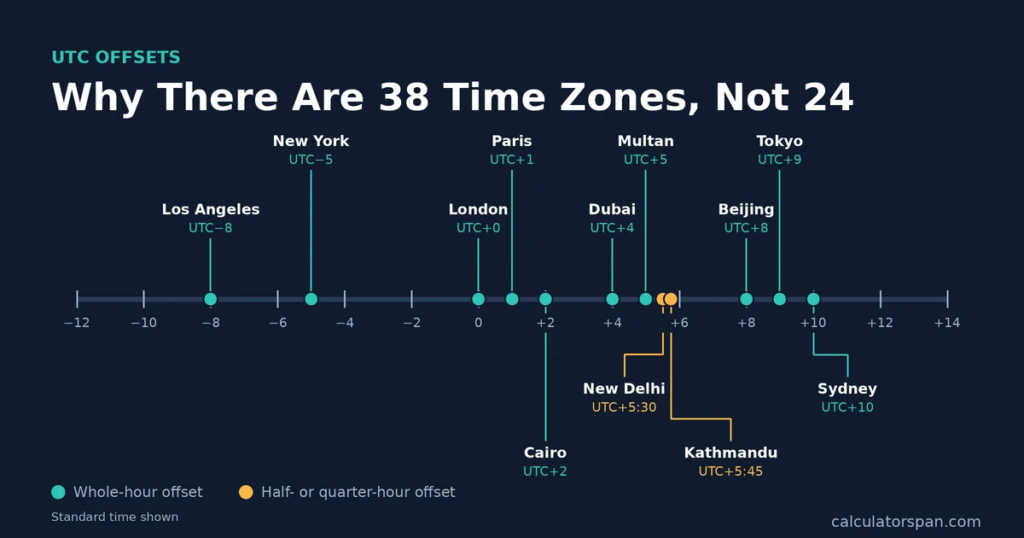
Table: Common Time Zone Abbreviations With More Than One Meaning
| Abbreviation | Meaning | UTC Offset |
| IST | India Standard Time | UTC+5:30 |
| IST | Irish Standard Time | UTC+1 |
| IST | Israel Standard Time | UTC+2 |
| CST | Central Standard Time (US) | UTC−6 |
| CST | China Standard Time | UTC+8 |
| CST | Cuba Standard Time | UTC−5 |
| PST | Pacific Standard Time (US) | UTC−8 |
| PST | Philippine Standard Time | UTC+8 |
| BST | British Summer Time | UTC+1 |
| BST | Bangladesh Standard Time | UTC+6 |
| AST | Atlantic Standard Time | UTC−4 |
| AST | Arabia Standard Time | UTC+3 |
Look at CST. The same three letters cover a 14-hour spread between Chicago and Beijing. That’s why a city name beats an abbreviation every time.
Entering Midnight and Noon Correctly
Midnight trips people up more than any offset. Choose 00 / 12 AM with 00 minutes, and you get the first minute of that date, not the last. Assume otherwise,e and your midnight event lands a full day early.
For noon, pick 12 / 12 PM with 00 minutes. I switch to 24-hour format whenever a call crosses zones, because 20:00 can’t be misread. In 12-hour format, 8:00 PM often loses its AM/PM marker in a rushed message. Our military time converter makes that switch instant.
Offsets add another layer. EST lags UTC by five hours and PST by eight. So 20:00 UTC equals 15:00, or 3:00 PM, in New York and 12:00 noon in Los Angeles during standard time. Enter times correctly, and the math holds.
Why a Converted Time Looks Wrong
The most common cause is daylight saving time. When one of two locations doesn’t observe it, the gap between them shifts by one hour about twice a year, and the converted time looks wrong even when it isn’t.
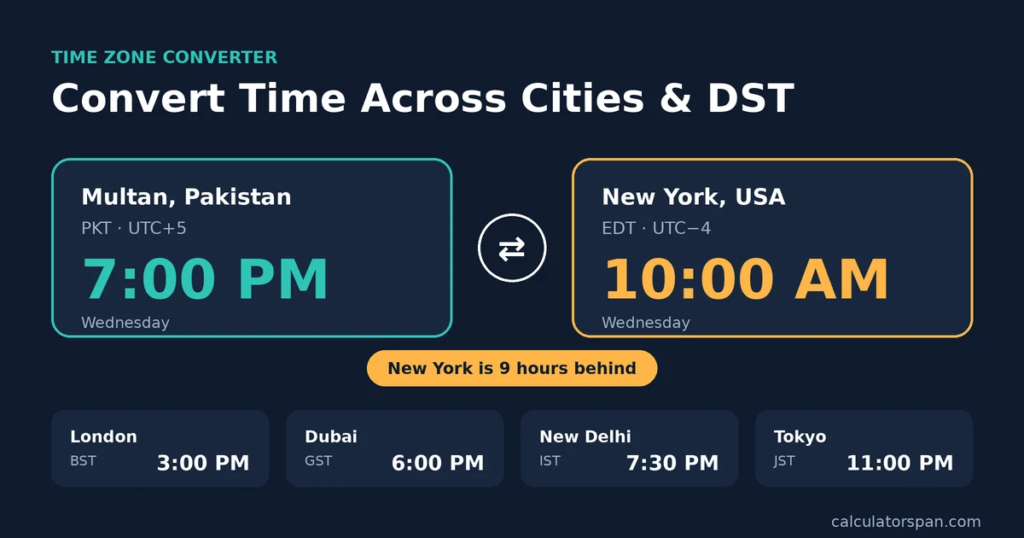
I deal with this constantly from Pakistan. We don’t use DST, so New York sits nine hours behind us in summer and ten in winter. North America, most European countries, New Zealand, and some Australian states all switch clocks.
The trickiest weeks come from mismatched DST rules. US daylight time starts in mid-March, but Europe moves at the end of March, and its DST ends a week earlier in autumn. Those short windows catch people off guard.
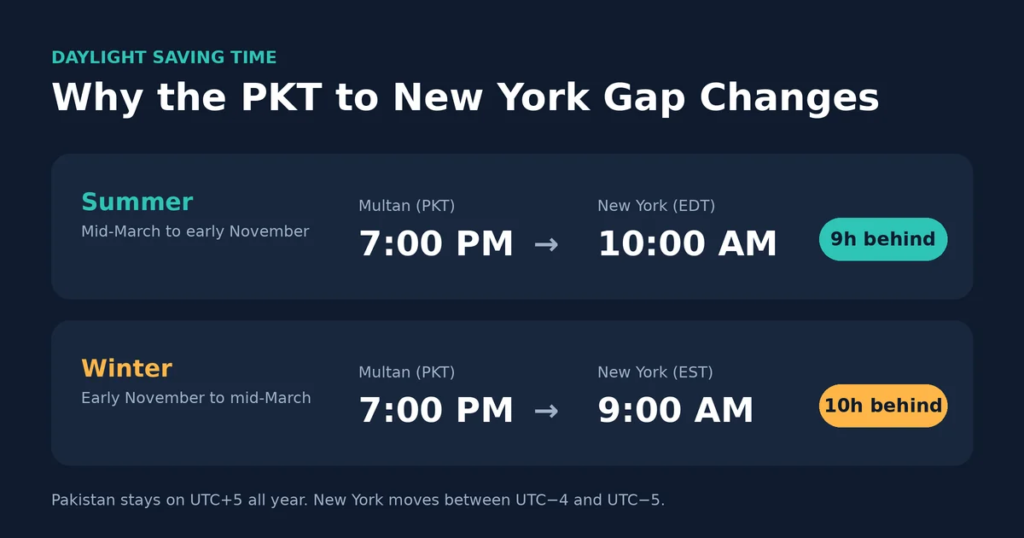
Table: Time Difference From Pakistan (PKT, UTC+5)
| City | Standard Time (UTC) | Daylight Time (UTC) | Difference From PKT (Standard / Daylight) |
| New York, USA | UTC−5 (EST) | UTC−4 (EDT) | 10h behind / 9h behind |
| Chicago, USA | UTC−6 (CST) | UTC−5 (CDT) | 11h behind / 10h behind |
| Denver, USA | UTC−7 (MST) | UTC−6 (MDT) | 12h behind / 11h behind |
| Los Angeles, USA | UTC−8 (PST) | UTC−7 (PDT) | 13h behind / 12h behind |
| London, UK | UTC+0 (GMT) | UTC+1 (BST) | 5h behind / 4h behind |
| Paris, France | UTC+1 (CET) | UTC+2 (CEST) | 4h behind / 3h behind |
| Cairo, Egypt | UTC+2 (EET) | UTC+3 (EEST) | 3h behind / 2h behind |
| Jerusalem, Israel | UTC+2 (IST) | UTC+3 (IDT) | 3h behind / 2h behind |
| Dubai, UAE | UTC+4 (GST) | No DST | 1h behind |
| New Delhi, India | UTC+5:30 (IST) | No DST | 30 min ahead |
| Beijing, China | UTC+8 (CST) | No DST | 3h ahead |
| Tokyo, Japan | UTC+9 (JST) | No DST | 4h ahead |
| Sydney, Australia | UTC+10 (AEST) | UTC+11 (AEDT) | 5h ahead / 6h ahead |
Last checked: September 2026. Sydney’s daylight time runs from October to April, the opposite of the Northern Hemisphere.
Frequently Asked Questions
Can I Use EST, PST or Other Abbreviations?
Yes, but I’d only trust UTC and GMT as input, because those two never shift with the seasons. EST, PST, and IST carry seasonal or regional mix-ups, and some tools won’t accept abbreviations at all for that reason. Searching by city or town is safer.
Can I Convert to More Than One City at Once?
Yes. Most converters let you add several places and view the same time across all of them in side-by-side rows. My usual board for a US launch shows Chicago, Denver, and Los Angeles, plus London and Paris for European partners.
Does Pakistan Observe Daylight Saving Time?
No. Pakistan Standard Time stays at UTC+5 all year. The country last used DST in 2009, so any time difference between Pakistan and a DST-observing country changes by one hour twice a year.
Why Is There More Than 24 Time Zones?
Some regions use half-hour or 45-minute offsets instead of whole hours. India (UTC+5:30), Iran (UTC+3:30), and Nepal (UTC+5:45) are common examples, which push the global count to 38.