This work hours calculator tells you exactly how many hours you worked in one shift. Enter your start time, end time, and break. You get the result in hours and minutes (hh: mm) and in decimal hours, including shifts that run past midnight.
Work Hours CalculatorEnter your start time, end time and break for each day. Totals update as you type. Monday – Tuesday – Wednesday – Thursday – Friday – Saturday – Sunday – Total hours0:00Decimal hours: 0
|
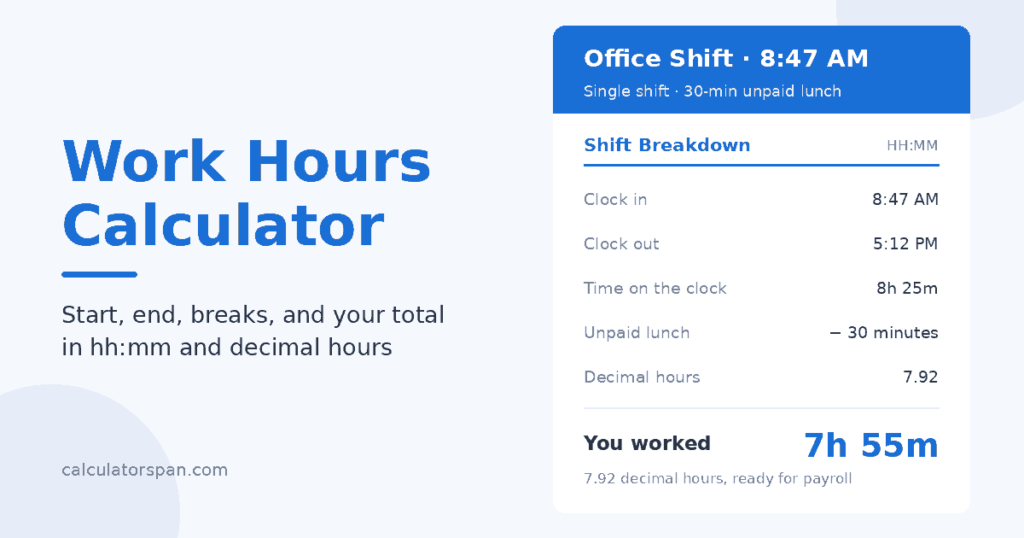
The work hours calculator is built for the quick, single-shift question: “I clocked in at 8:47, left at 5:12, and took a 30-minute lunch. What does that come to?” If you need to total a full week or pay period with overtime and gross pay, use the Timecard Calculator instead.
How the Work Hours Calculator Works
The work hours calculator uses one formula for every shift:
Hours Worked = (End Time − Start Time) − Unpaid Break
Say you clock in at 9:00 AM and clock out at 5:00 PM. That’s 8 hours on the clock. Take off a 30-minute unpaid lunch, and you worked 7 hours 30 minutes, or 7.5 hours.
The subtraction is easy. Most mistakes happen when you enter the times, so a few habits help:
- Watch the 12 o’clocks. 12:00 PM is noon and 12:00 AM is midnight. Most wrong entries I review come down to this one mix-up. If you’d rather avoid it, switch to 24-hour time, where noon is 12:00 and midnight is 00:00. The Military Time Converter can translate for you.
- Skip the colon if you like. Typing 1215 becomes 12:15, and 845 becomes 8:45.
- Only enter unpaid breaks. Paid rest breaks stay in your total (see the break section below).
Common Shifts, Already Calculated
These are the shift lengths people search for most, worked out for you:
| Shift | Unpaid break | Hours worked | Decimal |
| 9:00 AM – 5:00 PM | 30 min | 7h 30m | 7.50 |
| 8:00 AM – 5:00 PM | 1 hr | 8h 00m | 8.00 |
| 7:30 AM – 4:00 PM | 30 min | 8h 00m | 8.00 |
| 8:45 AM – 5:15 PM | 45 min | 7h 45m | 7.75 |
| 6:45 AM – 3:15 PM | 30 min | 8h 00m | 8.00 |
| 11:00 AM – 7:30 PM | None | 8h 30m | 8.50 |
| 10:00 PM – 6:00 AM | 30 min | 7h 30m | 7.50 |
| 7:00 PM – 7:30 AM | 1 hr | 11h 30m | 11.50 |
Calculating Overnight Shifts
This is where doing it by hand goes wrong most often. If you start at 10:00 PM and finish at 6:00 AM, subtracting directly gives you a negative number.
The fix is to add 24 hours whenever the end time is earlier than the start time. In 24-hour terms, 06:00 − 22:00 = −16, and −16 + 24 = 8 hours. The work hours calculator does this automatically. It recognises when a shift crosses midnight and returns the correct total, so night-shift nurses, security staff, and warehouse workers don’t have to think about it.
For a 12-hour night shift, such as 7:00 PM to 7:00 AM with a 1-hour meal break, the answer is 11 hours worked.
Breaks: What to Deduct and What to Keep
Breaks are where honest people lose money. Forget to deduct an unpaid 30 minutes, and you’ve overstated your day. Deduct a break that was paid, and you’ve shortchanged yourself.
In the US, the Department of Labor treats short rest breaks of about 5 to 20 minutes as paid working time. Bona fide meal periods, usually 30 minutes or more where you’re fully relieved of duty, are typically unpaid. So a 15-minute coffee break stays in your total, and a 30-minute lunch away from your desk comes out. Your contract and local law have the final say.
My own habit is to log a meal break as a break deduction, not as a second clock-out and clock-in. This keeps the record cleaner and easier to check later. For how long your breaks should be, see the Break Time Calculator.
Converting Your Hours to Decimal
Hours and minutes are for people. Decimals are for pay. Payroll software multiplies hours by a rate, and it can’t multiply 7:45.
To convert, divide the minutes by 60. 45 minutes ÷ 60 = 0.75, so 7h 45m is 7.75 hours. The work hours calculator shows both formats side by side.
The classic mistake is writing 7h 45m as 7.45. At $20 an hour, that’s $6 short on a single shift, which adds up to about $1,500 over a year of five-day weeks. For the full conversion chart, use the Hours to Decimal Calculator. To go the other way, use Decimal to Time.
Rounding Your Hours (The 7-Minute Rule)
Many employers round punch times, and it’s legal in the US under conditions. Federal regulation 29 CFR 785.48 allows rounding to the nearest 5 minutes, tenth of an hour, or quarter hour, as long as over time it doesn’t consistently favour the employer.
Quarter-hour rounding follows the 7-minute rule:
- 1 to 7 minutes past a quarter hour rounds down. A clock-in at 8:07 records as 8:00.
- 8 to 14 minutes past rounds up. A clock-in at 8:08 records as 8:15.
Tenths work differently. Every 6 minutes is 0.1 hour, so 6 minutes records as .10 and 12 minutes as .20. The 5-minute grid is the tightest standard option, and it’s the one I suggest to businesses that want rounding without fairness disputes.
[rounding] Switch on rounding in the work hours calculator to see your raw and rounded totals side by side.
If you’re checking your own pay, compare the two. Occasional small differences in either direction are normal. A pattern that always rounds against you is worth raising with payroll.
Is This Shift Overtime?
Some places trigger overtime on a single long day, not only after a long week. The calculator flags a shift that crosses a daily threshold:
| Jurisdiction | Daily overtime trigger |
| California | Over 8 hours at 1.5×, over 12 hours at 2× |
| Canada (federal) | Over 8 hours |
| India (Factories Act) | Over 9 hours |
| US federal (FLSA) | No daily trigger; overtime starts after 40 hours per week |
| UK | No statutory daily premium; overtime depends on your contract |
Weekly overtime needs a full week of shifts, which is what the Timecard Calculator handles. To turn overtime hours into pay, use the Time and a Half Calculator.
Frequently Asked Questions
How many hours is 9 to 5?
9:00 AM to 5:00 PM is 8 hours on the clock. With a 30-minute unpaid lunch, you worked 7.5 hours. With a 1-hour lunch, you worked 7 hours.
How many hours is 7 AM to 3:30 PM?
It’s 8 hours and 30 minutes on the clock. After a 30-minute unpaid break, that’s exactly 8 hours.
How do I calculate hours for a shift that ends after midnight?
If the end time is earlier than the start time, add 24 hours to the result. For example, 10:00 PM to 6:00 AM is 8 hours. The calculator detects overnight shifts automatically.
Should I deduct my lunch break?
Deduct it only if it’s unpaid. In the US, rest breaks of about 5 to 20 minutes are usually paid and stay in your total. Meal breaks of 30 minutes or more, where you’re fully off duty, are usually unpaid and come out.
Is 12 PM noon or midnight?
12 PM is noon and 12 AM is midnight. If this causes errors, switch the calculator to 24-hour time.
What is the 7-minute rule?
It’s the quarter-hour rounding rule. Punch times 1 to 7 minutes past a quarter hour round down, and 8 to 14 minutes past round up.
Can the Work Hours Calculator Total a Whole Week?
This tool is built for one shift at a time. To total a week or pay period with overtime and gross pay, use the Timecard Calculator.
Is the Work Hours Calculator Free?
Yes. It’s free to use in your browser, with no sign-up and no download.
- Total a full week or pay period: Timecard Calculator
- Convert hours and minutes to decimal: Hours to Decimal Calculator
- Calculate overtime pay: Time and a Half Calculator
- Add or subtract durations: Time Calculator