Most people get their ETA wrong before they even leave the house. Not because the drive takes longer than expected. Because the calculation starts at the wrong point entirely.
Departure time is not when you decide to go. It is when you walk out the door with everything you need. That gap between intention and movement is where most late arrivals are born. This arrival time calculator closes it.
Enter your departure time, travel time in minutes, transport mode, and appointment type. Get your exact arrival time plus a countdown to when you need to start getting ready. Free
When will you arrive?
Enter your departure time and travel details to get your exact arrival time, plus a live countdown until you need to get ready.
The Question Nobody Asks Before Leaving
Here is what experienced travelers know that casual commuters do not. The accuracy of any ETA calculation has almost nothing to do with how well you know the route. It depends entirely on how honestly you account for the time before the journey starts. If you need to find the exact time a set number of hours from now rather than calculating a journey, our hours-from-now calculator gives you the precise future timestamp instantly.
A work meeting at 10:00 AM with a 30-minute drive does not require you to leave at 9:30 AM. It requires you to start your get-ready time at 9:00 AM if your routine takes 20 minutes, leave at 9:20 AM, add 10 minutes for parking and walking from the stop, and arrive at 10:00 AM with a 5-minute safety buffer already built in.
The difference between those two versions of the same journey is 30 minutes of stress or 30 minutes of composure.
How to Use the Arrival Calculator
Departure time is your starting point. Set it to when you physically leave, not when you hope to leave.
Travel time in minutes is the raw duration of the journey. If you are driving through rush hour traffic, add 20 to 40 percent to your normal time. If you are using transit, include the wait at the stop.
Transport mode shapes how you interpret that number. Driving, transit, walking, and cycling each carry different levels of uncertainty.
Appointment type tells the calculator what is at stake. Casual, work meeting, medical, job interview, flight, important event. Each one triggers a different safety buffer because being late to a job interview and being late to a casual coffee have genuinely different consequences.
Extra buffers are where most arrival time calculations fail. Get-ready time covers the gap between deciding to leave and actually leaving. Parking and walking from the stop cover the gap between your vehicle stopping and you reaching the door.
Hit Calculate. Your exact arrival time appears. So does the countdown to when you need to start getting ready.
What Time Will I Arrive? The Actual Formula
Arrival Time = Departure Time + Travel Time + Parking Buffer + Safety Buffer
The get-ready time works differently. It does not push your arrival time forward. It pushes your start time backward. If you need 15 minutes to get ready and you are leaving at 9:00 AM, the calculator tells you that you need to start your routine at 8:45 AM. For adding or subtracting hours and minutes across multiple time values, our time calculator handles the base-60 arithmetic automatically without manual conversion.
That reversal is what makes this tool different from a simple time addition calculator.
Real scenario:
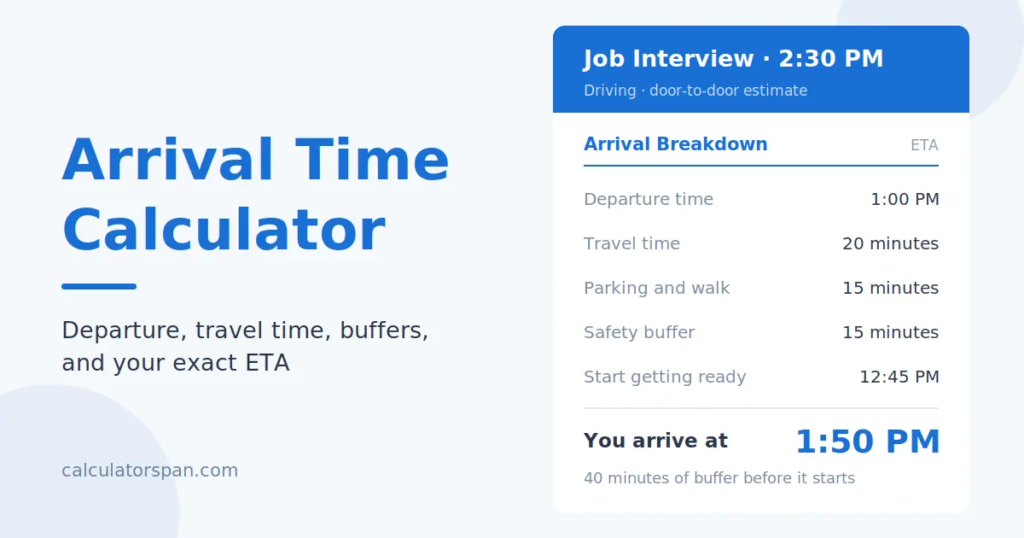
You have a job interview at 2:30 PM. Your drive takes 20 minutes. You need 15 minutes of get-ready time. You want 15 minutes for parking. The job interview safety buffer adds another 15 minutes.
| Component | Time |
| Departure time | 1:00 PM |
| Travel time | 20 minutes |
| Parking buffer | 15 minutes |
| Safety buffer | 15 minutes |
| Arrival time | 1:50 PM |
| Buffer before interview | 40 minutes |
40 minutes early to a job interview sounds excessive until you have missed one because the car park was full.
What the Arrival Time Calculator Shows You
| Output | What It Means |
| Arrival time | The exact time you will arrive at your destination |
| Depart at | Your confirmed departure time |
| Travel time | Your journey duration in minutes |
| Get-ready time | How long you need to prepare before leaving |
| Parking buffer | Extra time for parking and walking |
| Safety buffer | Auto-applied based on your appointment type |
| Time until you need to leave | A live countdown to when you should start getting ready |
The time until you need to leave updates in real time. If it shows 5h 02m 36s, that is exactly how long you have before you need to start your get-ready routine.
How Arrival Time Is Calculated
The formula behind every result is straightforward:
Arrival Time = Departure Time + Travel Time + Get-Ready Time + Parking Buffer + Safety Buffer
Example:
You are leaving at 8:30 AM for a work meeting. Your drive takes 45 minutes. You need 15 minutes to get ready and 15 minutes for parking.
| Component | Time |
| Departure time | 8:30 AM |
| Travel time | 45 minutes |
| Get-ready time | 15 minutes |
| Parking buffer | 15 minutes |
| Safety buffer | 5 minutes (auto for work meeting) |
| Arrival time | 9:50 AM |
The calculator runs this in one step the moment you hit Calculate.
Transport Modes: Why They Matter
Choosing the right transport mode is not just a label. It changes how you think about the travel time you enter.
| Mode | What to Consider When Entering Travel Time |
| Driving | Account for traffic; rush hour adds 20 to 40 percent to most journey times |
| Transit | Include waiting time at stops and transfer time between routes |
| Walking | Use a consistent pace; most adults walk 1 km in about 12 to 15 minutes |
| Cycling | Factor in hills, traffic lights, and locking your bike at the destination |
The mode you select also appears in your results summary, so your output always reads clearly: “Driving, 45 min travel, Arrive for Work Meeting.”
How long does it take to get there by different transport modes:
| Journey Type | Typical Underestimate | Real Additional Time |
| Urban driving in rush hour | 20 percent | Add 10 to 15 min per 30 min drive |
| Transit with one transfer | 15 percent | Add 8 to 12 min for connection wait |
| Walking to unfamiliar destination | 25 percent | Add 5 min for navigation pauses |
| Cycling in mixed traffic | 10 percent | Add 5 min for lights and locking |
| Hospital or airport parking | 35 percent | Add 10 to 20 min for walk to entrance |
These are not worst-case figures. They are averages. Your actual journey time on a bad day is worse than these numbers suggest.
Appointment Type Is a Risk Assessment
Most arrival time tools ignore what you are arriving for. This one does not, because what you are arriving for determines how much being late actually costs.
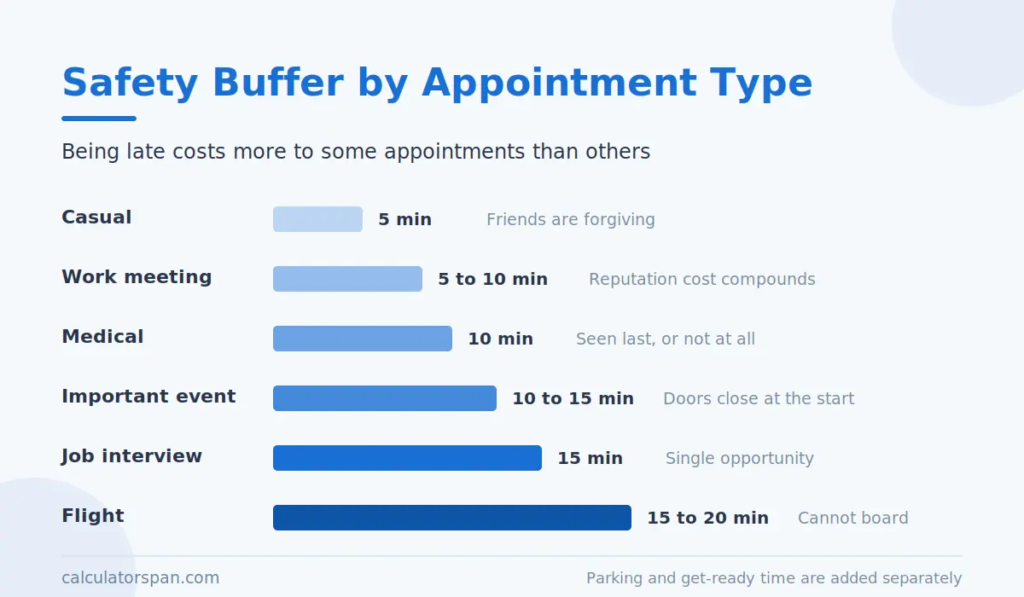
Casual meetups with friends absorb a 5-minute delay without consequence. The safety buffer reflects that.
Work meetings carry professional stakes. Walking in late while everyone is already seated has a reputational cost that compounds over time.
Medical appointments are harder to reschedule than people expect. Most practices have a late arrival policy that results in being seen last or not at all.
Job interviews are single-opportunity events in most cases. There is no recovery from arriving flustered. The safety buffer for a job interview is the highest of any appointment type because the downside is not inconvenience. It is a lost opportunity.
Flights are non-negotiable. The arrival time the calculator gives you is when you arrive at the airport. Security queues, check-in time, and gate distance are separate calculations you need to add on top. Landing in another country? Your calculated time stays in your departure city’s clock, so use our time zone converter to see the local time at your destination.
Important events cover everything else where being late matters: a wedding, a graduation, a presentation.
| Appointment Type | Cost of Being Late | Safety Buffer Applied |
| Casual | Minimal friends are forgiving | 5 minutes |
| Work Meeting | Professional reputation cost | 5 to 10 minutes |
| Medical | Hard to reschedule, seen last | 10 minutes |
| Job Interview | Single opportunity, no recovery | 15 minutes |
| Flight | Miss it, and you cannot board | 15 to 20 minutes |
| Important Event | Social and professional weight | 10 to 15 minutes |
Get-Ready Time: What It Actually Includes
Get-ready time is the gap between now and walking out the door. Most people underestimate it.
| Get-Ready Option | What It Covers | Best For |
| None | Already dressed and at the door | Leaving immediately |
| 10 minutes | Grab bag, quick check, head out | Already mostly ready |
| 15 minutes | Get dressed, gather essentials, final check | Standard quick departure |
| 20 minutes | Full outfit, bag pack, breakfast grab | Normal morning routine |
| 30 minutes | Complete routine, nothing rushed | Relaxed full preparation |
The before-you-go checklist the calculator shows is a useful last check: keys, phone, wallet, destination address confirmed, traffic checked, fuel or battery level OK. Five items that take 30 seconds to verify and prevent the kind of trip-ruining mistakes that no arrival time calculation can fix.
Parking and Walking Buffer
Parking buffer accounts for the gap between where your vehicle stops and where you need to be.
| Buffer Option | What It Covers | When to Use |
| None | Drop-off at door, zero walking | Taxi drop-off, someone driving you |
| +5 minutes | Close street parking, short walk | Quiet residential area |
| +10 minutes | Multi-storey car park, medium walk | Town centre, office building |
| +15 minutes | Large venue, hospital, airport | Anywhere with complex parking |
This is one of the most commonly missed variables in arrival planning. A 10-minute drive to a hospital becomes a 25-minute door-to-desk journey once you account for the car park and the walk to the right building.
Common Arrival Time Scenarios
Scenario 1: Morning Commute by Transit
You start work at 9:00 AM. The train takes 25 minutes, but you need to walk 10 minutes to the station first. There is a 7-minute wait for your connection. You need 20 minutes to get ready at home. Your workplace requires you to badge in, grab a coffee, and settle before the shift starts; that takes 10 minutes once you arrive.
| Component | Time |
| Get-ready time starts | 7:43 AM |
| Walk to station | 10 minutes |
| Connection wait | 7 minutes |
| Train travel | 25 minutes |
| Walk from station | 8 minutes |
| Safety buffer | 5 minutes |
| Arrival time | 8:38 AM |
| Time before shift | 22 minutes |
22 minutes of breathing room before a 9:00 AM shift. That is not excessive. That is the difference between a composed start and a stressed one.
Scenario 2: Medical Appointment
Appointment at 11:30 AM. The drive takes 15 minutes in normal traffic, but you are going during school drop-off time. Hospital parking is known to be busy. You need 15 minutes to get ready.
| Component | Time |
| Get-ready time starts | 10:15 AM |
| Departure time | 10:30 AM |
| Travel time with traffic | 22 minutes |
| Hospital parking and walk | 15 minutes |
| Safety buffer for medical | 10 minutes |
| Arrival time | 11:17 AM |
| Buffer before appointment | 13 minutes |
13 minutes to find reception, check in, and fill out any paperwork before being called. Without the parking buffer, that calculation comes out at 11:02 AM, enough time only if everything goes perfectly, which hospital car parks rarely allow.
Scenario 3: Flight Departure
Flight departs at 1:45 PM. The airport recommends arriving 2 hours before departure. The drive to the airport takes 40 minutes. Parking and walking from the stop to the terminal add 20 minutes. You need 30 minutes to get ready.
| Component | Time |
| Get-ready time starts | 9:35 AM |
| Departure time | 10:05 AM |
| Travel time | 40 minutes |
| Parking and terminal walk | 20 minutes |
| Safety buffer for flight | 15 minutes |
| Arrival at terminal | 11:20 AM |
| Time before recommended check-in | 25 minutes |
The calculator gives you your airport arrival time. Security queues, check-in, and gate distance are separate and should be planned on top of this number. For a 1:45 PM flight, arriving at the terminal at 11:20 AM gives you the full 2-hour recommended buffer plus 25 minutes extra.
Scenario 4: Cycling to a Casual Meetup
Meetup at a cafe at 2:00 PM. Cycling takes 18 minutes. You need 5 minutes to lock your bike and walk in. No get-ready time needed. Casual appointment, so the safety buffer is 5 minutes.
| Component | Time |
| Departure time | 1:32 PM |
| Cycling travel time | 18 minutes |
| Bike lock and walk in | 5 minutes |
| Safety buffer | 5 minutes |
| Arrival time | 2:00 PM |
This is the leanest version of an arrival calculation. No get-ready time. Minimal buffer. Casual appointment. The calculator handles this just as cleanly as it handles a job interview with 45 minutes of preparation time.
Scenario 5: Evening Awards Ceremony
Ceremony starts at 7:00 PM. The venue is a 20-minute walk from your hotel. You need 30 minutes to get ready. The walk from the hotel entrance to the ceremony hall adds 5 minutes. An important event buffer adds 10 minutes.
| Component | Time |
| Get-ready time starts | 5:55 PM |
| Departure time | 6:25 PM |
| Walking travel time | 20 minutes |
| Walk inside venue | 5 minutes |
| Safety buffer | 10 minutes |
| Arrival time | 7:00 PM |
Exactly on time. Which, for a formal ceremony where seats are assigned and doors close at the start, is the minimum acceptable outcome. Add 10 minutes more if you want to be seated before the room fills.
Quick Reference ETA by Common Scenario
| Scenario | Departure | Travel | Buffers | Arrival |
| Office commute by car | 8:15 AM | 25 min | 10 min parking + 5 min safety | 8:55 AM |
| Job interview by transit | 1:00 PM | 35 min | 15 min prep + 10 min walk | 2:00 PM |
| Medical appointment | 10:30 AM | 20 min | 15 min parking + 10 min safety | 11:15 AM |
| School run walking | 8:20 AM | 12 min | 5 min safety | 8:37 AM |
| Airport departure | 9:00 AM | 45 min | 20 min parking + 15 min safety | 10:20 AM |
| Casual dinner cycling | 7:00 PM | 15 min | 5 min bike lock + 5 min safety | 7:25 PM |
| Evening event walking | 6:30 PM | 20 min | 5 min inside walk + 10 min safety | 7:05 PM |
Once you have calculated your arrival time, the share buttons let you send the result directly to whoever needs it.
| Platform | Best Use Case | Who Receives It |
| Personal and professional ETA | Host, colleague, family | |
| Group travel updates | Multiple people at once | |
| X / Twitter | Public travel update | Followers or open update |
| Professional context | Business contact or client | |
| Copy link | Any message or email | Anyone on any platform |
Sharing your ETA before you leave removes the guesswork from both sides of the journey.
Why Manual Arrival Time Calculations Go Wrong
The departure time problem. Most people calculate from when they intend to leave, not when they actually leave. Intention and execution are rarely the same time.
The parking invisibility problem. Finding a space, paying the meter, and walking from the car park to the entrance is part of the journey. It is not a bonus at the end. For a busy hospital or a city centre venue, this adds 15 to 20 minutes that a basic calculation ignores completely.
The get-ready time gap. Deciding to leave at 9:00 AM is not the same as being at the door at 9:00 AM. The time between those two moments is where most late arrivals are created.
The fixed-speed assumption. Traffic conditions consistently extend journey times beyond what fixed-speed estimates predict. A 30-minute drive on a quiet road is not a 30-minute drive in rush hour traffic. Transit timetables are not actual arrival times at the stop. Walking speed in familiar territory is not walking speed in an unfamiliar area. Every transport mode carries variable time that a simple formula ignores.
What Next Day Arrival Actually Means
If your departure time plus travel time crosses midnight, your arrival time falls on the following day. The calculator handles this automatically.
This matters more than people realize for night shift workers, long-haul road trips, and late-night flights. Entering a 10:45 PM departure with a 3-hour drive returns an arrival time of 1:45 AM the next morning. That next-day arrival changes your planning for accommodation, reception hours, and who you need to notify about your ETA. For journeys that span multiple days rather than hours, our date difference calculator gives you the exact number of days, weeks, and months between any two dates.
The Before You Go Checklist
After your arrival time is calculated, the tool shows a five-point checklist before you leave.
Keys, phone, and wallet. These three items account for the vast majority of mid-journey returns home. A quick check takes 10 seconds and saves a 20-minute round trip.
Double-check the destination address. Navigation apps route to the address you give them, not the address you meant. A hospital with multiple entrances, a venue with a different postcode than its name, a business that moved premises since the address was saved. Confirm before you leave.
Check traffic on your route. A 30-minute drive with a reported 45-minute delay changes your departure time, not your arrival time. Knowing before you leave is the only version of this problem that gives you options.
Fuel or charge level. Running low on petrol or battery mid-journey is not a travel problem. It is a planning failure that adds unpredictable time to an already calculated journey.
Frequently Asked Questions
What is an arrival time calculator?
It is a tool that takes your departure time, travel duration, and additional buffers for preparation, parking, and appointment type, then returns the exact time you will arrive. It also calculates how long you have before you need to start getting ready.
How do I calculate my arrival time manually?
Add your travel time in minutes to your departure time. Then add your parking buffer and safety buffer. The formula is departure time plus travel time plus buffers equals arrival time. For get-ready time, subtract that from your departure time to find when your routine needs to start.
What is ETA?
ETA stands for Estimated Time of Arrival. It is the predicted time a person or vehicle will reach their destination based on departure time and travel duration. Every arrival time calculation produces an ETA.
What time will I arrive if I leave now?
Enter your current time as the departure time, add your travel duration in minutes, and calculate. The result is your arrival time from this exact moment. Add your parking buffer if you need a more accurate door-to-door figure.
How long does it take to get there by different transport modes?
It depends on the distance and mode. Driving is fastest for most journeys but the most variable. Transit is predictable on paper but adds waiting time. Walking is consistent but slower. Cycling sits between walking and driving for most urban distances. Enter the realistic time for your specific mode, not the best-case figure.
Can arrival time fall on the next day?
Yes. If your journey crosses midnight, the calculator displays your arrival time with a next-day indicator. This applies to overnight drives, late-night departures, and long-haul travel.
What is a safety buffer?
A safety buffer is a small amount of extra time added automatically based on your appointment type. Casual appointments get 5 minutes. Job interviews and flights get more. It accounts for minor unexpected delays without requiring you to manually pad every calculation.
What does get-ready time include?
Get-ready time is the gap between deciding to leave and walking out the door. Getting dressed, gathering your bag, doing a final check of the before-you-go list. Choosing 15 minutes tells the calculator to work backwards from your departure time and show you when your routine needs to start.
Is this calculator free?
Completely free. No account needed. No data stored. No sign-up required. Every calculation runs in your browser, and nothing is logged anywhere.