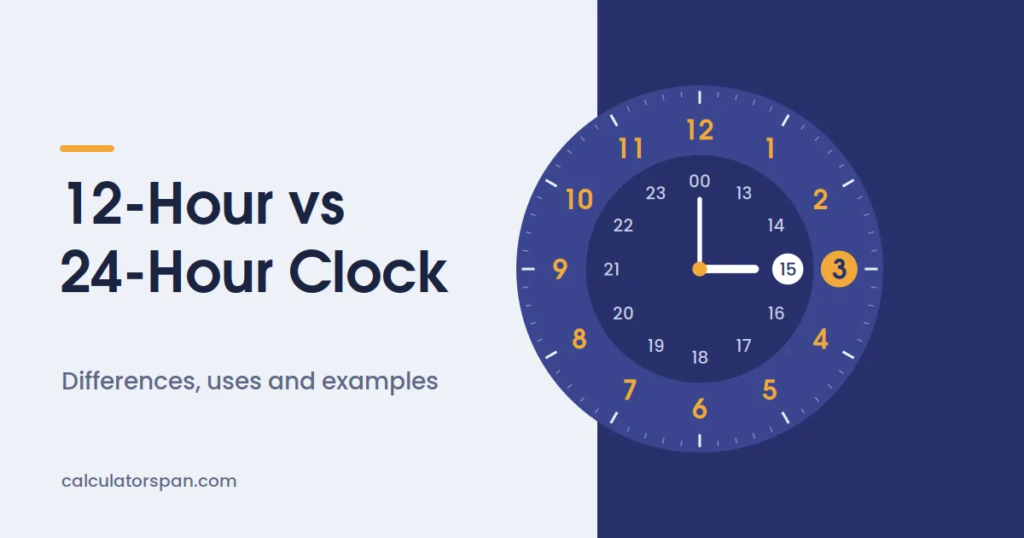
The 12-hour vs 24-hour clock question sounds simple until a meeting invite says “7” and half the team shows up at the wrong time. I switch between both formats every day. Parents and teachers start with analog time, yet students see digital time everywhere, and that gap creates real confusion in elementary school.
Children learn to tell time on analog clocks, then meet digital clocks set to 12h or 24h. Regular practice helps them convert 12-hour time with AM and PM into 24-hour time, with no calculator or online converter needed.
The skill matters outside class too. I schedule email sends for clients across the globe, and one wrong hour can hurt long-term relationships with audiences. Global marketing channels selling products and services face timing challenges. Communicating clearly takes a conversion table, solid resources, and a few considerations.
What Is the 24-Hour Clock?
The 24-hour clock splits one day into 24 hours, counted from hour 0 to hour 23. There are no a.m. or p.m. tags. Every hour gets a single number, which makes it the only fully unambiguous system.
Most digital clocks show it in a 4-digit form. The first two digits give the hour, and the last two give the minutes:
- 03:00 is the 3rd hour, or 3 am
- 14:00 is the 14th hour, or 2 pm
- 18:30 is 30 minutes into the 18th hour, or 6:30 pm
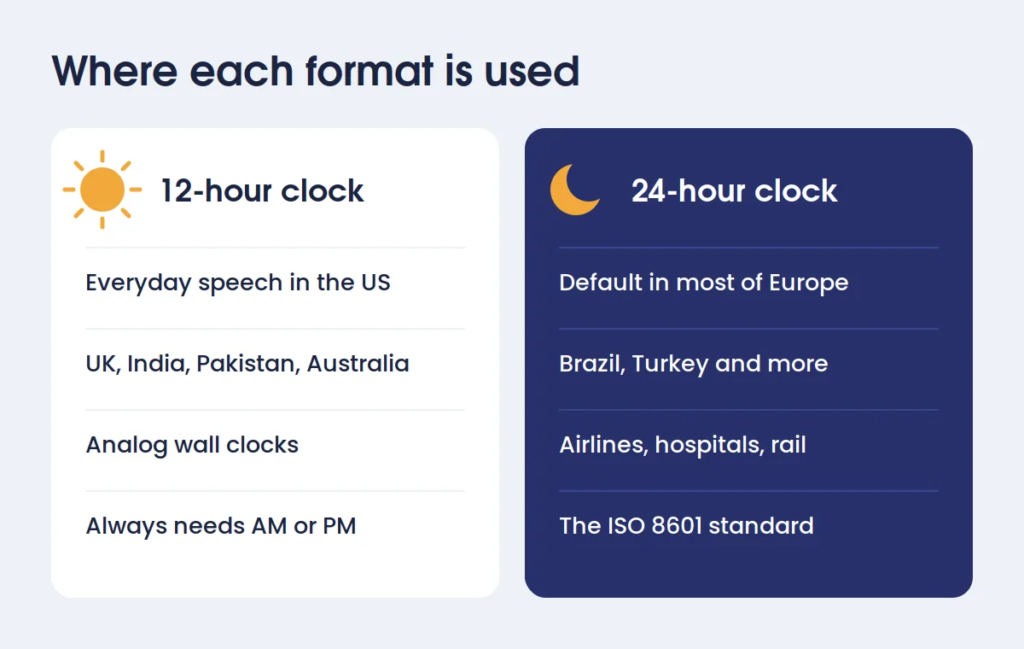
In the United States, people call 24-hour time “military time.” Across most of Europe, it’s simply the default. The ISO 8601 international standard also writes time in 24-hour format, so airlines, hospitals, and rail operators rely on it.
Scheduling is where it pays off. When I plan business meetings or trips with clients abroad, a note in 12-hour format like “meet at 7” could mean 7 AM or 7 PM. Write 7:00 or 19:00, and nobody can misread it or overlook the missing AM/PM label. Bus schedules use it for the same reason, and if you’re working out when you’ll actually get somewhere, an arrival time calculator saves the mental math.
What Is the 12-Hour Clock?
The 12-hour clock runs through the numbers 1-12 twice, so every time of day needs a label. a.m. comes from the Latin ante meridiem, meaning before midday. P.M. stands for post meridiem, meaning after midday.
Look at any analog clock or physical clock. The clock face carries 12-hour marks, and the hour hand completes two full circles each day. A digital clock set to 12-hour format simply adds an AM/PM tag.
The real difference becomes obvious on paper. I sketch a number line for learners, with 0 on the left and 23 on the right, then fold the line at noon. That quick visual graph explains conversion to the 24-hour system better than any rule. The 24-hour format keeps counting hours; the 12-hour one resets.
12-Hour vs 24-Hour Clock: Key Differences
The 12-hour vs 24-hour clock choice comes down to one trade-off: familiarity against precision. In my client work, I use 24-hour times in anything that gets scheduled and 12-hour times in anything people read casually.
| Feature | 12-Hour Clock | 24-Hour Clock |
|---|---|---|
| Hours counted | 1 to 12, twice a day | 00 to 23, once a day |
| Needs AM or PM | Yes | No |
| Midnight | 12:00 AM | 00:00 |
| Noon | 12:00 PM | 12:00 |
| Risk of misreading | Higher | Very low |
| Common in | Everyday speech in the US, UK, India, Pakistan | Europe, Brazil, Turkey, aviation, hospitals, military |
| Official standard | None | ISO 8601 |
How to Convert Between 12-Hour and 24-Hour Clock
To convert between the 12-hour clock and the 24-hour clock, you need two rules:
- 12-hour to 24-hour: For any PM time after noon, add 12 to the hour. 3 PM in the afternoon becomes 15:00, because 3+12=15. AM hours stay the same with a leading zero, so anything before noon keeps its number.
- 24-hour to 12-hour: For any hour above 12, subtract 12 and add PM. 18 hours and zero minutes (18:00) becomes 6 PM, written as 6:00 PM.
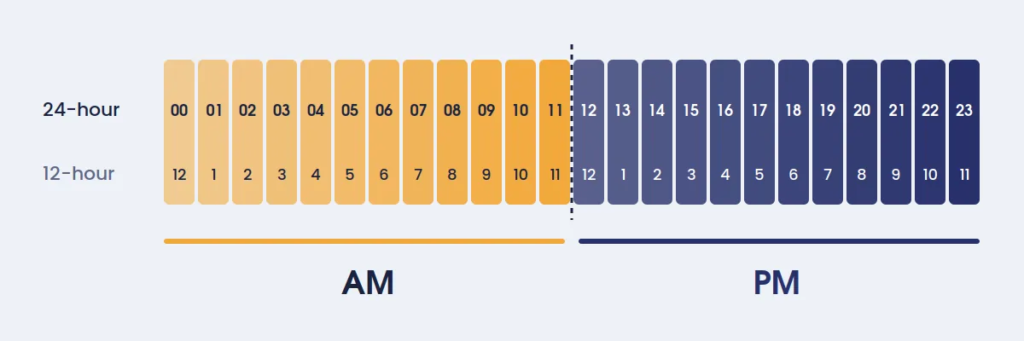
Two exceptions cause most of the confusion I see. Midday stays at 12:00, so you add nothing. Midnight drops to 00:00 at the beginning of the day. Some timetables print 24:00 to mark the end of a day at late night; both point to the same moment. If you’re counting down to that point, here’s how long until 12:00 AM.
The current ISO 8601-1:2019 standard writes times this way, and standard time or summer time doesn’t change the math. Every whole hour has a fixed 24-hour equivalent, so I keep a conversion table pinned for daily clock conversion. Three o’clock in the afternoon is 15:00 in any clock format. Phones often label this setting 24 h. For odd times like 16:47, a military time converter is faster than the table.
Whole-Hour Conversion Table
| Short | Spoken | Full 12-Hour | 24-Hour |
| 12 am | 12 AM | 12:00 AM | 00:00 |
| 1 am | 1 AM | 1:00 AM | 01:00 |
| 2 am | 2 AM | 2:00 AM | 02:00 |
| 3 am | 3 AM | 3:00 AM | 03:00 |
| 4 am | 4 AM | 4:00 AM | 04:00 |
| 5 am | 5 AM | 5:00 AM | 05:00 |
| 6 am | 6 AM | 6:00 AM | 06:00 |
| 7 am | 7 AM | 7:00 AM | 07:00 |
| 8 am | 8 AM | 8:00 AM | 08:00 |
| 9 am | 9 AM | 9:00 AM | 09:00 |
| 10 am | 10 AM | 10:00 AM | 10:00 |
| 11 am | 11 AM | 11:00 AM | 11:00 |
| 12 pm | 12 PM | 12:00 PM | 12:00 |
| 1 pm | 1 PM | 1:00 PM | 13:00 |
| 2 pm | 2 PM | 2:00 PM | 14:00 |
| 3 pm | 3 PM | 3:00 PM | 15:00 |
| 4 pm | 4 PM | 4:00 PM | 16:00 |
| 5 pm | 5 PM | 5:00 PM | 17:00 |
| 6 pm | 6 PM | 6:00 PM | 18:00 |
| 7 pm | 7 PM | 7:00 PM | 19:00 |
| 8 pm | 8 PM | 8:00 PM | 20:00 |
| 9 pm | 9 PM | 9:00 PM | 21:00 |
| 10 pm | 10 PM | 10:00 PM | 22:00 |
| 11 pm | 11 PM | 11:00 PM | 23:00 |
Conversion in Half-Hour Increments
| 24-Hour | 12-Hour |
| 00:30 | 12:30 AM |
| 01:30 | 1:30 AM |
| 02:30 | 2:30 AM |
| 03:30 | 3:30 AM |
| 04:30 | 4:30 AM |
| 05:30 | 5:30 AM |
| 06:30 | 6:30 AM |
| 07:30 | 7:30 AM |
| 08:30 | 8:30 AM |
| 09:30 | 9:30 AM |
| 10:30 | 10:30 AM |
| 11:30 | 11:30 AM |
| 12:30 | 12:30 PM |
| 13:30 | 1:30 PM |
| 14:30 | 2:30 PM |
| 15:30 | 3:30 PM |
| 16:30 | 4:30 PM |
| 17:30 | 5:30 PM |
| 18:30 | 6:30 PM |
| 19:30 | 7:30 PM |
| 20:30 | 8:30 PM |
| 21:30 | 9:30 PM |
| 22:30 | 10:30 PM |
| 23:30 | 11:30 PM |
Time Standards That Affect Global Scheduling
Coordinated Universal Time (UTC)
UTC is the time standard every other clock hangs from. It never shifts for seasons, which makes it the anchor for international coordination. Even Unix timestamps count seconds from a fixed UTC starting point.
Time zones are written as offsets from it. Places west of the prime meridian use UTC-, so New York sits at UTC-5 in winter. Places east use UTC+, and Pakistan runs on UTC+5 all year. When I brief a team spread across the world, I quote meeting times in UTC first. It cuts confusion because nobody’s local clocks become the “real” standard. Good timekeeping starts there.
International Time Zones
Here’s a real problem from email marketing. A client wants a launch email to land at 9:00 in both New York and Paris. New York runs on Eastern Time (ET), UTC-5 in winter. Paris runs on Central European Time (CET), UTC+1. That’s a six-hour offset.
One send time can’t hit both inboxes at 9 AM. So I split the list by region and convert each slot: 14:00 UTC for New York, 08:00 UTC for Paris. A time zone converter makes this check quick. Global and international communication campaigns across time zones fail more often from a sloppy time label than from weak copy.
Daylight Saving Time (DST)
Daylight Saving Time (DST) breaks that six-hour rule for a few weeks each year. Many countries move clocks forward in spring and back in fall, twice a year, but not on the same dates:
- The US springs forward on the second Sunday of March and falls back in early November.
- The EU springs forward on the last Sunday of March, so mid-to-late-March overall, and falls back in late October.
- In the Southern Hemisphere, it flips. Australian states with DST start in October and end in April, when the Northern Hemisphere is in autumn.
During those gap weeks, New York and Paris sit five hours apart, not six. I’ve watched scheduled marketing content go out an hour early because someone ignored the time change. Pakistan tried DST in 2008 and 2009, then dropped it, so I add clock adjustments to my seasonal calendar and check current DST dates by country as part of my procedures every year.
Date Formats (YYYY-MM-DD)
Time and date mistakes travel together. Date formats change across countries. The US writes month first, while Pakistan and much of Europe use DD-MM-YYYY. So 04-05-2026 means April 5 in one place and 4 May in another. Same numbers, different order, different day.
I use YYYY-MM-DD (2026-05-04) in every client report. It follows ISO 8601, sorts correctly in any spreadsheet, and makes a date difference calculator far less likely to read your input wrong.
International Holidays
Holidays add one more layer. National holidays, religious observances, and local celebrations differ across countries, and some move every year. Eid follows the lunar calendar, so its date shifts roughly 11 days earlier annually.
Before I schedule communications for a global target audience, I check the calendar for each of their locations. The right time on the wrong day still misses. Seasonal campaigns need this check most, and a working days calculator helps when deadlines fall near a holiday.
When Do Children Learn About the 12-Hour and 24-Hour Clock in Elementary School?
In US elementary school, children start with the 12-hour clock. The Common Core curriculum spreads teaching time across 1st grade, 2nd grade, 3rd grade, and 4th grade, with specific objectives at each stage. You can see the 3rd grade measurement standards as an example.
The 24-hour clock isn’t a formal US standard. In England, students meet it in Year 3 and convert between both formats by Year 4. Spreading time learning across these grades works because each skill builds on the one before.
12-Hour and 24-Hour Clock in 1st – 4th Grades
| Grade | What Students Learn |
| 1st grade | Tell the time to the hour and half past on analog clocks and digital clocks |
| 2nd grade | Tell and write the time to the nearest 5 minutes, using a.m. and p.m. |
| 3rd grade | Read time to the nearest minute and measure time intervals in minutes |
| 4th grade | Solve word problems with intervals of time, often on number lines |
These specific objectives show why kids struggle with time later. Skip the half-hour stage, and the nearest-minute stage falls apart.
How Do the 12- and 24-Hour Clocks Relate to Other Areas of Math?
Clock skills feed straight into math. Timetables are the clearest example. A child who can read a bus timetable and interpret the gaps between timings is subtracting in base 60 without realizing it. A time calculator is a good way to check their answers.
Ask them to plan a school day in both 12-hour and 24-hour clock notation. You’ll see fast who understands the pattern and who memorized it.
12-Hour Clock & 24-Hour Clock Worksheet Questions
Use these for home study with any clock:
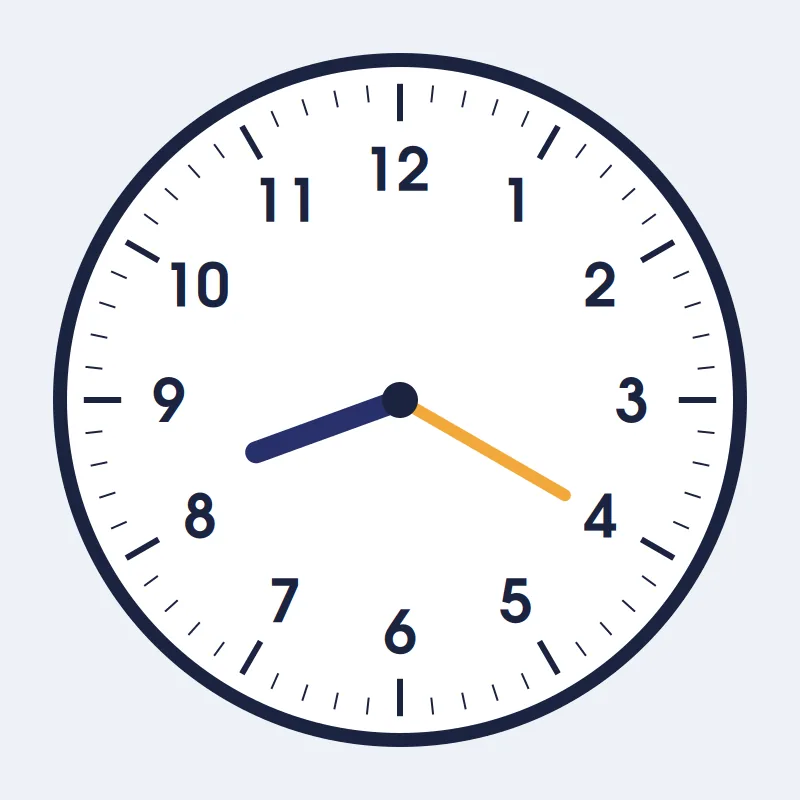
- On a clock face, the little hand is just past 8 and the big hand points at 4. What time is it?
Answer: 20 past 8 (8:20). - The little hand sits between 8 and 9, and the big hand points at 6. What time is it?
Answer: 8:30. - A film starts at 7 pm and runs for one hour. When does it end in 24-hour time?
Answer: 20:00h. For longer gaps, an hours from now calculator gives the answer instantly. - Which is earliest in the morning: 7:56 am, quarter to eight, six minutes to eight, or half past seven?
Answer: Half past seven (7:30). - Which of these times can a 12-hour display show twice a day: 03:45, 02:45, 09:45, 21:45, 14:45?
Answer: 03:45, 02:45, and 09:45. On 24-hour digital clocks, 21:45 and 14:45 appear once and have no 12-hour twin.
Frequently Asked Questions
What Time Is 12 PM in 24-Hour Clock?
12 pm is 12:00 on the 24-hour clock. It’s noon, or midday. Don’t add 12 to it.
What Is the 24-Hour Clock Called?
In the US, the 24-hour clock is usually called military time. Older British usage calls it continental time, and you’ll also hear railway time or railroad time, a nod to transport timetables.
What Is 12-Hour Clock Time?
12-hour clock time splits the day into two halves. It runs from midnight through 1 am to noon, then restarts at 1 pm. The 24-hour clock covers the same day from 00:00 to 23:59.