This break calculator shows how much break time your shift includes, which breaks are paid or unpaid, and how many hours you actually work once breaks are deducted. It works as a break time calculator for any shift, including a standard 30-minute lunch break.
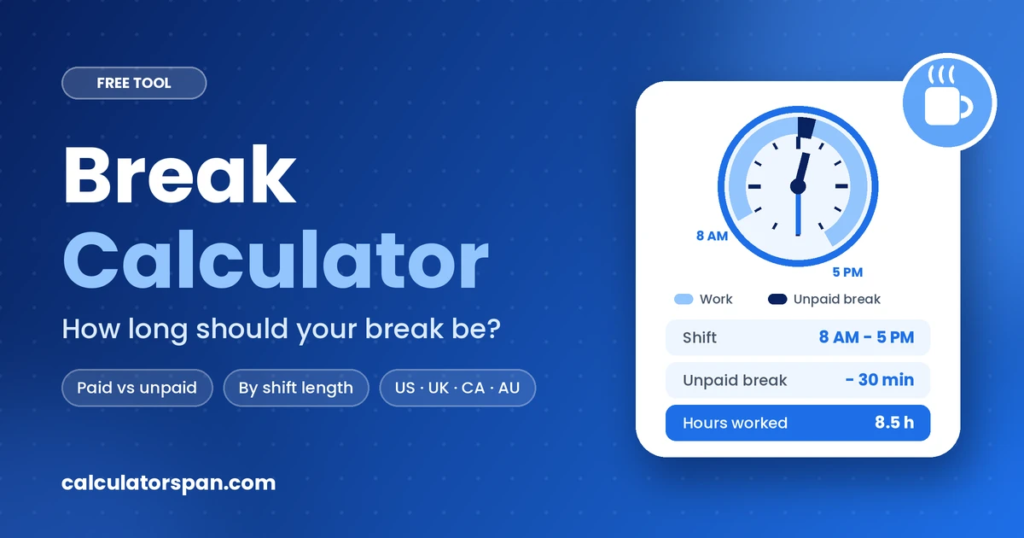
CalculatorSpan Calculate your shift length, break time, and net work hours instantly. Add each break and mark whether it is paid or unpaid. The end time is earlier than the start time, so this is treated as an overnight shift. These are general planning guidelines, not legal advice. Actual break entitlements depend on your location, industry, age, employment agreement, and applicable labor laws. Summary for general information only. Laws change and exceptions apply, so check the current rules where you work. Net Work Hours = Total Shift Duration − Total Break Time Example: 8:00 AM–5:00 PM is a 9-hour shift. With a 30-minute unpaid break, net work time is 8 hours 30 minutes.Break Time Calculator
Your breaks
Recommended break guide
Break rules by country
Below the break calculator, you can see how long your break should be for your shift length, how many hours you need to work before you get a break, and what the law says in the US, UK, Canada, and Australia.
How to Use This Break Calculator
- Enter your shift start time and end time.
- Add each break, set its length (15, 30, or 60 minutes), and mark it as paid or unpaid.
- Add your hourly rate if you want an estimated pay figure (optional).
- Click Calculate break time.
You will see your total shift length, total break time, unpaid break time, and hours worked after breaks.
This tool works one shift at a time. To total a full week of shifts with lunch breaks deducted, use the timecard calculator. To check how many hours you worked today, use the work hours calculator. If your shift times are in 24-hour format, the military time converter will switch them to AM/PM.
Break Entitlement by Shift Length
Your break depends on how long you work and where you work. Enter your shift in the break calculator above to see your total break time, then use the table below to check your legal minimum. On an 8 or 8.5-hour shift, most workers get one 20 to 30-minute meal break, and some also get paid 10-minute rest breaks.
| Shift length | California | UK | Canada (most provinces) | Australia (Retail Award) |
|---|---|---|---|---|
| 4 hours | One paid 10 min rest break | No legal break | No legal break | One paid 10 min break |
| 6 hours | 30 min meal break (can be waived) + one paid 10 min rest break | No legal break (must work over 6 hours) | 30 min meal break | Paid 10 min break + 30 to 60 min meal break |
| 8 hours | 30 min meal break + two paid 10 min rest breaks | 20 min break | 30 min meal break | Two paid 10 min breaks + 30 to 60 min meal break |
| 8.5 hours | 30 min meal break + two paid 10 min rest breaks | 20 min break | 30 min meal break | Two paid 10 min breaks + 30 to 60 min meal break |
| 12 hours | Two 30 min meal breaks + three paid 10 min rest breaks | 20 min break | 30 min meal break, plus a second in some provinces | Two paid 10 min breaks + two 30 to 60 min meal breaks |
This table shows legal minimums. Your contract, union agreement, or employer policy may give you more.
If I Work 6 Hours, What Is My Break?
In the UK, a shift of exactly 6 hours has no legal break. In California, you get a 30-minute meal break (which you can waive at 6 hours or less) and one paid 10-minute rest break. Most Canadian provinces give 30 minutes.
If I Work 8.5 Hours, What Is My Break?
On an 8.5-hour shift, UK workers get one 20-minute break. California workers get a 30-minute meal break plus two paid 10-minute rest breaks. Most Canadian provinces give a 30-minute meal break.
How Many Hours Before You Get a Break?
In most places, you must work 4 to 6 hours before a legal break applies. UK adults need to work more than 6 hours. Most Canadian provinces set the mark at 5 hours. In California, a paid rest break starts at 3.5 hours and a meal break at 5 hours.
| Location | Hours worked before a break |
|---|---|
| UK (adults) | More than 6 hours |
| UK (under 18) | More than 4.5 hours |
| California | 3.5 hours for a rest break, 5 hours for a meal break |
| Washington State | 5 hours for a meal break |
| New York | 6 hours (if the shift covers 11 AM to 2 PM) |
| Canada (most provinces) | 5 hours |
| Australia (Retail Award) | 4 hours |
| US states with no break law | No legal minimum |
In an 8-Hour Day, How Many Breaks Do You Get?
In an 8-hour day, you usually get one meal break. In California, you also get two paid 10-minute rest breaks, for three breaks in total. UK and most Canadian workers get one break. Australian retail workers get three: two paid rest breaks and one meal break.
How Long Should Your Break Be?
There is no single worldwide rule. If you are planning shifts or your location has no break law, this rule of thumb reflects how break rules tend to scale with hours worked. It is a planning guide, not a legal requirement, and you can test any pattern in the break calculator by adding breaks of the lengths shown.
| Shift length | Typical break time |
|---|---|
| Under 4 hours | Often no break |
| 4 to 6 hours | 10 to 15 minute rest break |
| 6 to 8 hours | 30-minute meal break |
| 8 to 10 hours | 30-minute meal break plus one or two short rest breaks |
| Over 10 hours | Two meal breaks, or one meal break plus rest breaks |
Your real entitlement depends on your country, state or province, industry, age, and contract. The sections below cover the legal rules.
Break Time Laws by Country
Break rules change a lot from one country to the next, and in the US and Canada they also change by state or province. Here is how the main regions handle it.
United States
Federal law does not require employers to give meal or rest breaks. The Fair Labor Standards Act (FLSA) only decides whether a break is paid once an employer offers it.
| Break type | Typical length | Paid under federal law? |
|---|---|---|
| Short rest break | 5 to 20 minutes | Yes |
| Meal break, fully relieved of duty | 30 minutes or more | No |
| Meal break where you keep working | Any length | Yes |
See the US Department of Labor guidance on breaks for the federal rules.
The actual right to a break comes from state law. Around 20 states require meal breaks for adult workers, and fewer than a dozen require paid rest breaks. Everywhere else, breaks are up to your employer, your contract, or your union agreement.
| State | Meal break rule | Rest break rule |
|---|---|---|
| California | 30 min unpaid before the end of the 5th hour; a second one for shifts over 10 hours | Paid 10 min per 4 hours worked (or major part of 4 hours) |
| Washington | 30 min for shifts over 5 hours, taken between the 2nd and 5th hour | Paid 10 min per 4 hours worked |
| New York | 30 min for shifts over 6 hours that cover 11 AM to 2 PM | None |
| Illinois | 20 min for shifts of 7.5 hours or more, starting no later than 5 hours in, plus 20 min for each additional 4.5 hours | None |
| Texas | None for adults | None |
| Florida | None for adults (under 18s get 30 min after 4 hours) | None |
If your state is not listed, check your state labor department’s website.
United Kingdom
Breaks in the UK come from the Working Time Regulations 1998.
| Who | Break entitlement | Paid? |
|---|---|---|
| Adult working more than 6 hours | One uninterrupted 20 min break | Only if your contract says so |
| Adult working 6 hours or less | No legal break | Not applicable |
| Worker under 18, working more than 4.5 hours | 30 min break | Only if your contract says so |
The 20-minute break has to be taken during the working day, not tacked onto the start or end of your shift. Your employer can decide when you take it. If your employer refuses your legal break, you can raise a grievance and, if that fails, take a claim to an employment tribunal.
Full details are on the GOV.UK rest breaks page.
Canada
Each province and territory sets its own break rules, and federally regulated workplaces follow the Canada Labour Code. The most common rule is a 30-minute break after 5 hours of work.
| Jurisdiction | Meal break rule |
|---|---|
| Ontario | 30 min so you never work more than 5 hours in a row without one |
| British Columbia | 30 min after 5 consecutive hours |
| Alberta | 30 min for shifts over 5 hours; two 30 min breaks for shifts of 10 hours or more |
| Quebec | 30 min after 5 consecutive hours |
| Manitoba | 30 min after 5 consecutive hours |
| New Brunswick | 30 min after 5 consecutive hours (set under the Occupational Health and Safety Act) |
| Newfoundland and Labrador | 1 hour after 5 consecutive hours |
| Federal workplaces | 30 min during every 5 consecutive hours |
These breaks are normally unpaid. In most provinces, if your employer makes you stay on call or at your workstation during the break, it has to be paid. In Ontario, you and your employer can agree to split the 30 minutes into two shorter breaks.
Sources: New Brunswick employee rights, provincial meal break summary (HR Insider).
Australia
The National Employment Standards do not cover meal or rest breaks. Your breaks come from the Modern Award, enterprise agreement, or contract that covers your job, so two people doing similar work can have different rules.
As an example, this is the break pattern commonly set by the General Retail Industry Award:
| Hours worked | Paid rest breaks | Unpaid meal breaks |
|---|---|---|
| 4 to 5 hours | One 10 min break | None |
| 5 to 7 hours | One 10 min break | One 30 to 60 min break |
| 7 to 10 hours | Two 10 min breaks | One 30 to 60 min break |
| Over 10 hours | Two 10 min breaks | Two 30 to 60 min breaks |
Other awards use different triggers and lengths. Look up your own award on the Fair Work Ombudsman breaks page.
Paid vs Unpaid Breaks
Short rest breaks are usually paid. Longer meal breaks are usually unpaid, as long as you are fully off duty. The break calculator lets you mark each break as paid or unpaid, so only unpaid time comes off your hours.
| Break type | Usual length | Counts as hours worked? |
|---|---|---|
| Rest or coffee break | 5 to 20 minutes | Yes |
| Meal break, fully off duty | 30 minutes or more | No |
| Meal break while still working | Any length | Yes |
What decides it is whether you are actually free. If you are expected to answer calls, reply to emails, watch a till or machine, or eat at your desk while covering work, that time is work and should be paid.
Staying on the premises is a different question. Under US federal law, an employer can ask you to stay on site during an unpaid meal break, provided you are relieved of all duties. In Quebec and several other Canadian provinces, a break becomes paid if you are not allowed to leave your workstation.
How to Calculate Break Time and Lunch Breaks
To calculate your hours worked, subtract your unpaid break time from your total shift length. Paid breaks stay in your hours. If you only know your start and end times, the time duration calculator gives you the total shift length first.
\text{Hours worked} = \text{Total shift length} - \text{Unpaid break time}Break Time Calculator Example: 30-Minute Lunch Break
Here is the math the break time calculator does for a typical shift. You work 8:00 AM to 5:00 PM with a 30-minute unpaid lunch and a paid 15-minute rest break.
- Total shift: 9 hours
- Unpaid lunch break: 30 minutes (0.5 hours)
- Paid rest break: stays in your hours, so do not subtract it
- Hours worked: 9 − 0.5 = 8.5 hours
Converting Break Time to Decimal Hours
Payroll usually needs decimal hours, so 8 hours 30 minutes becomes 8.5. The hours and minutes to decimal calculator converts it for you, and the decimal to time calculator converts it back. For shifts that run past midnight, the time calculator handles the math across the day change.
How Breaks Affect Your Pay
A 30-minute unpaid lunch on an 8-hour shift means you are paid for 7.5 hours. That is normal and legal, as long as you really are off duty for the full 30 minutes. The break calculator shows this split automatically when you mark the lunch as unpaid.
Problems start when a payroll system deducts the break automatically, but you work through it. Over a 5-day week, that is 2.5 hours of work you are not paid for, or about 10.8 hours a month. At $20 an hour, that comes to around $215 a month. If this happens to you, keep a record of the breaks you missed and raise it with your employer.
Unpaid breaks also don’t count toward overtime. Once your hours worked pass your overtime threshold, the time and a half calculator shows what those extra hours should pay. For a full week of shifts, the timecard calculator totals your hours with lunch breaks deducted each day.
Break Calculator FAQs
What does a break calculator do?
A break calculator subtracts unpaid break time from your shift to show the hours you actually worked. This break time calculator also separates paid and unpaid breaks and can estimate your pay from an hourly rate. It is free and needs no sign-up.
How much break time am I entitled to?
It depends on your location and shift length. UK adults get 20 minutes after more than 6 hours. Most Canadian provinces give 30 minutes after 5 hours. California gives a 30-minute meal break after 5 hours plus paid 10-minute rest breaks. Many US states have no legal minimum.
How many hours do you have to work to get a break?
Usually 4 to 6 hours. UK adults must work more than 6 hours, most Canadian workers 5 hours, and Australian retail workers 4 hours. In California, a paid rest break starts at 3.5 hours.
How do I calculate a 30-minute lunch break?
Subtract 0.5 hours from your total shift length if the lunch is unpaid. A 9-hour shift with a 30-minute unpaid lunch gives 8.5 hours worked. The break calculator above does this for you when you add a 30-minute unpaid break.
Is a 30-minute lunch break paid or unpaid?
Usually unpaid, as long as you are completely off duty for the whole 30 minutes. If you have to keep answering calls, serving customers, or watching over work, that time counts as work and should be paid.
Can my employer make me skip my break?
Where breaks are a legal right, no. In the UK, refusing your 20-minute break breaks the Working Time Regulations. In California, a missed meal break means your employer owes you one extra hour of pay at your regular rate for that day. In Canada, you can file a complaint with your provincial employment standards office. In US states with no break law, your employer can decide.
Do I get a second break on a 10 or 12 hour shift?
In some places, yes. California requires a second 30-minute meal break once you work more than 10 hours, plus a third paid rest break. Manitoba gives a second 30-minute break after another 5 hours of work. The Australian retail award gives two meal breaks for shifts over 10 hours. In the UK, the legal minimum stays at one 20-minute break no matter how long the shift is.
What is the minimum break between shifts?
In the UK, adults get 11 hours of rest between working days, and under 18s get 12. In Ontario, you get 11 hours off in a row each day and at least 8 hours between shifts. Australian awards commonly set 10 to 12 hours. The US has no federal rule, but some cities, such as Seattle and New York City, set rest periods between shifts for certain retail and food service workers.
Do short breaks have to be paid?
In the US, yes. Under federal law, breaks of 5 to 20 minutes count as hours worked for non-exempt employees in every state. In the UK, it depends on your contract. In Australia, most awards make short rest breaks paid.