Working extra hours should mean a bigger paycheck, and you shouldn’t need a spreadsheet to see how much bigger. Enter your hourly rate and total hours worked, and this time and a half calculator shows your overtime rate, overtime pay, regular pay, and total gross pay in seconds.
Time and a Half Calculator
Enter your hourly rate and hours worked — get your exact overtime pay instantly
What Is Time and a Half?
Time and a half is an overtime pay rate equal to 1.5 times your regular hourly wage. It’s the standard overtime premium most US employers pay non-exempt employees for hours worked beyond 40 in a workweek, as required by the Fair Labor Standards Act (FLSA).
Here’s what that looks like in real money. If you earn $20 an hour, your time-and-a-half rate is $30 an hour. Work 10 overtime hours in a week, and you take home an extra $300 before taxes, compared to just $200 if those same hours were paid at straight time. That $100 gap shows up in every week you put in extra hours, so it’s worth knowing your numbers.
How to Use the Time and a Half Calculator
The whole thing takes less than a minute:
- Enter your regular hourly rate. This is your base pay per hour before any overtime or premiums.
- Enter your standard hours. For most full-time workers, that’s 40 hours per week.
- Enter your total hours worked. Put in every hour you worked that week, not just the extra ones. The calculator separates your regular hours from your overtime hours automatically.
- Choose your overtime multiplier. The 1.5x rate is selected by default. Switch to double time (2x) or another rate if your employer pays differently.
- Click Calculate. You’ll see your overtime rate, overtime pay, regular pay, and total gross earnings for the pay period.
If you need to total a full week of clock-in and clock-out times first, our Timecard Calculator will track your weekly hours and breaks for you.
Time and a Half Formula
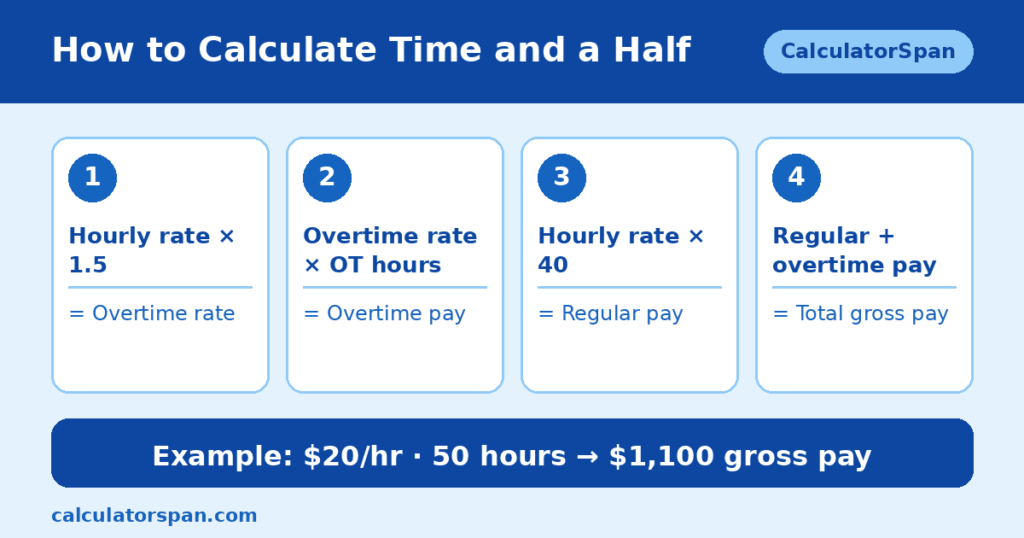
The math behind overtime pay is simple once you break it into four steps.
Step 1: Find Your Overtime Rate
Time and a Half Rate = Regular Hourly Rate × 1.5
Step 2: Calculate Your Overtime Pay
Overtime Pay = Time and a Half Rate × Overtime Hours
Step 3: Calculate Your Regular Pay
Regular Pay = Regular Hourly Rate × Standard Hours
Step 4: Add Them Together
Total Gross Pay = Regular Pay + Overtime Pay
Example: $20 an Hour, 50 Hours Worked
- Standard hours: 40
- Overtime hours: 50 − 40 = 10
- Time-and-a-half rate: $20 × 1.5 = $30
- Regular pay: $20 × 40 = $800
- Overtime pay: $30 × 10 = $300
- Total gross pay: $800 + $300 = $1,100
Every result this time-and-a-half calculator gives you follows these four steps.
One thing that trips people up is minutes. Payroll math runs on decimal hours, so 8 hours 30 minutes becomes 8.5, and 8 hours 45 minutes becomes 8.75. If your timesheet shows hours and minutes, run them through our Hours and Minutes to Decimal Calculator before you enter them here.
Time and a Half Chart: $7.25 to $50 per Hour
Most people searching for overtime pay want one specific answer, like “what is time and a half for $15 an hour” or “time and a half for $18.” This chart answers all of them in one place, or you can plug your exact rate into the time-and-a-half calculator above.
Quick answers: time and a half for $15 an hour is $22.50, for $18 an hour it’s $27.00, and for $20 an hour it’s $30.00.
| Regular Hourly Rate | Time and a Half (1.5x) | Double Time (2x) | Pay for 10 OT Hours (1.5x) |
| $7.25 | $10.88 | $14.50 | $108.75 |
| $8.00 | $12.00 | $16.00 | $120.00 |
| $9.00 | $13.50 | $18.00 | $135.00 |
| $10.00 | $15.00 | $20.00 | $150.00 |
| $11.00 | $16.50 | $22.00 | $165.00 |
| $12.00 | $18.00 | $24.00 | $180.00 |
| $13.00 | $19.50 | $26.00 | $195.00 |
| $14.00 | $21.00 | $28.00 | $210.00 |
| $15.00 | $22.50 | $30.00 | $225.00 |
| $16.00 | $24.00 | $32.00 | $240.00 |
| $17.00 | $25.50 | $34.00 | $255.00 |
| $18.00 | $27.00 | $36.00 | $270.00 |
| $19.00 | $28.50 | $38.00 | $285.00 |
| $20.00 | $30.00 | $40.00 | $300.00 |
| $21.00 | $31.50 | $42.00 | $315.00 |
| $22.00 | $33.00 | $44.00 | $330.00 |
| $23.00 | $34.50 | $46.00 | $345.00 |
| $24.00 | $36.00 | $48.00 | $360.00 |
| $25.00 | $37.50 | $50.00 | $375.00 |
| $26.00 | $39.00 | $52.00 | $390.00 |
| $27.00 | $40.50 | $54.00 | $405.00 |
| $28.00 | $42.00 | $56.00 | $420.00 |
| $29.00 | $43.50 | $58.00 | $435.00 |
| $30.00 | $45.00 | $60.00 | $450.00 |
| $32.00 | $48.00 | $64.00 | $480.00 |
| $35.00 | $52.50 | $70.00 | $525.00 |
| $38.00 | $57.00 | $76.00 | $570.00 |
| $40.00 | $60.00 | $80.00 | $600.00 |
| $45.00 | $67.50 | $90.00 | $675.00 |
| $50.00 | $75.00 | $100.00 | $750.00 |
Every figure comes from the same formula: regular rate × overtime multiplier. The chart starts at $7.25, the federal minimum wage, which means a non-exempt worker earning minimum wage should never get less than $10.88 for an overtime hour. Many states set their minimum wage well above the federal floor, so your state’s overtime minimum may be higher.
Overtime Multipliers Compared: 1.25x, 1.5x, 2x, and 3x
Time and a half is the most common overtime rate, but it isn’t the only one. Depending on your state, your employer, or your union contract, you might see any of these four.
Time and a Quarter (1.25x)
This is the least common rate. Some employers use it for a first tier of extra hours that fall below the legal overtime threshold, such as part-timers working beyond their scheduled shift. At $20 an hour, it pays $25 per hour.
Time and a Half (1.5x)
Time and a half (1.5x) is the federal overtime premium for non-exempt employees under the FLSA. Once you pass 40 hours in a workweek, every additional hour pays at 1.5 times your regular rate of pay. At $20 an hour, that’s $30 per hour.
Double Time (2x)
Double time doubles your hourly wage. It’s not required under federal law, but some states and employers mandate it. California, for example, requires double time after 12 hours in a single workday and after 8 hours on the seventh consecutive day of a workweek. At $20 an hour, double time pays $40 per hour.
Triple Time (3x)
Triple time is rare. You’ll mostly find it in union agreements, emergency call-outs, or holiday shifts in industries like construction, utilities, and healthcare. At $20 an hour, triple time pays $60 per hour.
| Overtime Multiplier | Rate at $15/hr | Rate at $20/hr | 10 OT Hours at $20/hr | Total Weekly Pay at $20/hr |
| 1.25x (Time and a Quarter) | $18.75 | $25.00 | $250 | $1,050 |
| 1.5x (Time and a Half) | $22.50 | $30.00 | $300 | $1,100 |
| 2x (Double Time) | $30.00 | $40.00 | $400 | $1,200 |
| 3x (Triple Time) | $45.00 | $60.00 | $600 | $1,400 |
Weekly totals assume 40 regular hours ($800) plus 10 overtime hours.
The difference between 1.5x and 2x is $100 in a single week at $20 an hour. Keep that up for a month, and it adds up to $400. So before you calculate anything, check your employment contract, employee handbook, or union agreement to confirm which overtime rate you’re owed. The Bureau of Labor Statistics also publishes overtime and earnings data by industry if you want to benchmark your pay.
Weekly Pay With Overtime
Here’s how total weekly earnings change at $15 an hour as your hours climb, with overtime paid at 1.5x after 40 hours.
| Hours Worked | Regular Pay | Overtime Pay | Total Weekly Pay |
| 40 hours | $600 | $0 | $600.00 |
| 45 hours | $600 | $112.50 | $712.50 |
| 50 hours | $600 | $225.00 | $825.00 |
| 55 hours | $600 | $337.50 | $937.50 |
| 60 hours | $600 | $450.00 | $1,050.00 |
Notice that regular pay stays flat at $600 at straight time, no matter how many hours you work. Everything beyond 40 hours pays at the overtime rate of $22.50. Over a year, those extra hours add up fast. At $20 an hour with a steady 10 hours of overtime a week, your gross annual income comes to about $57,200, compared to $41,600 on a straight 40-hour schedule.
Is Holiday Pay Time and a Half?
Not automatically. Federal law doesn’t require private employers to pay extra for working on holidays like Thanksgiving, Christmas, or the Fourth of July. Holiday pay is a matter of company policy, your employment agreement, or a union contract.
That said, a lot of employers do offer time and a half, or even double time, as holiday premium pay to make those shifts easier to fill. If yours does, the math works the same way. Working an 8-hour holiday shift at $18 an hour with a 1.5x holiday premium pays $27 × 8 = $216, compared to $144 at your regular rate.
Keep in mind that holiday hours count toward your 40-hour overtime threshold only if you actually work them. Paid time off for a holiday you don’t work usually doesn’t count as hours worked for overtime purposes. Check your employee handbook for the specific rules at your workplace.
Time and a Half for Salaried Workers
Being paid a salary doesn’t automatically mean you’re excluded from overtime. What matters is whether you’re classified as exempt or non-exempt under the FLSA.
Exempt vs. Non-Exempt Salaried Employees
Exempt employees, usually in executive, administrative, or professional roles that meet the salary threshold and job duties tests, aren’t entitled to overtime pay. Non-exempt salaried employees are, and they’re owed overtime just like hourly workers.
How to Convert a Salary to an Hourly Rate
To use this time and a half calculator as a non-exempt salaried employee, convert your salary to an hourly equivalent first:
Hourly Rate = Weekly Salary ÷ Hours the Salary Covers
If you earn $1,000 a week for a 40-hour schedule, your hourly equivalent is $25. Your overtime rate would be $37.50, so 5 overtime hours would add $187.50 to that week’s paycheck. If you’re paid annually, divide your annual salary by 52 first to get your weekly figure.
Not sure how you’re classified? The FLSA section on our Timecard Calculator page covers exempt vs. non-exempt status, and the U.S. Department of Labor Wage and Hour Division has the official guidance.
Common Mistakes When Calculating Time and a Half
The formula itself is easy. Most errors come from putting the wrong number in the wrong place. Here are the ones we see most often.
1. Entering Only Your Overtime Hours in the Total Hours Field
The calculator asks for your total hours worked and figures out your overtime on its own. If you worked 50 hours, enter 50, not 10. If you enter just your overtime hours, the calculator treats them as regular hours, and your overtime pay will show as zero.
2. Using the Wrong Regular Rate of Pay
For most people, the base hourly wage is the right starting point. But under the FLSA, your regular rate of pay can also include nondiscretionary bonuses (like production or attendance bonuses), commissions, and shift differentials. If you earn any of those, your true overtime rate may be higher than 1.5 times your base rate alone.
3. Not Converting Minutes to Decimal Hours
8 hours and 45 minutes is 8.75 hours, not 8.45. That small slip undercounts 18 minutes of work, and at an overtime rate, those minutes cost you real money. Convert first using the Hours and Minutes to Decimal Calculator.
4. Picking the Wrong Overtime Multiplier
If your employer pays double time for certain hours and you calculate at 1.5x, you’ll underestimate your overtime earnings by a full 50 cents on every dollar of base pay per hour. Always confirm the rate that applies to the specific hours you worked.
5. Forgetting About Shift Differentials
If you earn a night shift differential or a weekend premium, your overtime for those hours should be based on the higher rate. Using your standard daytime rate as the base will show a lower number than what you’re actually owed.
6. Using the Wrong Workweek
Overtime is calculated based on your employer’s defined workweek, which is a fixed, recurring 7-day period that doesn’t have to run Monday through Sunday. A Wednesday-to-Tuesday workweek can produce different overtime totals than a calendar week for the exact same hours. Find out when your employer’s workweek starts before you calculate.
7. Applying the Overtime Rate to Every Hour
The overtime rate only applies to hours beyond your overtime threshold. Your first 40 hours still pay at your regular rate. Multiplying your entire week’s hours by 1.5 will inflate your expected paycheck, and you’ll be disappointed on payday.
Frequently Asked Questions
What is time and a half pay?
Time and a half pay is an overtime rate equal to 1.5 times your regular hourly wage. If you earn $20 an hour, your time and a half rate is $30 an hour. Under the FLSA, non-exempt employees earn this rate for every hour worked beyond 40 in a workweek.
How do I calculate time and a half manually?
Multiply your hourly rate by 1.5 to find your overtime rate, then multiply that by your overtime hours. For example, at $15 an hour with 5 overtime hours: $15 × 1.5 = $22.50, and $22.50 × 5 = $112.50 in overtime pay. Add that to your regular pay for your total gross pay.
What is time and a half for $15 an hour?
Time and a half for $15 an hour is $22.50 per hour. Ten overtime hours at that rate add $225 to your weekly paycheck.
What is time and a half for $20 an hour?
Time and a half for $20 an hour is $30 per hour. Ten overtime hours at that rate earn you $300 in overtime pay, bringing a 50-hour week to $1,100 gross.
When does time and a half start?
Under federal law, overtime pay kicks in after 40 hours worked in a single workweek. Some states, including California, also require daily overtime after 8 hours in one workday. Your employer can choose to pay overtime sooner, but not later than the law requires.
What is double time pay?
Double time is an overtime rate equal to 2 times your regular hourly wage. At $20 an hour, double time pays $40 an hour. Federal law doesn’t require it, but some states, employers, and union contracts do, often for very long shifts, holidays, or the seventh consecutive workday.
Is time and a half the same as overtime?
Not exactly. Overtime refers to the hours you work beyond your standard schedule or legal threshold. Time and a half is the pay rate most commonly applied to those hours. Some overtime hours may be paid at a different rate, such as double time.
Do salaried employees get time and a half?
Only if they’re classified as non-exempt; exempt salaried employees don’t qualify for overtime pay. Non-exempt salaried workers can calculate their overtime by dividing their weekly salary by the hours it covers, then multiplying that hourly figure by 1.5.
Is time and a half taxed more?
No. Overtime pay is taxed at the same rates as your regular wages. It can look like it’s taxed more because a larger paycheck may trigger higher withholding for that pay period, but your actual tax rate is determined when you file your annual return.
- Track daily clock-in and clock-out times across a full pay period: Timecard Calculator
- Convert hours and minutes into decimal hours for payroll: Hours and Minutes to Decimal Calculator
- Convert decimal hours back to hours and minutes: Decimal to Time Calculator
- Figure out how long your breaks should be: Break Time Calculator
- Add or subtract hours and minutes: Time Calculator
This calculator provides estimates for informational purposes only and shows gross pay before taxes and deductions. Overtime rules vary by state, employer, and employment classification. Verify your figures with your payroll department or HR team, and see the U.S. Department of Labor for official overtime guidance.