Most date errors I’ve seen in spreadsheet exports weren’t math mistakes. They were format mix-ups. A 6-digit JDE Julian date like 113338 looks meaningless until you convert it, and then it’s simply December 4, 2013.
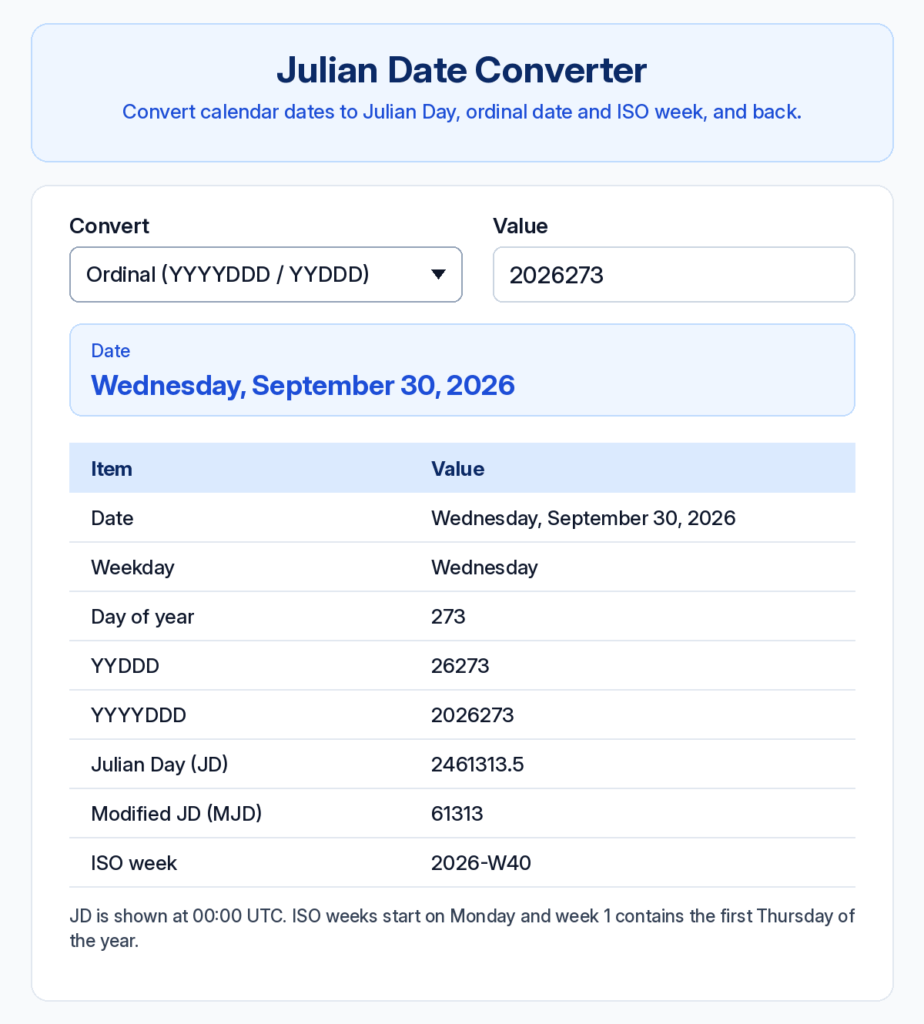
Convert calendar dates to Julian Day, ordinal date and ISO week, and back.
Astronomers solved a different problem. Their Julian Day is a continuous count of days from noon UTC on January 1, 4713 BC, which sidesteps calendar systems and time zones entirely. The Modified Julian Date trims that big number by starting in 1858.
This Julian date converter handles both worlds. Enter a mainframe-style CYYDDD or yyddd format value, a Julian Day Number, or a regular calendar date, and get a clean DD/MM/YYYY result instantly, with no Excel formula and no sign-up needed.
What Is a Julian Date? (Definitions and Formats)
Here’s the awkward truth: “Julian date” names two unrelated things. To astronomers and scientists, it’s the number of days since noon on January 1, 4713 BC, the start of the Julian Period. To mainframe teams, it’s a yyddd code.
The astronomical version carries a fractional day. The full Julian Date writes time of day as a decimal fraction, while the Julian Day Number is the whole-number value from floor(JD + 0.5), anchored to that same epoch.
The business version is technically an ordinal date, written as yyyyddd, yy-ddd, or the 6-digit CYYDDD used for a JDE Julian date. Most “wrong date” complaints I’ve checked came from mixing these two families.
Current / Today’s Julian Date
A current Julian Date doesn’t roll over at midnight. It changes at noon UTC, so in Asia you can see today’s date on your phone while the Julian count still shows yesterday’s integer until late afternoon.
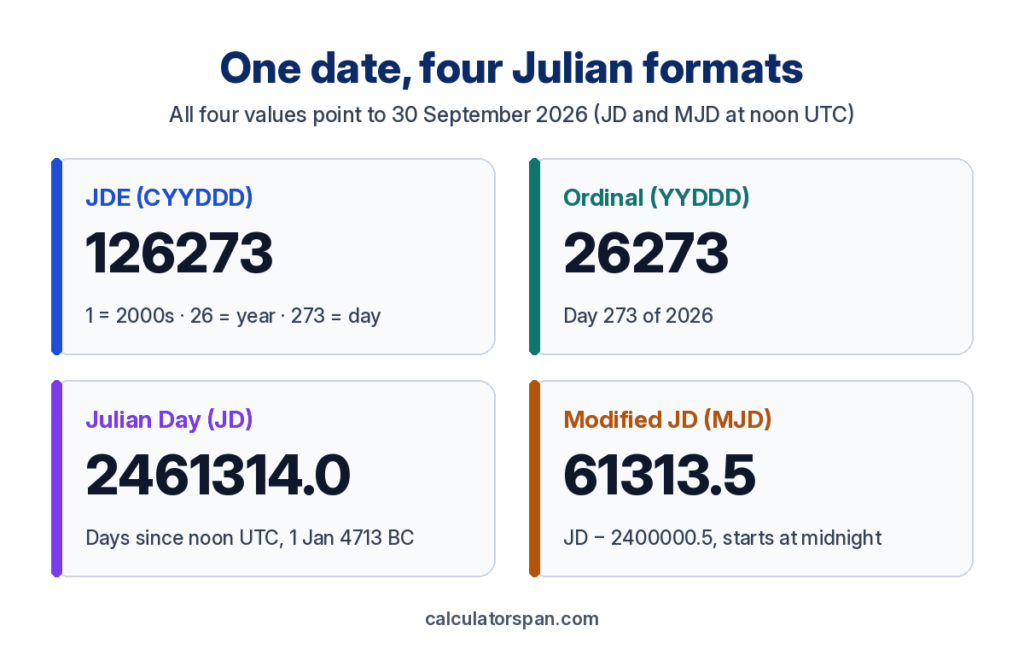
That’s why a good Julian date converter shows both counters. At noon Universal Time on 30 September 2026, the JD reads 2461314.0, almost 2.5 million days in. The current Modified Julian Date reads 61313.5 at that moment.
Today’s Julian date in yyddd format is a calmer number: 30 September 2026 becomes 26273, day 273 of the year. For a live day number, our days left in the year counter tracks it.
Convert Julian Date to Calendar Date
Before you use the Julian date converter, figure out which family you’re holding. A seven-digit value around 2.46 million is a Julian Day Number (JDN); five digits like 26273 are yyddd; separators give yy-ddd or yy.ddd.
A six-digit JDE Julian date with a leading century digit goes to DD/MM/YYYY directly. Astronomical values with fractional days return a readable date in UTC, and sometimes local time, because the decimal carries the clock.
My habit with any Julian date-to-calendar-date tool is simple: run one sample conversion or hit Show Example in the Julian date converter first. If 126273 doesn’t come back as a calendar date of 30/09/2026, stop.
Convert Calendar Date to Julian Date
In the Julian date converter, going the other way, the time you leave blank matters more than the date. Year, Month and Day land you at midnight, but an astronomical value needs Hour, Minute and Second in UT1, a form of Universal Time.
Historic dates need an AD or BC switch, since astronomy’s count reaches back to 4713 BC. Ordinary work is simpler: a calendar date in DD/MM/YYYY becomes a JDE Julian date, and today usually has a one-click shortcut.
Input formats trip up every Julian date converter. Some tools accept mm/dd/yy, dd-mmm-yyyy, or even +1 day, yet refuse anything before January 1, 1970. Test your oldest date first; if you only need the gap, use our date difference calculator.
Modified Julian Date (MJD)
The Modified Julian Day began as a storage trick. The Smithsonian Astrophysical Observatory needed to log Sputnik’s orbit in just 18 bits, and a seven-digit JD simply wouldn’t fit.
The conversion formula is one subtraction: MJD = JD − 2400000.5. That half-day shift moves the epoch to 00:00:00 UTC on November 17, 1858, so each MJD starts at midnight instead of noon.
Space and astronomy teams still lean on MJD. Values stay short, fractional days still carry the clock, and converting to local time only needs your offset from UTC. Its whole-number day count also reads cleaner in spreadsheets.
How the 1582 Calendar Change Affects Julian Dates
Ten days vanished from calendar dates in 1582, yet the Julian count skipped nothing. Thursday, 4 October 1582 starts at JD 2299159.5; the very next day, Friday, 15 October 1582, starts at JD 2299160.5. There’s a ten-day gap but zero discontinuity.
That jump fixed an astronomical error. Julius Caesar’s Julian calendar, launched in 46 BC, added a leap year every fourth year. Those too-frequent leap years drifted, so Pope Gregory XIII dropped the leap day in century years not divisible by 400.
Everything else stayed put. Same month names, same number of days in each month, same year-month-day structure, unbroken days of the week; only the leap rule changed. Today the Gregorian calendar handles civil purposes worldwide, far beyond the Western world where it started.
The changeover between calendar systems wasn’t uniform, which is where real converters get tested. Roman Catholic countries in Europe followed the Gregorian reform at once, but England and its colonies waited until September 1752, which the Unix cal command still reflects.
For switch dates by country, I use Claus Tøndering’s Calendar FAQ. For depth, read E. G. Richards’ Calendars chapter in the Explanatory Supplement to The Astronomical Almanac (S. E. Urban, P. K. Seidelmann, University Science Books, 2012) or L. E. Doggett’s 1992 edition.
Bulk Julian Date Converter for Multiple Dates
A one-at-a-time Julian date converter feels fine until month-end. When I reconcile an ERP export, multiple Julian dates arrive together, and a bulk conversion box saves an hour of copying cells.
A solid bulk Julian date converter lets you paste one value per line and convert in either direction: JDE dates out to calendar dates, or calendar values back into Julian codes.
One catch: keep every calendar entry in a single format, ideally DD/MM/YYYY. Mixing 04/12 and 12/04 in one list is how a December invoice quietly becomes an April one.
Converting JDE Julian Date to DD/MM/YYYY in Excel
Most tutorials hand you a formula stacked with TEXT, YEAR, MONTH, and DAY calls. You don’t need them. With a JDE Julian date like 113338 in cell A1, this shorter version in cell B1 does the job:
=DATE(1900+INT(A1/1000),1,MOD(A1,1000))
INT pulls the century and year, adding 1900, while MOD grabs the day count; DATE rolls day 338 forward to 4 December. On US settings, Excel displays it as 12/4/2013 because MM/DD/YYYY is the default.
Keep dates in Column A, update the cell reference if yours starts elsewhere, then drag to fill the column. For DD/MM/YYYY, open Format Cells, choose Number, then Date, and set the locale to English (United Kingdom).
Converting DD/MM/YYYY to JDE Julian Date in Excel
The reverse trip fails more often, usually because Excel misreads the input. Type 12/04/2013 on a US-set machine, and it becomes December 4, 2013, not 12 April. Match your DD/MM/YYYY or MM/DD/YYYY habit to your settings first.
With the date in cell B1, put this formula in cell C1. YEAR minus 2000 plus 100 builds the century-year prefix, times 1000; subtracting January 1 via DATE adds the day number.
=(YEAR(B1)-2000+100)*1000+B1-DATE(YEAR(B1),1,1)+1
The result should be 113338, a valid JDE Julian date. If it shows as a strange date, switch the cell to General. Adjust each cell reference as needed, then drag the formula down.
Time Scale and Precision
Here’s a detail every Julian date converter hides: a Julian Date is only as precise as the variable storing it. A 64-bit floating-point number, double precision, holds an epoch to roughly 1 millisecond precision.
That’s why astronomical software treats JD as a core time variable, much as developers treat a Unix timestamp. The time scale is Universal Time, and 0h UT lands on a Julian date fraction of 0.5, not zero.
So when a result ends in .5, it’s midnight, not an error. Fractions of a day convert simply: 0.25 is six hours after noon, 0.75 is six hours after midnight.
Finding the Day of the Week
The Julian date also tells you the weekday, which surprises most people. 7-day weeks are assumed to run in an uninterrupted sequence since ancient times, even across the 1582 calendar jump.
So the day of the week comes from the remainder after division by 7. With a Julian Day Number, add 1 before dividing: 0 is Sunday, 1 Monday, through 6 Saturday.
Quick check: 30 September 2026 has JDN 2461314. Add 1, divide by 7, and the remainder is 3, a Wednesday. I run this on the current Julian Day to sanity-test any Julian date converter.
Application Programming Interface
If you build tools, the official astronomy route is an Application Programming Interface rather than a form. The data service accepts a date and time, or a Julian value, and returns the conversion as JSON.
JavaScript Object Notation is easy to reshape, so you can pull the data into a spreadsheet, app,p or customized format without scraping a web page.
Before wiring any API into production, read its documentation page for era handling. Some services quietly treat year 0 as 1 BC, and that single rule can shift historic Julian calendar results.
Frequently Asked Questions
What Is a Julian Date?
It depends on who you ask. Astronomers use it for a running count of days since noon UTC on January 1, 4713 BC. In factories and mainframes, it usually means a year-plus-day code like 26273, which is the 273rd day of 2026.
Is the Julian Date the Same as the Julian Calendar?
No, and this trips up a lot of people. The Julian calendar is the leap-year system Julius Caesar introduced in 46 BC. A Julian date is just a day count or day number, and it works the same under either calendar.
What Is Today’s Julian Date?
It depends on the format. The astronomical Julian Day changes at noon UTC, while the yyddd version follows your calendar: the last two digits of the year plus the day number. For example, 30 September 2026 is 26273. Use the “today” shortcut in the converter to see yours.
How Do I Convert a Julian Date to a Calendar Date?
Count the digits first. A five-digit value like 26273 is year 26 and day 273, which is 30 September 2026. A seven-digit value around 2.46 million is a Julian Day Number. Paste either into the Julian date converter, and it returns the date.
What Does a JDE Julian Date Like 126273 Mean?
JD Edwards writes dates as CYYDDD. The first digit is the century (0 for the 1900s, 1 for the 2000s), the next two are the year, and the last three are the day. So 126273 is day 273 of 2026, or 30 September 2026.
How Do I Convert a Julian Date to a Normal Date in Excel?
For a five-digit yyddd value in cell A1, try =DATE(2000+INT(A1/1000),1,MOD(A1,1000)). It works for years 2000 to 2099, and Excel rolls the day number forward into the right month. For JDE dates, use 1900 instead of 2000 and add 100 to the year digits.
What Is the Difference Between JD and MJD?
The Modified Julian Date is just the Julian Date with a smaller number: MJD = JD − 2400000.5. It also starts at midnight instead of noon. At noon UTC on 30 September 2026, JD is 2461314.0, and MJD is 61313.5.
Why Does the Julian Day Start at Noon?
Astronomers wanted a single date to cover a whole night of observing. Starting the day at noon meant the date didn’t change halfway through the night. That’s why you’ll often see values ending in .5 for midnight.