Leap Year Calculator
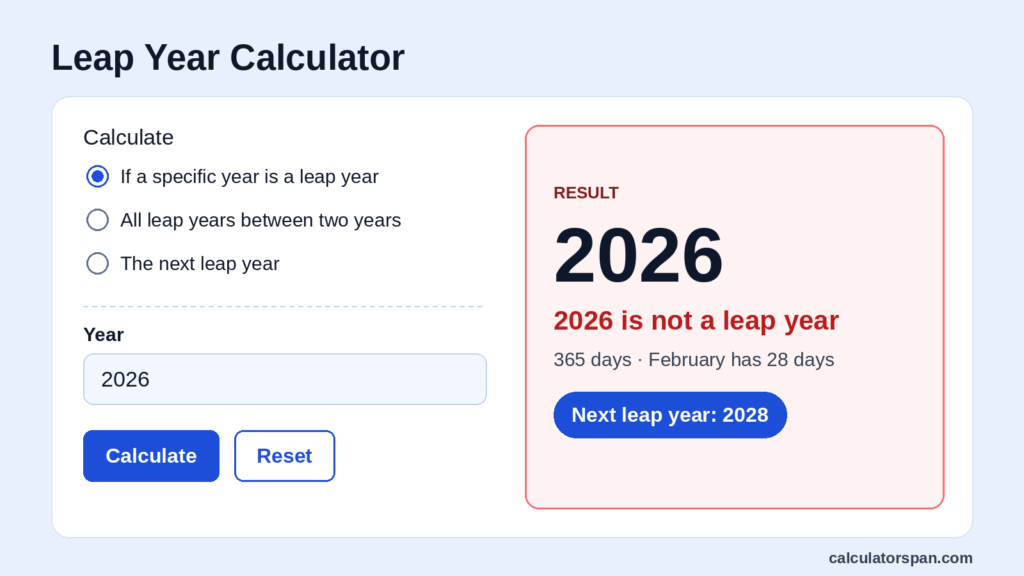
Every fourth year is not automatically a leap year, and that assumption quietly breaks spreadsheets. This leap year calculator follows the Gregorian calendar rule: 1980 had February 29; 2026 is a common year; 2030 isn’t; and the next leap year is 2028.
The astronomical year runs roughly a quarter day longer than 365 days, so a fixed calendar drifts. One extra day every few years, giving 366 days, pays back that whole day, and the math settles at 97 leap years per 400 years.
This tool runs three modes. The checker lets you check a year; another finds the next leap year after or the last leap year before any year. Enter a start year and end year, then calculate a count and list of leap years between the two years.
What Is a Leap Year?
Check a 2024 calendar: February ran to 29 days instead of 28 days. That leap day, February 29, turned a normal calendar year of 365 days into 366 days, and the Gregorian calendar repeats it roughly every four years.
The technical labels are intercalary year or bissextile year; the everyday names are leap year versus common year or ordinary year. Most people never need the jargon, but all five terms turn up in older almanacs and legal texts.
The extra day exists because a fixed year length can’t match the astronomical year. Earth needs about 365 days and a quarter day to circle the Sun, so every fourth year the spare hours add up to a whole day.
Without it, the drift is quiet but real. In the Northern Hemisphere, winter officially starts around Dec 21–22. Skip leap days for a few centuries, and that solstice slides later on the date grid, dragging the seasons with it.
Christmas Day 2023 landed on a Monday, then on a Wednesday in 2024, because February 29 sat between them and the weekday skips one day. In 2025, after a non-leap year gap, Christmas moved just one step to Thursday.
That two-step jump in the day of the week is the visible side of a leap year’s job: keeping the calendar and the seasonal year in sync. You’ll feel it in year-end math too, like how many days are left in the year.
Leap Year Rules: How to Calculate a Leap Year
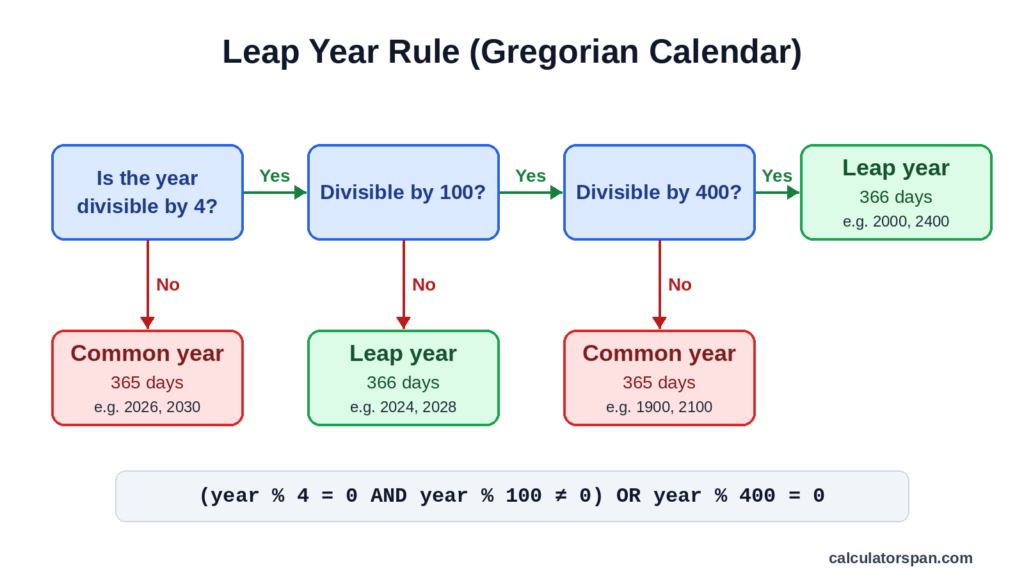
Most people remember the first of the rules and forget the exception. A year divisible by 4 is a leap year unless it’s a century year, and even then 2000 qualified while 1900 didn’t. The deciding condition is whether it’s divisible by 400.
Here’s the algorithm as a flow you can run in your head. It uses simple division: a number is evenly divisible when there’s no remainder, and any non-zero number left as the remainder means it isn’t.
Step 1: Check whether the year is divisible by 4. If yes, go to step 2. If not, jump straight to step 5, because nothing else can rescue it.
Step 2: Is it divisible by 100? If yes, go to step 3. If no, go to step 4. Years like 2016 and 2020 pass here and head directly to step 4.
Step 3: Is it divisible by 400? If yes, go to step 4; if no, go to step 5. 1600 passes this test, while 1800, 1900, and 2100 all fail it.
Step 4: The year is a leap year with 366 days. Step 5: The year is not a leap year. It’s a common year with 365 days, and February stops at 28.
Written as a formula: (year % 4 = 0 AND year % 100 ≠ 0) OR year % 400 = 0. It’s the same rule Royal Museums Greenwich publishes, and any correct leap year tool runs exactly this logic.
Examples of Leap Years and Common Years
The years that trip people up are the multiples of 100. 1700, 1800, 1900, 2100, 2200, and 2300 are all multiples of 4, yet each one is not a leap year because it fails steps 2 and 3.
Only multiples of 400 survive that filter. 1600, 2000, and 2400 are leap years. The order matters: test 4, then 100, then 400. Some older software got 2000 wrong by stopping at the 100 rule.
Worked example: 2100 is divisible by 4, so it clears the first check, then fails the 400 test and joins the common years. 2026 never gets that far. 2026 ÷ 4 is 506 with a remainder of 2, which leaves the title to 2028.
More sample years: 1584, 1588, 1592, and 1596 were among the first Gregorian leap years. Last century, 1956, 1960, 1964, 1968, 1972, 1976, 1980, 1984, 1988, 1992, and 1996 all had a February 29.
This century so far: 2004, 2008, 2012, 2016, 2020, and 2024. Odd picks like 1830, 1995, and 2001 land among the common years because none of them divides cleanly by 4.
How to Use the Leap Year Calculator
The leap year calculator offers three modes, though they really split into two main modes: a checker built around a single year, and a range counter for spans of time. Both return results instantly.
Check a Single Year
To check a single year, type it in and press calculate. Enter 2026, and the tool tells you whether it’s a leap year or a common year, then points toward the next leap year.
Find the Next or Last Leap Year
The second mode has two functions: next leap year after and last leap year before. Pick one, enter any year, and hit calculate. It’s handy for planning around February 29 without flipping through old calendars.
List All Leap Years Between Two Years
For the third, choose All leap years between two years, set a start year and end year, and you get a count plus a full list. The list of leap years is usually what people come for.
Keep in mind it counts leap years, not days. If you need the number of days between two dates, the Date Difference Calculator is the right tool for that job.
Leap Years Between Two Years (Range Mode)
Dividing a span by four is a shortcut that fails more often than you’d expect. Range mode checks each year between two years on its own, so confirm whether your start year and end year should be included.
Worked result: 1980 to 2001 gives a count of six leap years: 1980, 1984, 1988, 1992, 1996, and 2000. Dividing 21 years by four suggests five, which is exactly the slip this mode prevents.
Other sample ranges worth trying: 2010 to 2017 returns 2012 and 2016; 1995 to 2014 returns 1996, 2000, 2004, 2008, and 2012; 2016 to 2030 returns 2016, 2020, 2024, and 2028.
The trickiest span to test is 1830 to 1900. The list holds 17 years, from 1832 to 1896, and stops short because 1900 is a century exception. Hit Calculate and compare it with your own count.
Range mode stays focused on leap years. For business days inside a date range, which matters more for payroll and deadlines, use the Working Days Calculator.
What Is the Next Leap Year?
The next leap year is 2028, and it’s already crowded. The Summer Olympics return to Los Angeles as LA28, opening on Jul 14, and UEFA Euro 2028 will be staged across the UK and Ireland.
It’s also the year of the 61st US presidential election. Under the Gregorian calendar, 2028 is divisible by 4 and isn’t a century year, so there’s no exception to worry about.
For any other date, the tool handles it: the next leap year after or last leap year before a tested year takes one click. Nearly every presidential election lands in a leap year, though 1900 didn’t.
Want the exact number of days until February 29, 2028? The Days Until Calculator counts it from today.
How Often Do Leap Years Occur?
“Once every four years” is the answer everyone gives, and it’s nearly right. The accurate version is 97 out of every 400, because three century years in each 400-year cycle drop out.
So across 400 years you get 97 leap years, not 100. They still come roughly every four years and always fall on multiples of 4, but the algorithm removes century exceptions like 2100.
That cycle has repeated since 1582, and the list of leap years here runs all the way to 4818 if you want to watch it play out. Pick any year; every leap year follows the same rule.
Why Do We Need Leap Years?
A common year of 365 days comes up short. Earth’s full orbit around the Sun, measured season to season, takes about 365.242216 days, which works out to roughly 365 days, 5 hours, and 48 minutes.
Astronomers call that the tropical year, also known as the solar year or equinoctial year. It’s the version of the astronomical year that matters for a calendar, because it tracks the seasons rather than the stars.
That shortfall of nearly a quarter day piles up. Skip the leap day for a century and you’d see about 24 days of calendar drift, enough to give Christmas the weather of late November.
People often say that without leap years the seasons arrive earlier. It’s the reverse: each orbit finishes a little after the calendar year ends, so seasons land later by date. A leap year keeps both synchronized and stops the drift.
Note
The astronomical year isn’t a constant. Its orbit length varies by year, usually within about 30 minutes, because the Moon and planets tug on Earth as it completes each revolution around the Sun.
Between March 2015 and March 2016, the equinox-to-equinox gap was 365 days, 5 hours, and 45 minutes. From March 2016 to March 2017, it stretched to 5 hours and 59 minutes, a difference of 14 minutes.
Leap Day Babies: Birth Odds, Birthdays, and Driver’s Licences
Roughly 4 million people worldwide were born on February 29. They go by leaplings or leapers, and most have a well-rehearsed joke about only getting a “real” birthday in leap years.
The odds are often quoted as 1 in 1,461, or 0.000684, which assumes a leap day every four years. The Gregorian version is tighter: 97 leap days in every 400 years of 365 days each, so 97 in (400 × 365 + 97).
That works out to 0.000664, or about 0.066%, roughly 1 in 1,500. The chances of a leap day birthday are slim, but a mid-sized city still sees a handful of babies every February 29.
In non-leap years, the legal birthday depends on where you live, and countries differ. The UK and Hong Kong generally treat March 1 as the date, while New Zealand uses February 28. That matters when applying for a driver’s licence.
This section covers the calendar side of being a leapling. For someone’s exact age in years, months, and days, the Age Calculator handles February 29 birthdays properly.
When Did the Leap Year Concept Originate?
In parts of Europe, people went to bed on Thursday, Oct 4, 1582, and woke up on Friday, Oct 15. Ten dates vanished overnight, the most visible adjustment in the history of calendar reform.
The decree behind it was a papal bull, Inter gravissimas, signed on Feb 24, 1582 by Pope Gregory XIII. Born Ugo Boncompagni on Jan 7, 1502, he became pope on May 13, 1572, and died on Apr 10, 1585.
The concept didn’t originate with him, though. The Julian calendar already had leap days, and an Egyptian decree tried the idea in 238 BC. Gregory fixed the slow drift, a discrepancy of about 11 minutes a year against the astronomical year.
The Gregorian Calendar vs the Julian Calendar
Both systems use 12 months, 365 days in a normal year, and an intercalary day at the end of February. The only real difference between them is one rule about the century year.
Julius Caesar introduced the Julian calendar in 45 BC with a leap year every fourth year, no exceptions. That averages 365.25 days, about 11 minutes 14 seconds longer than the 365.242216 days of the astronomical year.
Tiny, but it compounds. By the 16th century, some 1,627 years after Caesar’s reform, the drift had pulled the vernal equinox to about March 11, well away from the March 21 date the church relied on.
The Gregorian calendar fixed it with a 10-day shift and one new rule: a century year counts only if it’s divisible by 400, not merely divisible by 100. It’s off by about a day in 3,236 years and is the civil calendar almost everywhere.
Equinox Note
An equinox happens twice a year, when day and night run roughly equal length. In the Northern Hemisphere, the vernal equinox falls around March 20 and the autumnal equinox around September 23; the Southern Hemisphere sees the names swap.
How Accurate Is the Gregorian Calendar?
No calendar is perfect, and every calendar is an approximation. The average Gregorian year is 365.2425 days, against an astronomical year of about 365.242216 days, a gap of under half a minute.
That error adds up to one extra day roughly every 3,236 years since the Gregorian calendar took effect in 1582. The Julian calendar slipped about 1 day every 128 years, so the Julian gap was roughly 25 times worse.
List of Leap Years
Here’s the list of leap years from 1904 to 2048. 1900 is missing because century years must pass the 400 test, and 2048 is the last before 2050. The full list in the tool runs from 1582 to 4818.
| Decade | Leap Years |
| 1900s | 1904, 1908 |
| 1910s | 1912, 1916 |
| 1920s | 1920, 1924, 1928 |
| 1930s | 1932, 1936 |
| 1940s | 1940, 1944, 1948 |
| 1950s | 1952, 1956 |
| 1960s | 1960, 1964, 1968 |
| 1970s | 1972, 1976 |
| 1980s | 1980, 1984, 1988 |
| 1990s | 1992, 1996 |
| 2000s | 2000, 2004, 2008 |
| 2010s | 2012, 2016 |
| 2020s | 2020, 2024, 2028 |
| 2030s | 2032, 2036 |
| 2040s | 2040, 2044, 2048 |
Frequently Asked Questions
When Is the Next Leap Day?
The next leap day is Tuesday, February 29, 2028, in the next leap year, 2028. It arrives months before LA28, the Summer Olympics in Los Angeles starting Jul 14, and ahead of UEFA Euro 2028 that summer. Want to know which weekday February 29 falls on in other leap years? Use the Day of the Week Calculator.
The 61st US presidential election follows in November. For any other leap day, enter a tested year and pick next leap year after or last leap year before. Nearly every presidential election year doubles as a leap year.
Is 2026 a Leap Year?
No. 2026 is not a leap year, so February stops at 28 and the year runs 365 days. It fails the first check of the algorithm because it isn’t divisible by 4.
The division is quick: 2026 ÷ 4 = 506, remainder of 2, so steps 2 and 3 never come into play. As a common year, it’s a good one to plan around; see how many weeks are left in the year.
How Do You Check if a Year Is a Leap Year?
Short answer: use the formula “divisible by 4, except century years, unless divisible by 400.” If a year is evenly divisible by 4 with no remainder, it’s a candidate; 2016 and 2020 qualify straight away.
The only extra thinking is for a century year. 1600 and 2000 are divisible by 400, so they’re leap years with 366 days. 1800, 1900, and 2100 are divisible by 100 but not 400, so each is a common year of 365 days.
The full walkthrough, step 1 through step 5, is in the algorithm section above. Step 2, step 3, and step 4 are where most people slip, so let the leap year checker confirm it if you’re unsure.
Is a Leap Year Always Every Four Years?
Nearly, but not always. Leap years fall on multiples of 4, yet three century years per 400-year cycle are skipped, so the true rate is 97 out of every 400, which means 97 leap years instead of 100.
The pattern of once every four years holds until 2100, when the gap stretches to eight years, from 2096 to 2104. So it’s roughly every four years, not a guarantee.
The cycle has run since 1582. Scan the list of leap years through 4818 and you’ll spot each eight-year gap exactly where the century rule says it should be.
What Would Happen Without Leap Years?
The calendar would lose nearly a quarter day every year. Earth’s orbit of the Sun takes about 365.242216 days, or 365 days, 5 hours, and 48 minutes, measured by the tropical year, also called the solar year, equinoctial year, or seasonal astronomical year.
Without a leap day, that drift reaches about a week every 30 years and a month in roughly 120. Christmas would start feeling like November. The idea that seasons arrive earlier is backwards; they’d arrive later by date. Leap years keep everything synchronized.
Will the Gregorian Calendar Ever Need Fixing?
Eventually, but not soon. The Gregorian calendar averages 365.2425 days against roughly 365.242216, an error that grows to one extra day in about 3,236 years from 1582. Any fix is thousands of years away.
By comparison, the Julian calendar slipped 1 day every 128 years. Earth’s rotation is also slowing very gradually, so any future change will likely be decided long after us. For now, this approximation holds up remarkably well.
What Are the Chances of Being Born on February 29?
The chances are about 1 in 1,500, or 0.066%. That comes from 97 in (400 × 365 + 97): 97 leap days across 400 years of 365 regular days, which equals 0.000664.
The simpler odds of 1 in 1,461 (0.000684) ignore skipped century years, so they slightly overstate your shot at a February 29 leap day birthday.
When Do Leap Day Babies Celebrate Their Birthday or Get a Driver’s Licence?
Most of the 4 million people worldwide born on February 29, known as leaplings or leapers, celebrate on February 28 or March 1 in non-leap years.
Legally, countries differ. The UK and Hong Kong usually recognise March 1, while New Zealand uses February 28 for birthday milestones like getting a driver’s licence.