The 7-minute rule is the common name for quarter-hour time rounding, which federal rules permit as long as it is neutral: a punch up to seven minutes past a quarter-hour mark rounds back to that mark, and a punch eight or more minutes past rounds forward to the next one.
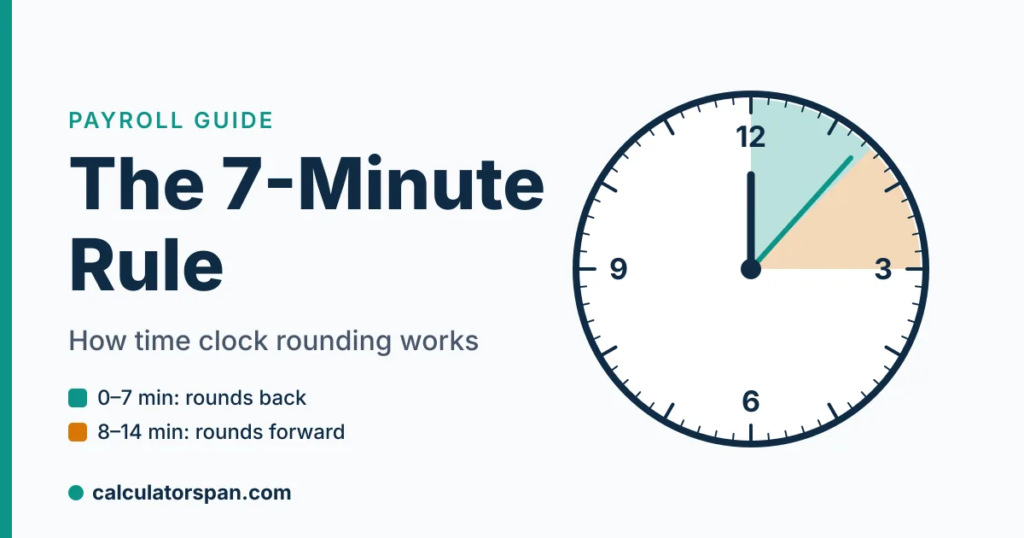
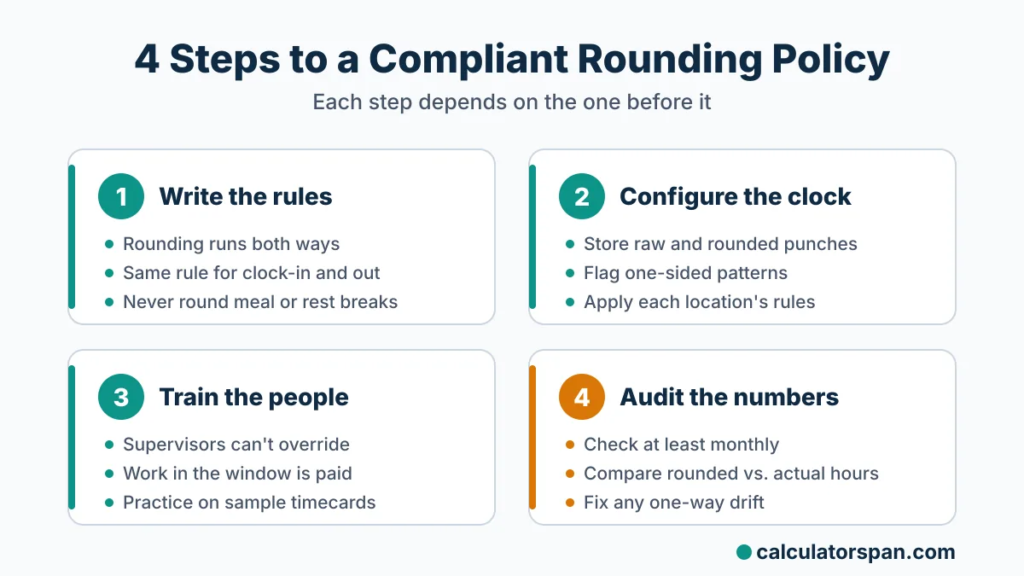
Every hour on a time clock splits into four blocks of 15 minutes, and the seventh minute is the hinge inside each block. That one cut point is the whole mechanism. Here is how it plays out around an 8:00 shift start and a 5:00 finish:
| Where the punch lands | Rounds to | Effect on a clock-in | Effect on a clock-out |
| 0–7 minutes past a quarter-hour (8:00–8:07, 5:00–5:07) | Back to that quarter-hour (8:00, 5:00) | Worker gains 0–7 minutes | Worker loses 0–7 minutes |
| 8–14 minutes past a quarter-hour (8:08–8:14, 5:08–5:14) | Forward to the next quarter-hour (8:15, 5:15) | Worker loses 1–7 minutes | Worker gains 1–7 minutes |
So clocking in at 8:05 and being paid from 8:00 helps the worker, while leaving at 5:06 and being paid to 5:00 costs them six minutes. Across a year those minutes should cancel out. When they don’t, rounding quietly turns into unpaid work, and that’s the point where employers get into trouble. To see the gap on a real week, enter the exact punches into a timecard calculator and compare the total with the rounded one.
The same phrase lives outside payroll too. In conversation, it describes giving a slow chat seven minutes before reaching for your phone. In public speaking, it means fitting any business talk into seven minutes, with minute one spent winning attention and the last minute spent summing up.
What Does the 7-Minute Rule Mean at Work, in Conversation, and on Stage?
The 7-minute rule means three different things depending on who says it: a timekeeping standard for rounding payroll punches, a length limit for business talks, and a habit of staying in a conversation for seven minutes before escaping into a screen.
The payroll version is a rounding method that only stays compliant when it cuts both ways. On the time and payroll calculator sites I manage, this is the meaning most visitors arrive looking for, which is why the clock math gets most of the space here.
The speaking version comes from a business writer and author of a book on seven-minute productivity, who argues that anything you need to say in a business setting should fit inside seven minutes.
The conversation version comes from a 2015 book by an MIT sociologist on how people talk in a digital age. She describes a college junior who told her it takes about seven minutes to know whether a conversation will be interesting, and who admitted she rarely waited that long before taking out her phone.
The author’s point is that the lulls and boring stretches in a conversation are often where the real talk begins, and phones let us skip them. The habit is widespread: in a 2015 national survey, 89% of U.S. cellphone owners said they used their phone during the most recent social gathering they attended, and 82% of adults said phone use in group settings at least occasionally hurts the conversation.
Why Is Seven Minutes the Cutoff and Not Five or Ten?
Seven minutes works as a cutoff because, on a time clock, it is the last whole minute before the halfway point of a quarter-hour (7.5 minutes), and in speaking and conversation it is roughly when listeners decide whether something is worth their attention.
For presentations, the argument is that people tend to tune out of anything that runs past about seven minutes, and that in a world of texts and constant notifications, patience runs short.
In conversation, the logic runs the other way. Seven minutes is the minimum you should give a conversation before judging it, because it takes that long to settle into the other person’s rhythm.
On the clock, seven is plain arithmetic. Splitting each quarter-hour at minute seven means a punch has close to even odds of rounding up or down, so results shouldn’t drift toward the employer or the employee across a year. When I review client timecard exports, that balance is the first thing I check.
How Does the 7-Minute Rule Compare With the 18-Minute Talk Format?
The 7-minute rule gives a speaker well under half the time of the 18-minute limit used by the best-known idea conferences, because it targets everyday business settings rather than big-stage keynotes.
The 18-minute format was chosen by conference organizers as long enough to say something that matters and short enough to hold attention. The 7-minute version argues that only people who speak for a living really need that much time, and that most people presenting at work can make their point in seven.
That’s why the seven-minute structure front-loads the work. Open by getting attention, then state the idea, then back it up, and use the final minute to summarize.
My own contrarian take: an 18-minute talk still works when it is really two or three seven-minute blocks stacked together.
How Do You Structure a 7-Minute Presentation Minute by Minute?
A 7-minute presentation works best when it is split into five parts: rehearse against a timer, open with a hook, state the idea in one minute, spend four minutes on proof, and close by restating one idea.
- Rehearse to the second. Map what happens in each minute, then run it until it lands on seven.
- Hook before thesis. Use the first minute to get the room’s attention, ideally with something visual, rather than leading with your main claim.
- One idea in one minute. Say what you’re selling, suggesting, or discussing. If it won’t fit, the idea needs revising, not faster talking.
- Proof in minutes three to six. Bring numbers and examples, and leave short pauses so listeners can keep up.
- Restate in minute seven. Summarize, leave one thing to remember, and stop.
In my own talks, the awkward moments come from unrehearsed transitions, not from pauses. Sitting through the discomfort of a planned silence, and the boredom of rehearsing it five times, is what makes seven minutes feel natural.
How Much Can a Bad Rounding Policy Cost an Employer?
A bad rounding policy can cost an employer anywhere from several hundred thousand dollars to tens of millions, because unpaid minutes add up across thousands of workers and years of pay periods, and damages can be doubled.
Recent cases show the range:
| Case | What happened | Amount |
| Bennett v. Providence Health & Services (Washington, 2024) | Jury found a 15-minute rounding policy systematically favored the hospital system | $9.3M in rounding wages, part of a $98.2M verdict that was doubled for willfulness; more than $229M with interest |
| California grocery chain class action | Settlement of rounding claims alongside overtime, sick pay, and break claims | $12.47M |
| Indiana hospital network (federal court) | Settlement over a rounding system workers said shaved time | $4M |
| North Carolina hospital system (federal FLSA collective) | Settlement over rounding that allegedly shorted overtime | $750,000 |
The settlement or verdict is only the headline number. Under the FLSA, workers can recover back wages plus an equal amount in liquidated damages, along with attorney fees. The DOL can also assess civil penalties of up to $2,515 per violation for repeated or willful minimum wage or overtime violations.
Most employers I’ve seen burned didn’t set out to shave minutes. Their system simply rounded lunch breaks with the same logic it used for shift starts, and nobody looked at the totals until a complaint landed. Breaks should always be measured to the minute, which a break time calculator makes easy to check.
What Does Federal Law Require From a 7-Minute Rounding Policy?
Federal law allows 7-minute rounding only when it averages out so that employees are paid for all the time they actually work, under 29 CFR § 785.48(b).
The DOL judges results, not promises. In a May 2026 opinion letter (FLSA2026-8), it reviewed a hospital that rounded clock-ins made up to seven minutes early forward to the scheduled start time while employees were already doing handoff work. The DOL found that one-way rounding was not neutral and that the pre-shift work had to be paid. That is why original timestamps should sit next to every rounded punch.
Quarter-hours aren’t the only accepted option. The regulation also names rounding to the nearest 5 minutes or to one-tenth of an hour (6 minutes). Tenth-of-an-hour rounding is really decimal time, so an hours and minutes to decimal calculator shows exactly where each punch lands.
Overtime rules reach anyone who has to track hours, including salaried non-exempt staff. Rounded time still has to add up correctly once a week tips into overtime, so check the extra hours with a time and a half calculator.
In Texas, the state workforce commission simply points employers to the federal rule, so the federal standard is effectively the whole rulebook there.
Which States Restrict 7-Minute Rounding the Most?
California, Oregon, and Washington are where 7-minute rounding faces the most legal pressure, and in all three the law is still moving.
California
For years, See’s Candy Shops v. Superior Court (2012) was the main authority, holding that rounding is lawful if it is neutral on its face and as applied. AHMC Healthcare v. Superior Court (2018) followed it and upheld a quarter-hour policy that paid employees a net surplus of hours overall, even though some individuals lost time.
Three later decisions pulled the other way. Troester v. Starbucks (2018) held that California law has no federal-style de minimis exception for regular off-the-clock minutes. Donohue v. AMN Services (2021) barred rounding of meal-period punches. Camp v. Home Depot (2022) held that when an employer records exact minutes, it must pay for all of them, even under a neutral rounding policy. The California Supreme Court granted review of Camp in February 2023 and, as of late 2026, had not yet ruled, so check for a decision before relying on any California rounding policy.
California also requires daily overtime after 8 hours, so rounding errors can turn into overtime errors faster than under federal rules. A work hours calculator makes it easy to spot any day that crosses the 8-hour line.
Oregon
No Oregon statute addresses rounding. The state labor bureau says employers may round but must make sure workers are paid for all time each pay period. A federal court in Eisele v. Home Depot (2022) went further and held that Oregon law does not permit rounding. A 2025 bill to allow federal-style rounding (SB 397) died in committee.
Washington
The state Department of Labor & Industries allows the 7-minute rule but does not allow rounding of meal and rest periods. In Bennett v. Providence, a trial court found the employer’s rounding unlawful, the Court of Appeals upheld the award in 2025, and the case is now before the Washington Supreme Court.
Payroll teams in these states should treat state law as the real rulebook. Federal rules are the floor, not the ceiling.
How Do You Set Up a Compliant 7-Minute Rounding Policy?
Setting up a compliant 7-minute rounding policy takes four stages in a fixed order: write the rules, configure the clock, train the people, and audit the numbers.
- Write the rules. Publish a policy stating that rounding runs in both directions, applies to start and end punches alike, never applies to meal or rest breaks, and can’t be overridden by a supervisor.
- Configure the clock. Look for dual timestamp storage, automated neutrality reports, pattern detection, multi-state rule handling, and a full audit trail.
- Train the people. Train supervisors regularly, have payroll staff practice rounding sample timecards, and make sure everyone knows that work done after clocking in is paid, even inside the rounding window.
- Audit the numbers. Audit monthly and document everything.
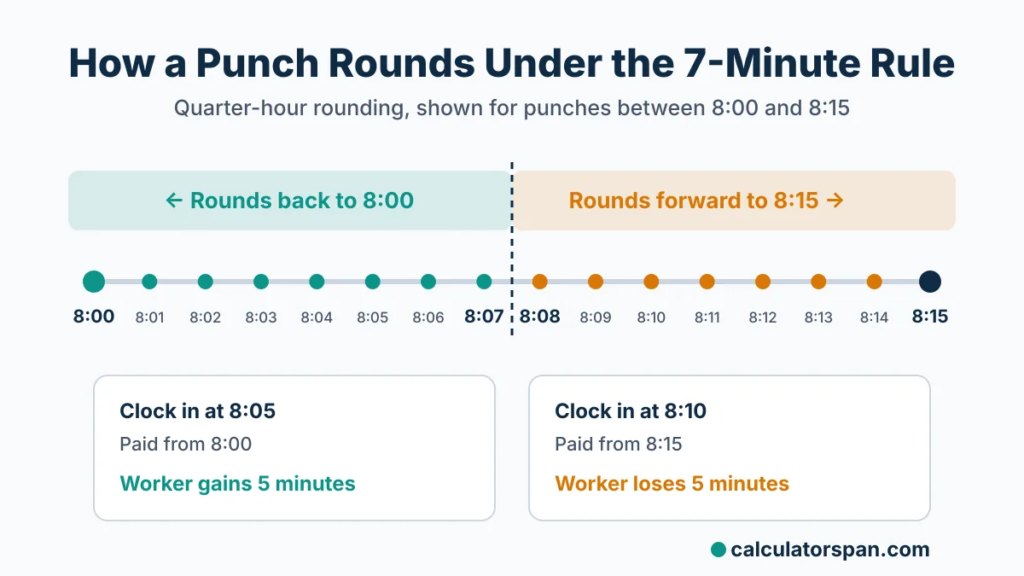
The order matters because each stage depends on the one before it. You can’t audit what the system never stored, and supervisors can’t follow a policy nobody wrote down. In the setups I’ve reviewed, stage two is where most gaps hide.
Which Rounding Mistakes Trigger Wage Lawsuits?
The rounding mistakes that trigger wage lawsuits are the ones that quietly move minutes toward the employer: rounding in one direction only, rounding meal breaks, letting people work during the rounding window without pay, and editing punches after the fact.
The DOL’s 2026 hospital letter is a clear example of the third mistake. Staff clocked in early and started work, but the system always rounded them to the shift start, so the early work was never paid.
Trouble can start on the employee side as well. Some staff deliberately punch right at the edge of the rounding window, and manual edits made afterward to “fix” those punches create a second problem on top of the first.
What Should Timekeeping Software Do to Support the 7-Minute Rule?
Timekeeping software for 7-minute rounding should store raw punches beside rounded ones, flag lopsided patterns without being asked, and apply each location’s rules separately.
Good system configuration starts with keeping raw and rounded timestamps, so any audit can rebuild what actually happened. Without both, a wage dispute turns into your word against a spreadsheet.
The software should detect patterns and raise red flags on its own: clustering of punches near the rounding line, negative rounding balances in a department, odd supervisor patterns, and complaints about missing minutes. It should also automate neutrality reports so nobody has to remember to run them.
Location rules matter for multi-site teams. Oregon has a statewide predictive scheduling law (the Fair Work Week Act of 2017), and New York City has its own fair workweek rules, so payroll integration has to carry the right rule set for each site.
Remote workers follow the same rules, which means mobile and web clocks need to capture actual start times rather than the moment someone remembers to tap in.
What Are the Alternatives to the 7-Minute Rule?
Exact-minute tracking is the main alternative to the 7-minute rule, because it pays every recorded minute and removes rounding disputes entirely. Adding up exact hours and minutes takes seconds with a time calculator.
Rounding was always about administrative convenience, and the federal rule dates from an era of paper time cards. Now that most systems record exact minutes, courts in California and Oregon have asked why employers convert those minutes into rounded ones at all. Switching trades a little convenience for much lower legal risk, and in my experience the extra payroll work is smaller than most owners expect.
Finer increments are a middle path. Rounding to 5 or 6 minutes still needs neutrality checks, but each punch moves less.
Taking a role off the clock is another route, since exempt employees aren’t owed overtime. That only works for jobs that genuinely pass the exemption tests, not as a workaround.
Moving away from rounding means telling staff in advance and retraining supervisors, so nobody gets caught off guard by a paycheck that looks different.
How Do You Audit a 7-Minute Rounding Policy?
Auditing a 7-minute rounding policy means comparing rounded hours with actual hours on a fixed schedule and investigating any person, department, or pattern that keeps losing time.
The number I track is a Neutrality Score: (total rounded hours − total actual hours) ÷ total actual hours. Actual hours come straight from the raw punches, and a time duration calculator works them out one shift at a time. A score that stays negative means the employer is the one gaining. My own working range is -0.5% to +0.5%. That’s a rule of thumb, not a legal threshold, and in California, after Camp, even a positive overall score may not protect an employer if individual workers lose recorded minutes.
Run the check at least monthly, and more often in states with tight wage rules. Add department-level reviews, document patterns as you find them, and send every problem into a corrective action plan.
Ongoing monitoring depends on good records. Federal rules require payroll records to be kept for 3 years and time cards for 2 years. Keep original punch data for at least 3 years anyway, since that matches the FLSA’s lookback period for willful violations.
Is the 7-Minute Rule Worth the Legal Risk?
The 7-minute rule is worth keeping only for employers ready to audit it every month and act on what they find; for everyone else, and for most employers in California, Oregon, and Washington, paying exact minutes is the lower-risk path.
If you stay with rounding, monthly neutrality audits are non-negotiable. My own triggers are to investigate any overall balance beyond ±1% and to look hard at manual edits once they pass a few percent of punches. Again, these are working rules of thumb, not legal limits.
Disputes need a deadline too. Open disputes should clear within one payroll cycle and never sit past two. Every employer I’ve seen do this well treats those limits as fixed, not as targets.
Frequently Asked Questions About the 7-Minute Rule
Is the 7-Minute Rule Legal Everywhere?
No. The 7-minute rule is allowed under federal rules when it is neutral, but several states limit it or are actively testing it in court.
California bans rounding of meal periods and has a pending Supreme Court case that may limit rounding further. Washington allows the 7-minute rule but not for meal and rest periods, and a major rounding case is before its Supreme Court. In Oregon, a federal court has held that state law doesn’t permit rounding at all.
Can You Round Clock-Ins but Not Clock-Outs?
No. Rounding only one side of a shift, or only in the employer’s favor, is not neutral and fails the federal test.
Federal neutrality means start and end punches follow one rule, applied in both directions. A written policy should state a neutrality commitment, set procedures for missed punches, and ban supervisor manipulation of either side. That applies to managers as much as hourly staff.
What If Employees Game the System?
When employees time their punches to exploit rounding, the fix is to log the pattern and apply discipline evenly, supervisors included.
Have staff sign an acknowledgment of the policy so the rules can’t come as a surprise. Spell out consequences in the handbook and policy documentation, and cover them in supervisor training so favorites don’t get a pass. Repeated clock-ins at the last friendly minute, paired with tidy clock-outs, are the usual giveaway.
Do Salaried Employees Follow the 7-Minute Rule?
Only salaried staff who are non-exempt, and who therefore log hours for overtime, fall under the 7-minute rule.
Under the FLSA, rounded time must still produce accurate overtime once a week passes 40 hours. For salaried non-exempt staff, that starts with the hourly rate, which a salary to hourly calculator works out. Exempt status removes the need to track hours only for positions that genuinely pass the exemption tests.
How Often Should You Audit Rounding?
Rounding should be audited every month at minimum, and more often in states with strict wage laws.
Use a fixed checklist each time: the overall neutrality score, each department’s balance, individual workers who lose time month after month, and the share of punches edited by hand. Back it up with regular payroll training that walks through the rounding grid.
Can You Switch From Rounding to Exact Time?
Yes, an employer can move from rounding to exact-minute pay at any time, and several employment law firms now recommend it as the safest option for California and Oregon employers.
Run a cost estimate first using your own raw punch data, since that shows exactly how many minutes rounding has been adding or removing. An hourly paycheck calculator turns those minutes into dollars per worker. Then give staff advance notice, retrain supervisors, and watch the first few pay cycles closely.
Do Remote Workers Follow the Same Rounding Rules?
Yes, off-site staff are rounded under exactly the same policy as on-site staff.
A phone timer or a stopwatch on someone’s desk isn’t a time record. The punch has to come from the official clock app, so the raw and rounded times match what the employer keeps for everyone else.
Is 15-Minute Rounding Also Allowed?
Yes, federal rules allow rounding to the nearest quarter-hour as long as it averages out in both directions.
15-minute rounding and the 7-minute rule describe the same practice, and payroll teams use the two names interchangeably. The regulation itself names 5 minutes, one-tenth of an hour, and a quarter-hour as the accepted increments.
How Do You Calculate the 7-Minute Rule?
To calculate the 7-minute rule, check how far a punch sits past :00, :15, :30, or :45; seven minutes or less rounds back to that mark, and eight or more rounds forward to the next.
A punch at 10:52 is seven minutes past 10:45 and rounds back to 10:45; a punch at 10:53 is eight minutes past and rounds forward to 11:00. Many time clocks print punches in 24-hour format, so a 17:06 clock-out is 5:06 PM; a military time converter helps if your exports look like that.
What’s the Difference Between the 7-Minute Rule and 15-Minute Rounding?
There is no real difference, since the 7-minute rule is simply the decision point inside quarter-hour rounding.
Count the minutes past the quarter-hour: 0–7 minutes rounds down, and 8–14 minutes rounds up. So 8:07 AM becomes 8:00 AM, while 8:08 AM becomes 8:15 AM.
Can Employers Get Sued Over the 7-Minute Rule?
Yes, employers can be sued when their rounding systematically favors the company, leaves work done during the rounding window unpaid, produces unpaid overtime, or breaks state law.
Courts look at what the policy actually did to workers’ pay, not just how it was written. The Washington hospital case, which reached more than $229 million in total with interest, shows how fast the numbers grow when rounding problems combine with break violations and a finding of willfulness. A solid defense means weighing state-specific risks before picking a policy, auditing it regularly, and keeping the raw records that prove it was fair.