How Does a Travel Time Calculator Work?
A travel time calculator turns the total distance, your average speed, and the duration of breaks into a trip length, then converts that into an arrival time or an optimal departure time.
1Route
2Travel
Find your average speed from a past trip
3Schedule
4Fuel cost
The sums are shared by nearly every tool, so the calculation itself rarely differs; what changes is what each site wraps around it, such as cost splitting, live traffic, or port lists. Dividing one number by another is enough to roughly estimate an ETA, yet it quietly assumes nothing goes wrong, and unexpected events are exactly what it leaves out. I treat the first figure any tool gives me as a baseline, not a promise.
Some tools also work in reverse: give them the particular time you must arrive and they back-calculate when to leave. For a leave-by time with parking and appointment buffers built in, use our arrival time calculator. It also pays to compare two tools before a long journey, because no single popular tool covers cost splitting, live traffic, and river freight together. One tool covered below advertises No Account Required and Privacy First handling of addresses.
What Do You Enter Into a Travel Time Calculator?

A travel time calculator needs the trip length and an expected pace, and most tools then ask for stops, a start time, or a target finish.
The leanest version comes from a courier company serving Nova Scotia, which asks only for a trip length in km and a pace in km/h. One calculator built for drivers adds break time, a start date and fuel cost inputs, and it points to its own MPG calculator when you do not know your car’s fuel use.
Some planners also let you reuse Saved Routes, which saves retyping a regular trip. A river-freight tool from an Austrian waterway agency is more specialised: its port lists run from Gent and Rotterdam to Sulina. On privacy, one departure planner states 0 data stored and calls itself 100% private, though those are the site’s own statements and I could not verify them independently.
How Reliable Is a Travel Time Estimate?
A travel time estimate is only as good as the speed you feed it. For the clock time you will actually arrive, use our arrival time calculator.
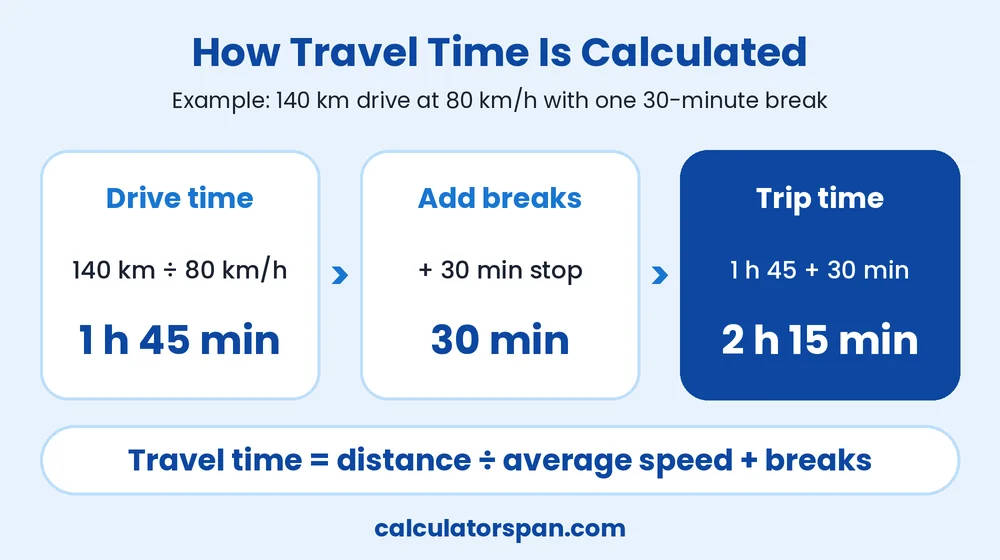
The driving calculator’s worked example shows the idea. A 140 km (87 mi) drive at 80 km/h (50 mph) with a 30-minute break, leaving at 7:00 pm on January 22, 2024, gives a drive of 2 hours and 15 minutes, so the car arrives at 9:15 pm.
Its drive-time FAQ shows the same division in decimals (a decimal-to-time calculator does that conversion for you): 3.5833 hours is 3 hrs 35 mins, and 3 hrs 50 min once a short stop is added.
Reality adds what division cannot see: road conditions, road closures, and traffic speeds. One departure planner states a 99% accuracy rate across 10K+ calculations, but those are the site’s own claims rather than independent measurements, so treat any arrival estimate as a range.
How Do You Work Out the Drive Home, Including Cost?
The drive home equals trip length over pace plus every planned stop, and its cost equals fuel burned times the price paid per liter.
Start by fixing the units of measurement: choose imperial or metric and stay with it, since mixing miles with kilometres breaks the arithmetic.
Then add the stops. A realistic total duration for a vacation trip home includes meals and rests, plus a Smart Safety Buffer of the sort some planners recommend. Enter the month and year with the day, so an overnight run rolls into the next date correctly. A reasonable allowance for breaks keeps the answer honest, because leaving them out produces a shorter figure than any real trip achieves.
Cost follows the same pattern. Enter your fuel price and the number of passengers, and the tool splits the bill; the same site’s carpooling calculator and fuel cost calculator handle the sharing and the fuel breakdown separately.
How Is Fuel Cost Calculated and Split Between Passengers?
Drive cost equals trip length divided by 100, multiplied by liters burned per 100 km and by the price per liter, then split among the people in the car.
That site built its calculator to estimate the fuel costs of a journey alongside its timing. In its short example, a car using 8 liters per 100 kilometers (the page pairs that with 62 miles) buys fuel at $0.90 per liter and shares the trip with a companion.
The long example covers 850 km at 110 km/h in an SUV burning 9.5 liters of fuel per 100 km, with gasoline at €1.22 per liter and four friends in the car. The two examples end like this:
| Example | Total cost | Per person | People sharing |
| Short drive | $10.08 | $5.04 | Driver plus one companion |
| Long drive home | €98.52 | €24.63 | Four friends |
To see your own figures, track mileage at each refueling: note the amount of fuel added and the fuel used between stops. The FAQ on mileage below walks through it.
Does Real-Time Traffic Data Make a Travel Time Calculator More Accurate?
Yes, real-time traffic data makes an estimate more current than a fixed-speed calculation, although it only reflects conditions at the moment you ask.
One leave-time tool pulls its figures from a popular mapping service. You give it a starting location, a destination, and a transportation mode, then press Calculate My Leave Time.
It layers appointment-specific buffers and your own preparation time on top. The get ready question runs from a Normal routine to a Full routine, so two people leaving the same door can get different answers.
A long highway leg shows why live data matters. The 215 miles along I-90 W in the road-trip FAQ assumes steady speed; a slowdown anywhere on that road moves the finish time, and a fixed calculation cannot see it. Per its own page, the tool is Mobile Optimized for any phone or tablet, includes Dark Mode and Smart Tips, and is Always Available around the clock, which the page abbreviates as 24/7.
How Does the Mode of Transport Change a Travel Time Calculator?
The mode of transport changes the estimate because each mode has its own speed, route, and stop pattern; aircraft are usually quicker over long distances, while road and river trips depend on traffic and locks.
Tools for air and road often show flight times and driving times side by side. Where two cities are close, such as New York and Boston, one flight-and-drive tool notes that the road estimate can remain workable, so flying does not automatically win.
A time zone converter answers a different question: how much the clock shifts. A time zone change matters for international calls, because it decides which hour suits both people.
Inland shipping stretches the logic further. A river-freight planner lets you pick a Motor cargo vessel 1.350 to tonnage or Motor cargo vessel 2.000 to. tonnage, a 2-unit pushed convoy or a 4-unit pushed convoy, and a running day of 14 hrs or 24 hrs. Its port lists include Vienna, Budapest, nd Bratislava.
How Do You Calculate Travel Time by River Vessel?
River travel time is calculated port to port: you pick the port of loading, the port of destination, a vessel type and an operation mode, and the tool returns the distance, the number of locks and the travel time.
A cruise bus follows one road at one speed, but a ship carrying cargo also has to work through locks, which is why the tool reports their count beside the distance.
The choice of daily running hours changes the outcome as well: a schedule limited to part of the day stretches elapsed time compared with round-the-clock running.
Time-difference tools, by contrast, work for anywhere in the world, while a river planner covers only its listed corridor of ports.
How Far Can You Trust a Travel Time Calculator?
A travel time calculator can be trusted only as far as its inputs, method, and stated limits allow: preparation time, stops, route conditions, and whether speeds are fixed or live.
Preparation time is easy to overlook. One departure planner’s menu runs from 5 minutes for someone already ready, through 10 minutes for Quick prep and 20 minutes for Thorough prep, up to 45 minutes for Detailed preparation. Its countdown panel shows 00:00:00 before any calculation has been run.
Season and terrain matter, and so does daylight: a sunrise and sunset calculator shows how much light you have left for a winter drive. The driving calculator’s long example is a winter vacation return from the mountains, and its own method notes that plain division ignores poor weather. One travel site pairs its trip calculator with a time-difference tool that helps you pick a good moment for a phone call across zones.
For freight, the river-freight portal offers a Download result as PDF option, a useful record when quoting a leg such as Belgrade to Constanta or a run starting at Passau (Schalding).
How Do I Calculate the Average Speed for My Trip?
Average speed is the distance covered per hour of moving time, found by removing stopped time from the trip duration.
Read the initial odometer reading at the start and the final odometer reading at the end to get the distance, then relate it to the moving hours. Check the result against a calculator you trust; the driving calculator’s site says each of its tools is peer-reviewed by a trained expert and proofread by a native speaker, with its standards set out on an Editorial Policies page.
How Fast Can I Reach Boston From New York Driving at 60 mph?
At that speed, the drive between these two cities takes about three and a half hours without stops, and a little under four hours with a short break.
To reproduce the figure, divide the trip distance by the speed to get drive time without stops, then add the total time used for breaks. The sum assumes a fixed travel distance along one particular road between a particular place of departure and the destination. It also leaves out car accidents and bad weather conditions, so read the answer as a floor, not a promise.
How Do I Calculate the Mileage of My Vehicle?
Your vehicle’s fuel economy is the distance driven between two fill-ups, set against the fuel burned over that stretch.
At the first fill-up, note the odometer; at the next, subtract the first number from the second, and the difference is the distance travelled. Relating that to the fuel added gives your fuel consumption rate or, flipped around, your fuel efficiency. Verify the figure against a calculator before you use it to price a long trip.
How Far Can You Drive in One Day?
Driving for 8 hours at 60 mph, with breaks every 2 hours a 115-minutebreak each time) and an hour-long lunch break, covers 390 miles in the driving calculator’s example. The arithmetic runs in three steps:
- Add the stops to get the total break time (a time calculator helps here): 15 min + 60 min + 15 min = 1 hr 30 min.
- Remove that from the driving window, which leaves 6 hr 30 min of motion.
- Multiply the moving hours by the speed: 60 × 6.5.
Driving speed is the biggest lever on the result. The calculator’s longer trip example uses three short 15-minute breaks and a 1-hour dinner break, which together come to 1 h 45 min. Planning those stops around the best time to eat keeps them from feeling like lost hours.