Ever slept a full eight hours and still woken up feeling like a zombie? Meanwhile, a short six-hour night sometimes leaves you oddly sharp. That’s not luck. It comes down to when your alarm goes off during your sleep cycle.
Sleep Calculator: Best Time to Sleep & Wake Up
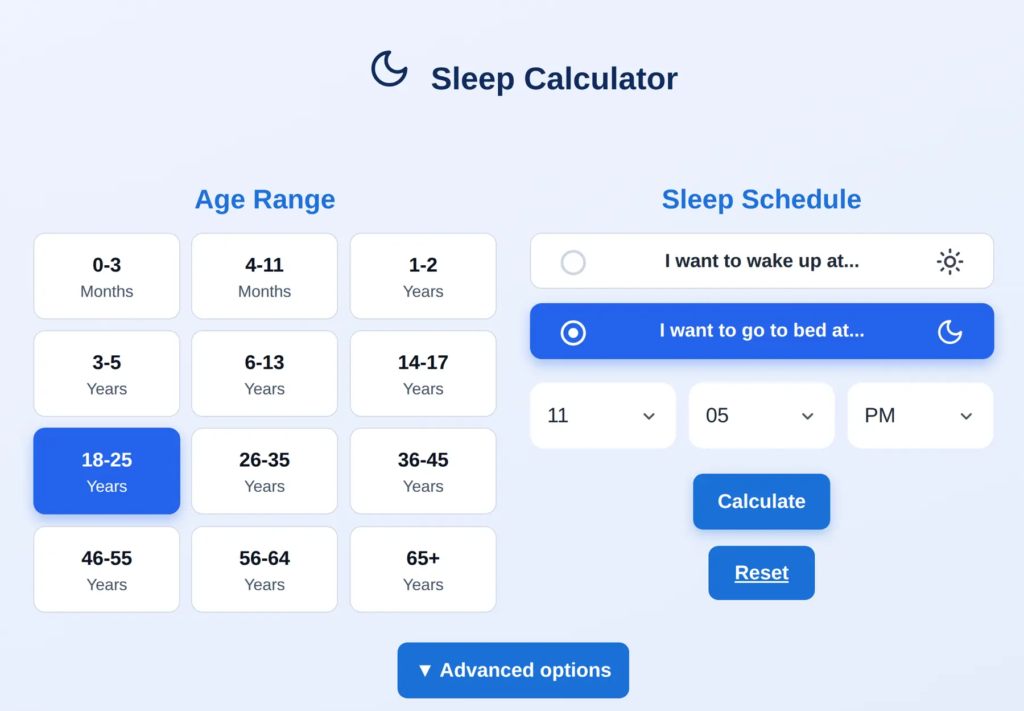
Sleep Calculator
Age Range
Sleep Schedule
Results
A sleep calculator takes the guesswork out. Tell it when you need to wake up, and it shows the best times to go to bed. Or tell it when you’re heading to bed, and it finds the wake-up times that line up with the end of a sleep cycle.
In this guide, we’ll walk you through how our free sleep calculator works, the science behind it, and simple habits that help you wake up feeling genuinely rested.
What Is a Sleep Calculator?
A sleep calculator is a free online tool that works out the ideal time to fall asleep or wake up. It’s based on the natural rhythm of your sleep cycles, which last about 90 minutes each.
Instead of counting hours, it counts cycles. The goal is to wake you at the end of a cycle, when your sleep is lightest, rather than in the middle of deep sleep. That simple shift can be the difference between bouncing out of bed and hitting snooze four times.
Most sleep calculators, including ours, work in two directions:
- Bedtime calculator: you enter your wake-up time, and it suggests when to go to bed.
- Wake-up time calculator: you enter when you’ll go to sleep, and it suggests when to set your alarm.
It also adds a buffer for the time it takes to drift off. For most adults, that’s around 15 minutes.
How Sleep Cycles Work (and Why Timing Matters)
Your body doesn’t sleep in one flat, steady block. Each night you move through four to six cycles, and each one lasts roughly 90 minutes. Every cycle has four stages:
- N1, light sleep: the drowsy, drifting-off phase. It lasts only a few minutes, and you can wake easily.
- N2, deeper light sleep: your heart rate slows and body temperature drops. This is where you spend about half the night.
- N3, deep sleep: the restorative stage. Your body repairs tissue and strengthens immunity. Waking here is hard.
- REM sleep: your brain becomes active, and most dreaming happens. REM supports memory and mood.
When an alarm pulls you out of deep sleep, you feel heavy, foggy, and slow. That feeling has a name: sleep inertia. It can hang around for 30 minutes or more.
Wake up at the end of a cycle instead, and you skip most of that fog. That’s exactly what a sleep cycle calculator helps you do.
Quick note: 90 minutes is an average. Your own cycles may run anywhere from 80 to 120 minutes, so treat the results as a smart starting point and adjust to how you feel.
Your Body Clock Plays a Part Too
Sleep cycles aren’t the only rhythm running the show. Your circadian rhythm is your body’s 24-hour internal clock. It’s the reason you get that afternoon slump and start yawning once it gets dark.
This clock is also why your chronotype matters. Some of us are early birds who feel great at 6 AM. Others are night owls who come alive after 10 PM. Neither is wrong. If you’re a night owl, pick the later bedtime options the calculator gives you, and let morning sunlight slowly nudge your clock earlier if you need to.
How to Use Our Sleep Calculator
Using the CalculatorSpan sleep calculator takes less than ten seconds. No sign-up, no app download.
If you know when you need to wake up:
- Select “I want to wake up at.”
- Enter your wake-up time, for example, 6:30 AM.
- Click Calculate.
- Pick one of the suggested bedtimes. The calculator already adds 15 minutes to fall asleep.
If you’re going to bed now (or at a set time):
- Select “I’m going to bed at” or tap “Sleep now.”
- Enter your bedtime.
- Click Calculate.
- Set your alarm for one of the suggested wake-up times.
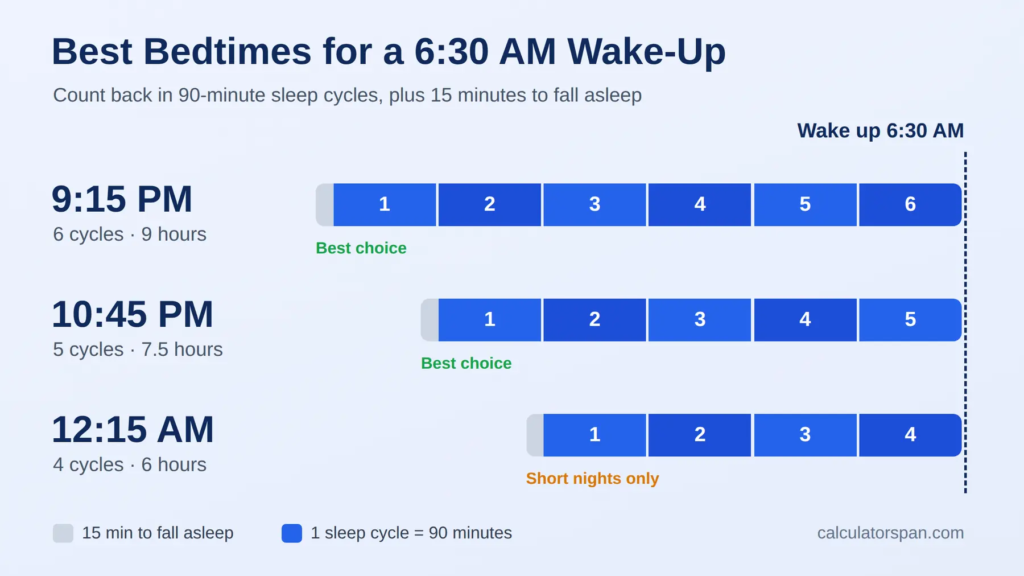
Which option should you choose? Aim for five or six full cycles if you can. That gives you 7.5 to 9 hours of sleep, which suits most adults. Four cycles (6 hours) works for an occasional short night, but it shouldn’t become your routine.
Example: Say you need to wake at 6:30 AM. Counting back in 90-minute cycles plus 15 minutes to fall asleep, your best bedtimes are 9:15 PM (six cycles), 10:45 PM (five cycles), or 12:15 AM (four cycles).
Want to test a different wake-up time? Our time calculator lets you add or subtract 90-minute blocks yourself.
Bedtime Chart: When Should I Go to Sleep?
No time to open the calculator? Use this quick sleep cycle chart. Each bedtime already includes 15 minutes to fall asleep.
| Wake-up time | 6 cycles (9 h) | 5 cycles (7.5 h) | 4 cycles (6 h) |
| 5:00 AM | 7:45 PM | 9:15 PM | 10:45 PM |
| 5:30 AM | 8:15 PM | 9:45 PM | 11:15 PM |
| 6:00 AM | 8:45 PM | 10:15 PM | 11:45 PM |
| 6:30 AM | 9:15 PM | 10:45 PM | 12:15 AM |
| 7:00 AM | 9:45 PM | 11:15 PM | 12:45 AM |
| 7:30 AM | 10:15 PM | 11:45 PM | 1:15 AM |
| 8:00 AM | 10:45 PM | 12:15 AM | 1:45 AM |
| 8:30 AM | 11:15 PM | 12:45 AM | 2:15 AM |
For any other time, our sleep calculator gives you an exact answer in seconds.
Looking for the best time to wake up instead? Just flip it around. Heading to bed at 11:00 PM? Set your alarm for 6:45 AM (five cycles) or 8:15 AM (six cycles), and you’ll wake up between cycles instead of in the middle of one. Going to bed right now? Plug the time into our hours from now calculator to see exactly when 7.5 or 9 hours will end.
How Much Sleep Do You Need by Age?
Timing matters, but so does the total. Most adults need at least 7 hours a night, while kids and teens need a lot more. Here’s a general guide based on the CDC’s sleep recommendations:
| Age group | Recommended sleep per 24 hours |
| Newborns (0–3 months) | 14–17 hours |
| Infants (4–12 months) | 12–16 hours, including naps |
| Toddlers (1–2 years) | 11–14 hours, including naps |
| Preschoolers (3–5 years) | 10–13 hours, including naps |
| School-age kids (6–12 years) | 9–12 hours |
| Teens (13–17 years) | 8–10 hours |
| Adults (18–60 years) | 7 or more hours |
| Adults (61–64 years) | 7–9 hours |
| Older adults (65+ years) | 7–8 hours |
Think of these as ranges, not strict rules. If you wake up alert and stay energized until evening, you’re probably getting what you need.
What About Sleep Debt?
Missed an hour here and there? It adds up, and that shortfall is called sleep debt. Lose one hour a night for a week, and you’re seven hours behind. No wonder Friday feels so heavy.
The good news is you can chip away at it. Go to bed 30 to 60 minutes earlier for a few nights instead of sleeping until noon on Sunday. A huge lie-in confuses your body clock and makes Monday morning even harder.
8 Simple Tips to Fall Asleep Faster and Wake Up Refreshed
A sleep calculator works best when you actually fall asleep on time. These small habits make a real difference:
- Stick to a schedule. Go to bed and wake up at the same time every day, weekends included. Your body clock loves consistency.
- Put screens away 30–60 minutes before bed. Blue light from phones and laptops can delay the release of melatonin, your sleep hormone.
- Cut caffeine after lunch. Caffeine can stay in your system for six hours or longer.
- Keep your room cool, dark, and quiet. A slightly cool room, blackout curtains, and a fan or white noise all help.
- Get morning sunlight. Ten minutes of daylight soon after waking helps set your internal clock for the day.
- Go easy on late, heavy meals. Try to finish dinner two to three hours before bed.
- Build a wind-down routine. Reading, light stretching, or a warm shower tells your brain it’s time to rest.
- Don’t fight it. If you can’t sleep after 20 minutes, get up, do something calm in dim light, and return when you feel sleepy.
Sleeping Around Night Shifts
Working night shifts or rotating hours? The cycle math still works, just on a different clock. Count back from whenever you need to wake, even if that’s 2 PM. Keep your sleep window as steady as you can and use blackout curtains for daytime rest. If you’re juggling shifts, our timecard calculator and work hours calculator make it easier to plan your hours around sleep. Shift work sleep is tough, so be kind to yourself on the off days.
If you regularly struggle to sleep or feel exhausted no matter how long you rest, talk to a doctor. Ongoing sleep problems can point to conditions like insomnia or sleep apnea.
Frequently Asked Questions
How does a sleep calculator work?
It counts backward or forward in 90-minute sleep cycles from your chosen time. It also adds about 15 minutes for falling asleep, so your alarm lands at the end of a cycle when sleep is lightest.
Is a sleep calculator accurate?
It’s a reliable guide, not a medical device. Sleep cycles average 90 minutes but vary from person to person. Try the suggested times for a week and fine-tune by 10–15 minutes if needed.
What is the best time to go to sleep?
There’s no single best time for everyone. The best bedtime is one that gives you five or six full cycles before your wake-up time. For a 7:00 AM alarm, that’s 9:45 PM or 11:15 PM.
Is 6 hours of sleep enough?
Six hours (four cycles) can leave you feeling okay for a night or two. Over time, though, most adults need 7 to 9 hours to stay healthy, focused, and in a good mood.
Is it better to sleep 6 hours or 8 hours?
Generally, more sleep is better for your health. But waking mid-cycle after 8 hours can feel worse than waking after exactly 6 or 7.5 hours. The ideal is 7.5 or 9 hours, timed to full cycles.
Can I use the sleep calculator for naps?
Yes. A 20-minute power nap keeps you in light sleep and avoids grogginess. A 90-minute nap gives you one full cycle. Try to avoid napping for 30–60 minutes, as that’s when you’re most likely to wake from deep sleep. To time a nap, use our hours from now calculator to set your alarm.
Is the CalculatorSpan sleep calculator free?
Completely free. There’s no sign-up, no download, and it works on a phone, tablet, or desktop.
Conclusion: Sleep Smarter, Not Just Longer
Good sleep isn’t only about how many hours you get. It’s about waking up at the right moment in your natural rhythm. When your alarm matches the end of a sleep cycle, mornings feel lighter and the day starts on a better note.
Our free sleep calculator does the math for you in seconds. Pair it with a steady schedule and a few healthy habits, and you’ll notice the difference within a week.
Ready to wake up refreshed? Try the CalculatorSpan Sleep Calculator now and find your perfect bedtime.