What Is an Hourly Paycheck Calculator?
An hourly paycheck calculator estimates your take-home pay by subtracting federal, state, and local taxes, FICA, and deductions from your gross hourly earnings. Enter your hourly wage, hours worked, and pay frequency to see your real net pay before payday.
Pay and hours
Hours per week can't exceed 168. Lower your regular or overtime hours.
Taxes and deductions
| Earnings | Amount |
| Regular pay | |
| Overtime pay | |
| Gross pay |
| Deductions | Amount |
| Pre-tax deductions | |
| Federal income tax | |
| State / local tax | |
| Social Security and Medicare | |
| After-tax deductions | |
| Total deductions |
- Yearly gross pay
- Yearly take-home pay
- Take-home per week
- Take-home per hour
Results are estimates based on the rates you enter. Actual withholding depends on your filing status, allowances and local tax rules.
Most hourly employees I’ve worked with guess their take-home pay wrong, usually by trusting gross pay. The calculator also handles overtime hours, tips, commissions, filing status, allowances, and pre-tax deductions such as 401k contributions.
Depending on the version, it supports six or eight pay rates across all fifty states. While testing it against real pay stubs, I found most errors start with a misread hourly rate or a skipped deduction.
The results break your check into gross pay, federal withholding, state withholding, FICA taxes, and deductions, so you can see exactly where each dollar goes before it reaches your account.
How the Hourly Paycheck Calculator Works
Gross Pay vs. Net Pay
Gross pay is your earnings before taxes: hours worked multiplied by your hourly rate, plus overtime, tips, and bonuses. Net pay, or take-home pay, is what remains after taxes and deductions are withheld.
If you work multiple rates, such as a weekday rate and a weekend differential, each block of hours is multiplied by its own rate before the totals are added together.
Between gross and net, money is withheld for federal income tax, Social Security, Medicare, and state or local taxes. Pre-tax and post-tax deductions for health insurance or retirement then come off before you get paid.
The calculator recalculates every line when you change one input, which makes it easy to test an extra shift, a raise, or a new deduction before it happens.
What Each Calculator Field Changes
The check date matters because year-to-date income decides where you sit in the IRS tax tables. I’ve watched people skip that field and then wonder why their withholding looks off.
Rate 1 and Hours 1 hold your base hourly rate and regular hours. Pull those hours from the timecard calculator, and convert any minutes with the hours to decimal calculator before entering them.
Additional rates cover shift premiums or overtime, usually at 1.5 times your base rate; the time and a half calculator breaks that premium down. Tips, commissions, and bonuses go in the additional income lines.
Your state of employment sets which state and local tax rates apply. Your W-4 details, including filing status, dependents, and extra withholding, set your federal withholding for every check.
Finally, list pre-tax deductions like health insurance premiums and 401k contributions, then post-tax items such as union dues, wage garnishments, and voluntary deductions. When a result looks wrong, it’s almost always an input problem.
Worked Example: $22 an Hour, Paid Bi-Weekly
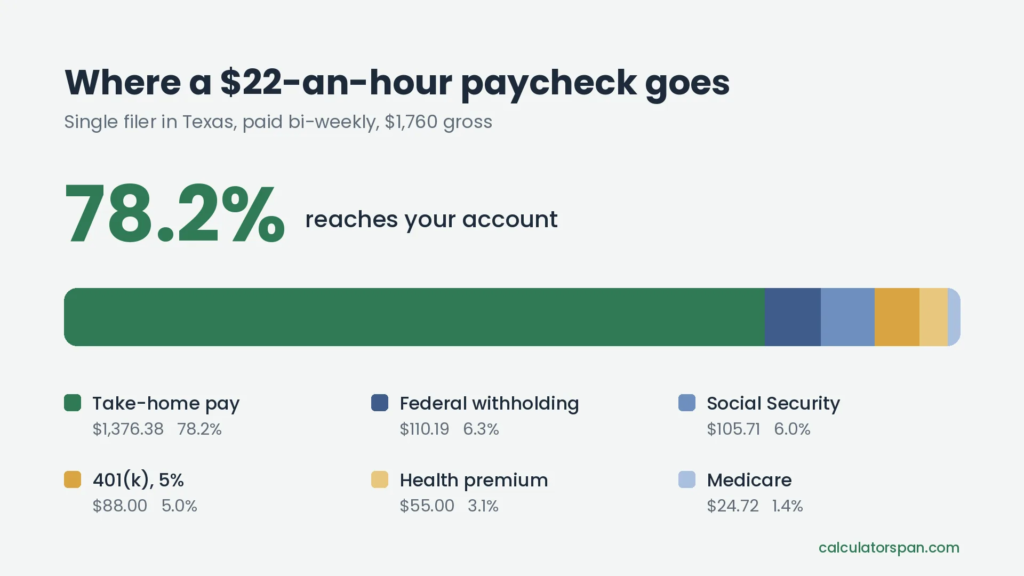
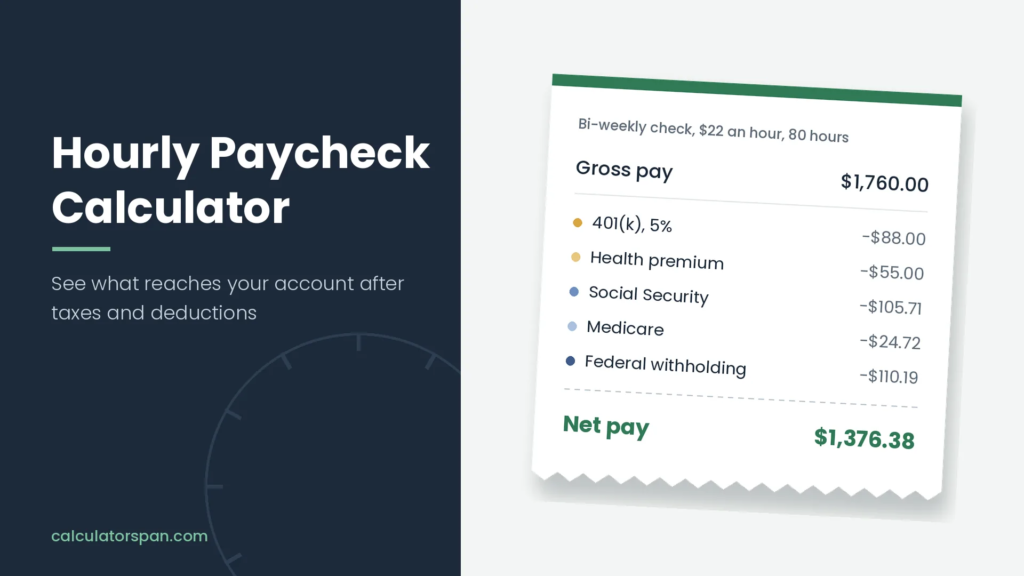
A single filer in Texas earning $22 an hour for 80 hours takes home about $1,376 of a $1,760 bi-weekly check, assuming a 5% 401k contribution and a $55 health premium.
| Paycheck Line | Amount |
| Gross pay | $1,760.00 |
| 401k (5%, pre-tax) | −$88.00 |
| Health premium (pre-tax) | −$55.00 |
| Social Security (6.2% of $1,705) | −$105.71 |
| Medicare (1.45% of $1,705) | −$24.72 |
| Federal withholding (estimate) | −$110.19 |
| State withholding (Texas) | $0.00 |
| Net pay | $1,376.38 |
The 401k does not reduce FICA wages, but a cafeteria-plan health premium does. That is why Social Security and Medicare apply to $1,705 while federal withholding applies to $1,617.
The federal estimate annualizes $1,617 over 26 checks, subtracts the $16,100 standard deduction, applies the 10% and 12% brackets, and divides back down. Employer payroll tables may differ by a dollar or two.
That leaves roughly 78% of gross pay in the account. Treat any estimate like this as an approximation and compare it with your first real pay stub before setting a monthly budget.
Paid a Salary? Convert It First
This calculator works from an hourly wage. If your offer shows an annual salary or monthly wage, convert it with the salary to hourly calculator first, which shows gross figures only, then enter that rate here.
The salary to hourly page answers what a job pays per hour; this page answers what actually reaches your bank account after taxes and deductions.
How Hours and Pay Schedule Affect Take-Home Pay
Hourly vs. Salaried Paychecks
Hourly employees see a different gross pay every period because it tracks hours worked. Salaried employees receive a fixed amount, so their withholding stays steady unless benefits or tax settings change.
Under the Fair Labor Standards Act (FLSA), non-exempt workers earn overtime pay after 40 hours per week, while exempt employees do not. Holiday premiums, including Christmas Day overtime, are required only by employer policy or state law.
At $17.40 an hour, a 45-hour week pays $696 regular plus $130.50 overtime, or $826.50 gross. Withholding is figured on that bigger check, so the extra hours look smaller after tax.
Salaried roles usually include more pre-tax benefits, such as health insurance and a 401k plan, which shrink taxable income. That is why two people with the same gross pay can take home different amounts.
When Your Hours Change Every Week
With irregular shifts, net pay swings more than gross pay, because larger checks are withheld at higher annualized rates. Track total hours worked each week and compare contracted hours with the schedule you actually receive.
Few hourly roles offer guaranteed hours, so estimate your lowest realistic week first. Building a budget on that low week gives you income stability on paper, even when the real weekly paycheck bounces.
Also confirm your employer pays at least the minimum wage for every hour, including short or split shifts. The federal minimum is $7.25, but many states and cities require considerably more.
Bi-Weekly vs. Semi-Monthly Pay
Pay frequency is how often your employer runs payroll. Bi-weekly pay arrives every other week, usually 26 times a year, and occasionally 27 when the calendar lines up.
Semi-monthly pay arrives twice a month, usually on the 15th and last day, for 24 checks a year. Semi-monthly checks are larger, but bi-weekly workers get two extra paychecks annually.
Because payroll software annualizes each check to estimate withholding, the same annual pay can produce slightly different per-check tax amounts depending on how often you are paid.
How Taxes Are Withheld From an Hourly Paycheck
Four taxes can come out of an hourly paycheck: federal income tax, Social Security, Medicare, and state or local income tax. The 2026 figures below drive most of the calculator’s results.
| Item | 2026 Figure |
| Social Security tax | 6.2% of wages up to $184,500 |
| Medicare tax | 1.45% of all wages |
| Additional Medicare tax | 0.9% on wages over $200,000 |
| Supplemental wage withholding | 22% flat (37% above $1 million) |
| Standard deduction | $16,100 single, $32,200 married filing jointly, $24,150 head of household |
Federal Income Tax Withholding
Federal income tax applies to more than wages. Salaries, tips, bonuses, business income, gambling income, unemployment benefits, and even cash gifts from employers all count as taxable income.
Your employer calculates federal withholding from your W-4, your year-to-date wages, and IRS Publication 15-T. The system is progressive, so each slice of income is taxed only at its own bracket’s rate.
| Tax Rate | Taxable Income (Single, 2026) |
| 10% | $0 to $12,400 |
| 12% | $12,401 to $50,400 |
| 22% | $50,401 to $105,700 |
| 24% | $105,701 to $201,775 |
| 32% | $201,776 to $256,225 |
| 35% | $256,226 to $640,600 |
| 37% | Over $640,600 |
Married filing jointly roughly doubles these ranges. A single filer with $60,000 of taxable income pays 22% only on dollars above $50,400, so a raise never shrinks your paycheck through brackets alone.
Bonuses, Tips, and Overtime
Bonuses paid separately are supplemental wages, so employers can withhold a flat 22% instead of using the normal tables. That is withholding, not your final tax; any difference settles on your annual return.
Commissions paid together with regular wages are usually withheld through the normal tables instead, since the employer treats the combined amount as one regular paycheck.
Tips of $20 or more in a month must be reported to your employer, who withholds income tax and FICA on them from your regular wages.
From 2025 through 2028, federal law allows a deduction of up to $25,000 for qualified tips and $12,500 for qualified overtime premium pay, with income phase-outs. Both lower income tax, not FICA.
The current W-4 worksheet can account for these deductions, which keeps your withholding from overshooting all year if you earn significant tips or overtime.
The W-4 Form
The W-4 form tells your employer how much federal income tax to withhold from each paycheck. Since 2020 it no longer uses allowances; it asks for facts about jobs, dependents, and other income instead.
Step 2 covers multiple jobs or a working spouse. Step 3 claims dependents if income is 200,000orless(400,000 married), with each child under 17 worth $2,200. Step 4 adds other income, deductions, or extra withholding per check.
A mismatched filing status or a skipped step is the most common cause of an unexpected tax liability, and both employee and employer rely on what the form says.
Most states use separate state withholding forms. Accurately completing both is the simplest way to avoid a surprise tax bill or an oversized refund in April.
Filing Status and Tax-Exempt Status
Head of household is taxed more gently than single, with wider brackets and a larger standard deduction. It requires being unmarried, paying over half the household’s costs, and having a qualifying dependent.
You can claim exemption from withholding only if you owed no federal income tax last year and expect to owe none this year. IRS Publication 505 explains the rules; claiming it wrongly brings penalties. Exempt status must be renewed every year.
In practice, exemption usually means your income stays below the 2026 standard deduction shown above, with higher thresholds if you are 65 or older or blind.
FICA, under the Federal Insurance Contributions Act, funds Social Security and Medicare. Employees pay 7.65% of wages in total, and employers match it, so the government receives double what your stub shows.
Social Security stops once wages pass the $184,500 wage base for 2026. The 0.9% Additional Medicare Tax starts at $200,000 of wages for withholding, even though married joint filers’ actual threshold is $250,000.
Employers also pay federal unemployment tax (FUTA) on the first $7,000 of each worker’s wages, but it never appears on your stub. It is one reason your total cost to an employer exceeds your gross pay.
State and Local Taxes
Nine states do not tax wages: Alaska, Florida, Nevada, New Hampshire, South Dakota, Tennessee, Texas, Washington, and Wyoming. Others use flat rates or brackets, and some, like Pennsylvania, tax 401k contributions.
Local income taxes apply in places like New York City, Philadelphia, and most Ohio cities. California, New York, New Jersey, and Washington also deduct for disability or paid family leave programs.
If you live in one state and work in another, withholding usually follows the work state, and your home state may give a credit or have a reciprocity agreement.
Deductions and Your Pay Stub
Pre-Tax vs. Post-Tax Deductions
Pre-tax deductions reduce taxable income before withholding; post-tax deductions come out afterward. Health insurance premiums, a traditional 401k, and a flexible spending account (FSA) are pre-tax, while a Roth 401k is post-tax.
Withholding and deductions are different things. Withholding sends federal and state taxes to the government; deductions pay for benefits or savings. The calculator’s exempt checkboxes mark which deductions skip federal income tax.
Choosing a Roth 401k over a traditional one lowers take-home pay today but can mean tax-free withdrawals in retirement, so the choice changes your tax liability now and later.
The easiest legal way to lower paycheck taxes is routing more pay into pre-tax retirement accounts and other tax-advantaged accounts. Even a small increase in your 401k contribution reduces taxable income immediately.
Review every benefits deduction once a year, along with any employer benefits you have not enrolled in. Unused FSA room or a skipped 401k match is money left on the table.
How to Read Your Pay Stub
Pay stubs use short codes: FIT for federal income tax, SIT for state income tax, OASDI for Social Security, and MED for Medicare. Check the current column first, then year-to-date totals.
Line up your first stub against the calculator’s results side by side; matching each line individually is faster than comparing only the final net pay figure.
To check the math yourself, multiply hours by rate for gross pay, add up every tax line, and subtract taxes and deductions. If gross matches but net doesn’t, look at a deduction or withholding setting.
If year-to-date Social Security stops growing late in the year, you have likely reached the wage base. That is normal, and Medicare keeps applying to every dollar.
Freelancers paid on a 1099 have nothing withheld and owe self-employment tax plus quarterly estimates instead. Bill clients with free invoice templates and set aside money for taxes from each payment.
Common Paycheck Estimate Mistakes
The most common mistake I see is assuming every pre-tax deduction lowers FICA. Traditional 401k contributions don’t, so estimates that subtract them from Social Security wages come out a few dollars too high.
Picking the wrong pay frequency is the second. Bi-weekly and semi-monthly checks for the same annual pay are different sizes, so an estimate built on the wrong one misses every check.
Third, people leave an old W-4 in place after marriage, a second job, or a new baby. Withholding only follows life changes if you update the form.
Finally, many people forget local taxes and state-specific deductions entirely. The calculator gives instant results, but only for the work hours, location, and settings you actually enter.
Frequently Asked Questions
How Much Is $20 an Hour After Taxes?
About $1,369 per bi-weekly check for a full-time single filer in a state without income tax, or roughly $17.12 an hour after federal tax and FICA.
No. A traditional 401k lowers federal income tax withholding, but Social Security and Medicare still apply. Cafeteria-plan health premiums reduce both.
Is Overtime Taxed at a Higher Rate?
No. Overtime is taxed like other wages, but bigger checks are withheld at higher annualized rates. The 2025–2028 overtime deduction can offset part of it.
Why Is My First Paycheck Different From the Estimate?
First checks often cover a partial pay period or arrive before benefits start. Compare your second or third stub for a fair read on normal net pay.
How Often Should I Update My W-4?
Review it every January and after major life changes, such as marriage, a new child, a second job, or a large raise.
Can Tipped Employees Use This Calculator?
Yes. Enter your base hourly wage, which may be below minimum wage under tip-credit rules, then add reported tips as additional income.