This salary-to-hourly calculator converts an annual salary into an hourly wage, and back again, based on the hours you actually work. Enter your pay in any format (yearly, monthly, bi-weekly, weekly, daily, or hourly), and every other figure updates instantly.
Salary Details
Subtracted from total working days
Conversion Results
| Pay Frequency | Equivalent Amount |
|---|---|
| Hourly | $0.00 |
| Daily | $0.00 |
| Weekly | $0.00 |
| Bi-Weekly | $0.00 |
| Semi-Monthly | $0.00 |
| Monthly | $0.00 |
| Annual | $0.00 |
It’s free, needs no sign-up, and runs entirely in your browser. Use it to compare job offers, set a freelance rate, or check what a salaried role really pays per hour.
Results are gross figures before tax. The calculator doesn’t apply income tax or deductions, so it works the same in any country.

How to Use the Salary to Hourly Calculator
- Enter your pay. Type the amount and choose its frequency: annual, monthly, semi-monthly, bi-weekly, weekly, daily, or hourly.
- Set your schedule. Enter hours per day and days per week. The default is 8 hours × 5 days, a 40-hour week.
- Adjust weeks per year. Leave it at 52 if you’re paid for holidays and vacation. Subtract only unpaid time off.
- Add unpaid leave (optional). Enter unpaid leave days, and the calculator removes those hours from your annual total.
- Turn on overtime (optional). Add weekly overtime hours and a multiplier to see how extra hours change your yearly earnings.
- Read your results. You’ll see your hourly, daily, weekly, bi-weekly, semi-monthly, monthly, and annual pay side by side.
If your hours include minutes, such as 7 hours 45 minutes a day, convert them first with our hours and minutes to decimal calculator. 7:45 becomes 7.75.
Salary to Hourly Formula
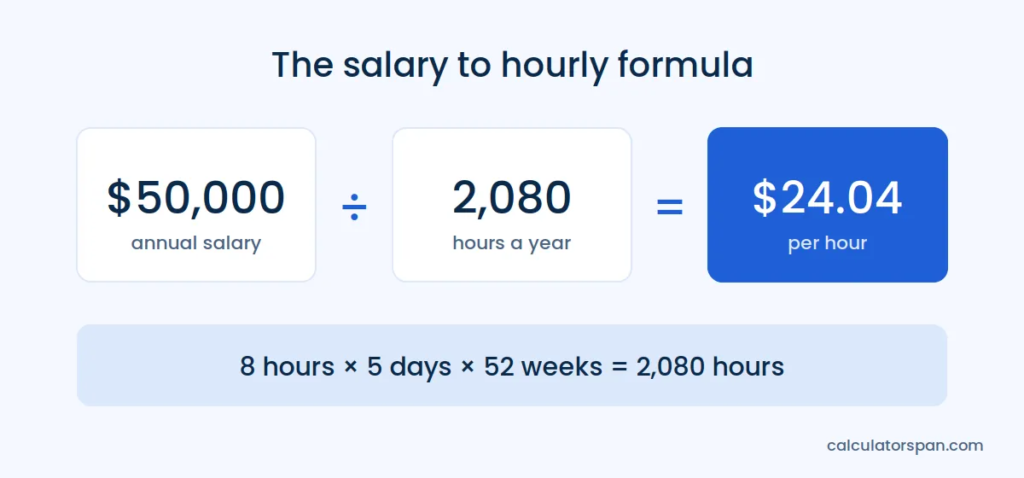
The salary to hourly calculator uses one simple formula: divide your annual salary by the number of hours you work in a year.
Hourly rate = Annual salary ÷ [(Hours per day × Days per week × Weeks per year) − Unpaid leave hours]
Example: $50,000 a year, 40-hour week, no unpaid leave
- Annual hours: 8 × 5 × 52 = 2,080 hours
- Hourly rate: $50,000 ÷ 2,080 = $24.04 per hour
Same salary with 10 unpaid leave days
- Unpaid hours: 10 days × 8 hours = 80 hours
- Annual hours: 2,080 − 80 = 2,000 hours
- Hourly rate: $50,000 ÷ 2,000 = $25.00 per hour
Fewer paid hours for the same salary means a higher effective hourly rate. That’s why the unpaid leave setting matters when you compare offers.
Hourly to salary (the reverse)
Multiply your hourly rate by your annual hours. At $20 an hour for 40 hours a week over 52 weeks: $20 × 2,080 = $41,600 a year.
Salary to Hourly Conversion Chart
This chart assumes a 40-hour week and 52 paid weeks (2,080 hours a year). Monthly and weekly figures are rounded to the nearest dollar.
| Annual salary | Hourly rate | Monthly pay | Bi-weekly pay | Weekly pay |
| $25,000 | $12.02 | $2,083 | $962 | $481 |
| $30,000 | $14.42 | $2,500 | $1,154 | $577 |
| $35,000 | $16.83 | $2,917 | $1,346 | $673 |
| $40,000 | $19.23 | $3,333 | $1,538 | $769 |
| $45,000 | $21.63 | $3,750 | $1,731 | $865 |
| $50,000 | $24.04 | $4,167 | $1,923 | $962 |
| $55,000 | $26.44 | $4,583 | $2,115 | $1,058 |
| $60,000 | $28.85 | $5,000 | $2,308 | $1,154 |
| $65,000 | $31.25 | $5,417 | $2,500 | $1,250 |
| $70,000 | $33.65 | $5,833 | $2,692 | $1,346 |
| $75,000 | $36.06 | $6,250 | $2,885 | $1,442 |
| $80,000 | $38.46 | $6,667 | $3,077 | $1,538 |
| $90,000 | $43.27 | $7,500 | $3,462 | $1,731 |
| $100,000 | $48.08 | $8,333 | $3,846 | $1,923 |
| $120,000 | $57.69 | $10,000 | $4,615 | $2,308 |
| $150,000 | $72.12 | $12,500 | $5,769 | $2,885 |
| $200,000 | $96.15 | $16,667 | $7,692 | $3,846 |
Work a different schedule? Enter your own hours in the salary-to-hourly calculator above and every figure recalculates.
Converting Other Pay Frequencies to Hourly
Not paid yearly? The salary-to-hourly calculator handles any pay frequency. It turns your pay into an annual figure first, then divides by 2,080 hours (or your own annual hours).
| Pay frequency | Pay periods per year | Example pay | Annual equivalent | Hourly rate (40 hrs/week) |
| Monthly | 12 | $5,000 | $60,000 | $28.85 |
| Semi-monthly (twice a month) | 24 | $2,500 | $60,000 | $28.85 |
| Bi-weekly (every two weeks) | 26 | $2,000 | $52,000 | $25.00 |
| Weekly | 52 | $1,000 | $52,000 | $25.00 |
| Daily (5 days/week) | 260 | $120 | $31,200 | $15.00 |
Semi-monthly and bi-weekly are easy to mix up. Semi-monthly means 24 paychecks a year, usually on the 15th and last day of the month. Bi-weekly means 26 paychecks, one every other week.
Monthly shortcut: a 40-hour week averages 173.33 hours a month (2,080 ÷ 12). Divide your monthly salary by 173.33 to get your hourly rate. For example, $6,500 ÷ 173.33 = $37.50 per hour.
How Overtime Changes Your Annual Pay
If you’re eligible for overtime, regular extra hours can add thousands to your yearly income. Turn on the overtime setting in the salary to hourly calculator to see the difference.
Example: $60,000 salary, non-exempt, 5 overtime hours a week at 1.5×
- Base hourly rate: $60,000 ÷ 2,080 = $28.85
- Overtime rate: $28.85 × 1.5 = $43.27
- Weekly overtime pay: $43.27 × 5 = $216.35
- Annual overtime pay (52 weeks): about $11,250
- Total annual pay: about $71,250
This only applies if your job qualifies for overtime. Many salaried roles are exempt, which we cover in the next section.
Need to work out overtime for a single week or pay period instead? Use our time and a half calculator. It handles 1.25×, 1.5×, 2× and 3× rates. To total the hours you actually worked, try the timecard calculator.
Working Hours Per Year by Country
A full-time year is 2,080 hours in the US, but the standard week varies by country. Use the right figure, or the same salary will convert to a different hourly rate.
| Country | Standard full-time week | Basis | Hours per year (52 weeks) |
| United States | 40 hours | Overtime threshold under the Fair Labor Standards Act | 2,080 |
| United Kingdom | 37.5 hours | Common full-time contract (legal cap: 48-hour average) | 1,950 |
| Canada | 40 hours | Federal standard hours, Canada Labour Code (provinces set their own) | 2,080 |
| Australia | 38 hours | Maximum weekly hours, National Employment Standards | 1,976 |
| Brazil | 44 hours | Federal Constitution, Article 7 | 2,288 |
| Turkey | 45 hours | Labour Law No. 4857, Article 63 | 2,340 |
| India | 48 hours | Occupational Safety, Health and Working Conditions Code, 2020 | 2,496 |
Part-time at 20 hours a week works out to 1,040 hours a year. To count the actual working days in a given year, including public holidays, use our working days calculator.
Salary vs Hourly Pay: Key Differences
The biggest practical difference between salaried and hourly pay is how extra hours are treated.
Hourly employees are paid for every hour they work. In the US, non-exempt workers must receive at least 1.5 times their regular rate for hours over 40 in a workweek. At $14 an hour, a 40-hour week pays $560. Add 5 overtime hours at $21, and that week pays $665.
Salaried employees receive a fixed amount each pay period, regardless of how many hours they work. Many are classified as exempt from overtime. In the US, exemption depends on three tests: being paid a salary, earning above a minimum salary threshold, and doing qualifying job duties. Being salaried alone doesn’t make someone exempt.
| Salaried | Hourly | |
| Pay each period | Fixed | Varies with hours worked |
| Overtime | Often exempt | Usually paid at 1.5× or more |
| Income predictability | High | Lower if shifts change |
| Schedule flexibility | Lower | Often higher |
| Benefits (health, retirement, paid leave) | More common | Less common, especially part-time |
Neither is better by default. A salary offers stability. Hourly pay rewards extra hours. Converting both to an hourly figure with this calculator is the fairest way to compare them.
The US federal minimum wage is $7.25 an hour, set by the Fair Labor Standards Act and enforced by the Department of Labor. Many states set a higher minimum. Rules differ in every country, so check your local labor law for overtime and minimum wage.
Using Your Hourly Rate to Compare Offers
A higher salary doesn’t always mean better pay. Running each offer through a salary-to-hourly calculator shows what you really earn for your time.
Example: two job offers
| Offer A | Offer B | |
| Annual salary | $62,000 | $58,000 |
| Hours per week | 45 | 37.5 |
| Weeks per year | 52 | 52 |
| Annual hours | 2,340 | 1,950 |
| Hourly rate | $26.50 | $29.74 |
Offer A pays $4,000 more a year but about $3.24 less per hour. If your time matters, Offer B is the better deal.
Setting a freelance or contract rate
If you’re leaving a salaried job to freelance, don’t just match your old hourly rate. As a contractor, you cover your own benefits, taxes, equipment, and unpaid time between projects. Many freelancers charge 1.25 to 2 times their salaried hourly equivalent to account for this.
For example, a $75,000 salary equals $36.06 an hour. At a 1.5× markup, a comparable contract rate is about $54 an hour.
Once you’ve set your rate, bill clients professionally with these free invoice templates. Add your logo, tax, and currency, then download a PDF. No sign-up needed.
Benchmarking against market pay
Convert the salary range in a job ad to hourly, then compare it to official data. In the US, the Bureau of Labor Statistics publishes median wages by occupation. In the UK, the Office for National Statistics publishes earnings by job, age and region.
Frequently Asked Questions
How do I convert my salary to an hourly rate?
Divide your annual salary by the hours you work in a year. For a standard 40-hour week over 52 weeks, that’s 2,080 hours. A $60,000 salary works out to $60,000 ÷ 2,080 = $28.85 per hour. Or enter your salary in the salary to hourly calculator above to get the result instantly.
How do I calculate my annual salary from an hourly wage?
Multiply your hourly rate by your hours per week, then by 52. At $20 an hour for 40 hours a week, that’s $20 × 40 × 52 = $41,600 a year.
How many working hours are in a year?
A full-time US schedule of 40 hours a week over 52 weeks is 2,080 hours. A UK schedule of 37.5 hours a week is 1,950 hours. Subtract any unpaid leave; 10 unpaid days at 8 hours each brings 2,080 down to 2,000.
What is $6,500 a month as an hourly rate?
About $37.50 an hour on a 40-hour week. A 40-hour week averages 173.33 hours a month, and $6,500 ÷ 173.33 = $37.50.
Does it work for part-time or irregular schedules?
Yes. Enter your own hours per day and days per week. For example, 4 hours a day over 3 days is 12 hours a week, or 624 hours a year over 52 weeks.
Does the calculator include taxes?
No. All results are gross pay before income tax, social security, and other deductions. This keeps the calculator accurate in any country, since tax rules differ everywhere.
Which currencies are supported?
USD, GBP, EUR, INR, CAD, AUD, AED, and SGD, plus a custom currency symbol. The currency only changes how numbers are displayed. The calculator doesn’t convert between currencies or use live exchange rates.
Is my salary data private?
Yes. All calculations run in your browser, and your salary inputs are never sent to our servers. If you save a preset, it’s stored only on your own device.