Most missed deadlines come from one bad assumption: that what counts as a business day is the same everywhere. It isn’t. A bank, the United States Postal Service, and a small shop in Japan can each count the same week differently.
Picture a refund promised in two business days. The request comes in on a Thursday before a legal holiday. The customer counts calendar days and expects the money by Saturday. The store counts business days and pays out the following Tuesday. Both sides think the other one is wrong.
Local customs, religion, and closures required by law all shape the count. Under 5 U.S.C. § 6103, federal holidays close government agencies, while some lending desks stay open six days a week. Knowing which rule applies helps you plan accurately and avoid costly mistakes.
The Nine-to-Five Business Day Is Breaking Apart
Start with an unpopular view: the traditional business day matters less every year, yet it still decides when your money lands. Both statements are true, and most guides only tell you one of them.
Hospitals, police, fire departments, airports, hotels, and gas stations never followed the office calendar. They run 24/7, so a weekend day works the same as any weekday for them.
The internet pushed the change further. Information-based companies depend very little on physical goods. A sale, a support ticket, or a software update can go out at midnight on a Sunday with no one in an office.
Teams are now globalized, with offshored support, flex time, and flexible schedules. For a hybrid workforce built on remote work, the fixed 8-hour workday looks like a leftover from another era.
The challenge is this: the workforce moved into an always-on economy, but banks, courts, and carriers still settle transactions on a fixed clock. The old schedule is losing importance in some industries, not all of them.
The trend for the coming years looks clear. Your own hours will keep loosening, while the service providers you depend on keep fixed schedules. Plan around their clock, not yours.
Five Business Day Myths That Cost Real Money
These myths come up constantly in refund disputes, contract questions, and shipping complaints. Each one sounds reasonable, and each one creates misunderstandings that cost time, money, or trust.
- Myth: Business days are the same everywhere. Your country and region set the rules. A Monday-to-Friday schedule in the United States doesn’t match parts of the Middle East or Asia, where the week can start on Sunday.
- Myth: Saturday counts if the doors are open. A business open on Saturday may still hold refunds, payroll, and approvals until Monday. Administrative and financial processes usually stop for the weekend.
- Myth: Staff on site means an official working day. Some departments stay open on weekends, and employees often work public holidays. A “we remain open” holiday notice usually covers the sales floor, not the accounts team.
- Myth: Same day means within 24 hours. “Same business day” means by the end of that specific business day, not 24 hours later. Submit a request at 4 PM, and you may get a result by close of business, not by 4 PM tomorrow.
- Myth: A holiday on a weekend doesn’t affect the count. It usually does. In the U.S., a Saturday holiday moves to Friday and a Sunday holiday moves to Monday, so you still lose a weekday.
Spot these early, and you can set realistic expectations before anyone signs a contract or clicks “buy.”
The Legal and Practical Definition of a Business Day
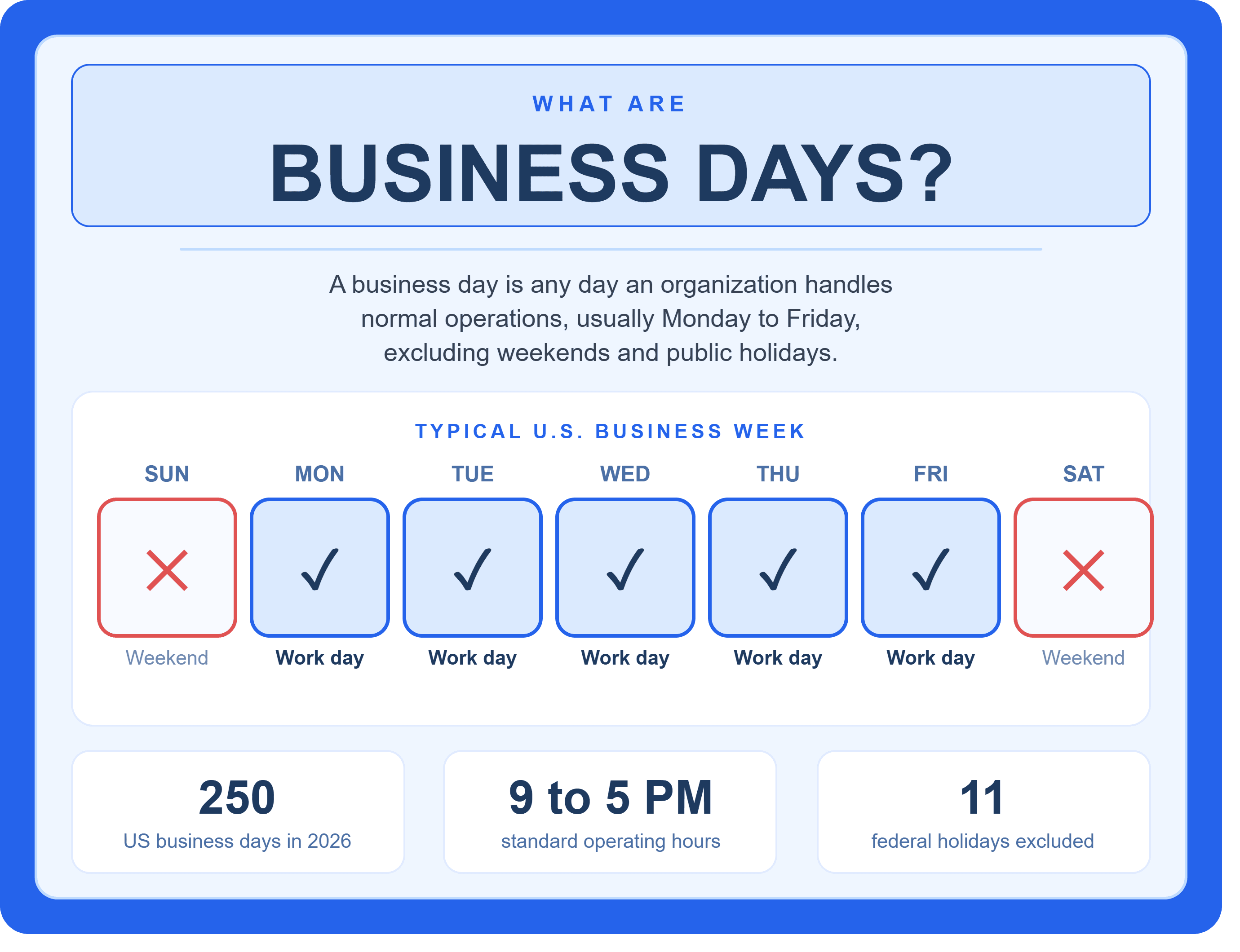
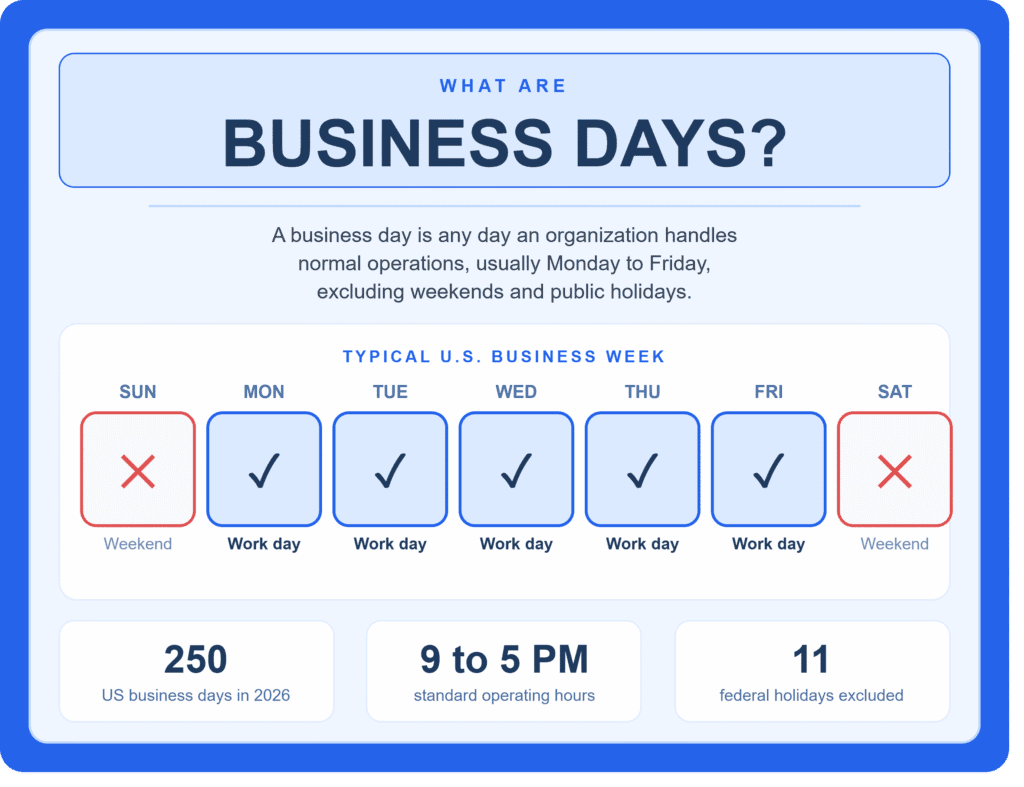
Strip away the jargon,n and a business day is any day an organization handles normal operations. In the United States, Canada, and most of Europe, that means Monday to Friday, with weekends and public holidays left out.
The legal definition is often narrower. U.S. banking rules such as Regulation CC define a business day as any day except Saturday, Sunday, or a federal holiday. Contracts and state laws can use their own wording, so always check the governing text.
For an individual, a business day is simply paid working time. For a company, it’s the unit every promise gets measured in, and the backbone of each commitment it makes to clients.
Treat it as a framework, not a fixed rule. Payroll cycles, contract deadlines, project timelines, and reporting all depend on it. So do trading desks and administrative teams.
Shipping companies like FedEx and UPS quote delivery timelines in business days. When a carrier promises 3 to 5 business days, a Friday dispatch could arrive anywhere from Wednesday to the following Friday.
Banking mostly works the same way. Standard transfers clear during set transaction hours, and processing pauses when banks close. Instant payment networks like FedNow and RTP now settle around the clock, but your bank has to support them.
Location and the type of business change the details. A U.S. firm plans around 11 federal holidays and Saturday and Sunday off. A company in the Middle East may follow a different weekend pattern and a completely different holiday list.
Across most sectors, the standard working week has five days, even though hours shift by role. When a contract doesn’t define the term, a court or counterparty will usually assume that five-day week.
The gap hurts remote and hybrid teams most. When clients and partners sit in different regions, planning, responses, and deliveries drift apart unless everyone agrees on the count.
Seven-day businesses add a twist. A store can open daily and advertise service seven days a week, while refunds and invoices still run only on weekdays.
What Counts as a Business Day in a Typical Week
In a typical U.S. week, business days run Monday, Tuesday, Wednesday, Thursday, and Friday. Saturday and Sunday fall outside the count because banks and government offices stay closed for processing.
Public holidays take out more days. New Year’s Day, Independence Day, Thanksgiving, and Christmas don’t count as business days, even when they land midweek. Your state or region may add holidays of its own.
Then industry comes in. Healthcare facilities, restaurants, and retail stores run seven days a week. For billing and payroll, though, most of them still treat only weekdays as business days.
Regional differences go deeper in international business. Several Middle Eastern countries run a Sunday to Thursday week with a Friday and Saturday weekend. Check the local workweek before you commit to any date.
How Many Hours Sit Inside One Business Day
Hours vary more than days do. In the Western world, the classic working day runs about 8 hours, from 9:00 AM to 5:00 PM. People still shorthand it as “nine to five.”
Offices in Japan and South Korea often stretch it. Staff commonly start around 8:30 AM, and long working hours keep many at their desks until 7 PM. Other companies treat 8:00 AM to 6:00 PM as their normal day.
Length also changes by industry. An 8-hour day is common. A 10-hour day shows up in compressed four-day schedules, and shift work can range from 4 hours part-time to 16 hours on a double shift. A timecard calculator helps you track the real total.
Banks split their clock. A branch might serve customers from 9:00 AM to 4:00 PM, while back-office processing continues after the doors close. Your working hours and your bank’s hours rarely line up.
The detail that trips most people up is the cutoff time. Many banks and payment platforms set it around 2:00 PM. Beat it, and your request goes through the same business day. Miss it, and the bank holds it until the next one.
For time-sensitive payments, get the exact cutoff in writing. A transfer sent at 2:05 PM on a Friday before a Monday holiday won’t move until Tuesday.
Business Days vs Working Days vs Calendar Days
These three terms sound interchangeable, but they count different things. Most unrealistic promises, disputes, and surprise costs start in the gap between them.
| Term | What It Counts | Where You’ll See It |
| Calendar days | Every day of the year, including weekends and holidays | Return windows, legal notices |
| Business days | Days an organization officially operates, usually Monday to Friday minus holidays | Shipping estimates, contracts, payment terms |
| Working days | Days a specific person or team actually works | Shift rosters, support schedules |
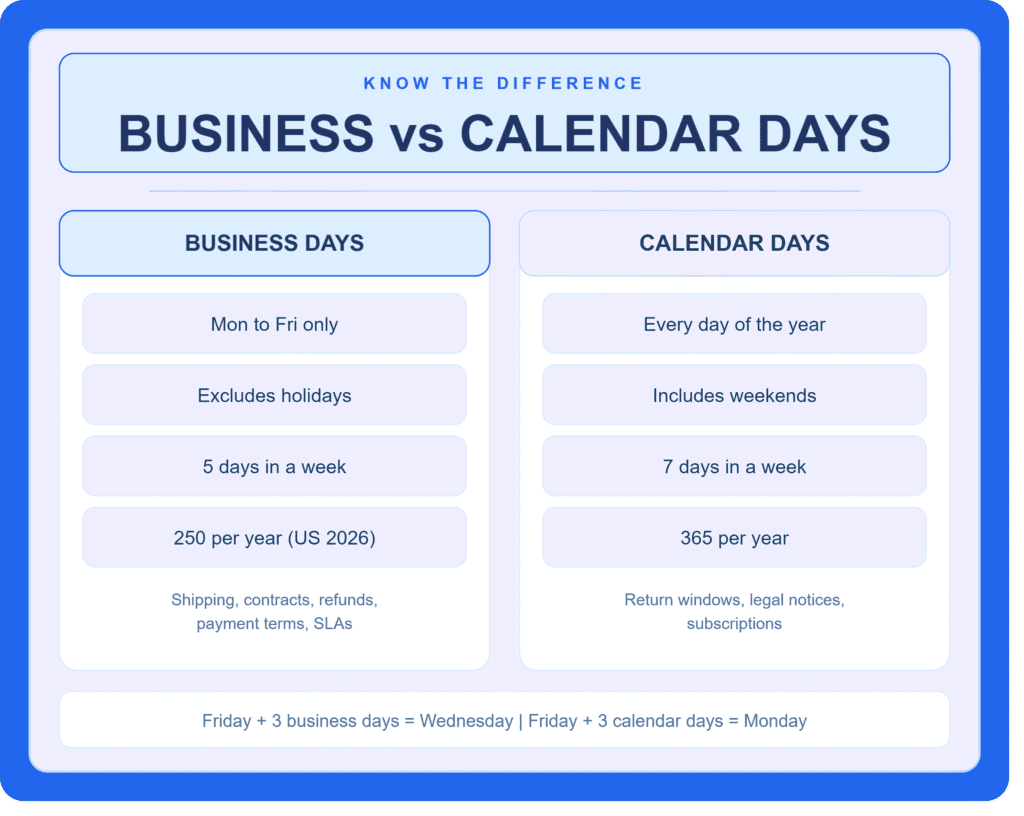
A week holds 7 calendar days but only 5 business days. Place an order on Friday with a three-business-day window, and it arrives Wednesday. Count calendar days instead,d and you’d expect it on Monday.
Hospitality, healthcare, and retail run every day, so their working days rarely match an office calendar. Flexible hours and remote teams blur the lines even more.
Take a real example. A 10-business-day payment term starting Monday, June 1, 2026, ends on Monday, June 15, 2026, counting from the next day. Read it as 10 calendar days, ys and you’d chase payment on June 11, four days early.
Vendor contracts often mix both units. A service agreement might promise fixes within “30 business days” while its shipping policy uses calendar days. That mismatch can add around 12 days, so ask vendors to state the unit clearly in every SLA.
Courts, freight schedules, and bank operations all depend on these distinctions, which is why clear communication matters. It protects deadlines, builds accountability, and keeps clients away from surprise late fees. To see both counts side by side, run your dates through the date difference calculator.
How Different Industries Count Business Days
Every industry counts a little differently, because each one has its own operating needs and compliance rules. Planning across sectors means knowing whose clock you’re working on.
Banking and Finance
Banks follow settlement systems. A deposited check usually clears in 1 to 2 business days, while international wire transfers often take 3 to 5 business days, depending on the countries involved.
Domestic wires usually move faster, but regulatory checks can still delay them. Loan disbursements and scheduled payments only settle on valid business days.
Traders go a step further with business day conventions. In interest rate swaps, a payment date that lands on a holiday moves under rules like “following” or “modified following.” The modified version keeps the payment inside the same month.
Shipping and Logistics
Standard ground shipping runs about 5 to 7 business days, and express options take 1 to 3. USPS, UPS, and FedEx all deliver on Saturdays in many areas. UPS and FedEx just don’t count Saturday as a transit day in their ground estimates.
Every online order gets an arrival date built from transit time plus warehouse handling. Customers track packages day by day, so schedules that ignore holidays break trust fast. The lead time calculator helps you work out a realistic order-to-delivery window.
Legal and Government
Legal work leaves little room for error. Court deadlines, permit applications, and government requests may use business days or calendar days, and a wrong guess can have serious consequences.
U.S. federal courts switched to counting every calendar day in 2009 under Federal Rule of Civil Procedure 6. A deadline only rolls forward when the last day lands on a weekend or legal holiday. Government agencies often follow their own rules, so check each one.
E-Commerce and Retail
Online stores run on both clocks. They count business days for processing orders, issuing refunds, and answering support tickets, but a 30-day return policy almost always means 30 calendar days.
After a return arrives, refunds typically take 5 to 7 business days. Stores that state this timeline on their refund page get far fewer “where’s my money” emails.
Healthcare, retail, and hospitality serve people every day, yet their billing still follows business days. Consumers, employees, and business owners all benefit from knowing that split.
Business Days Around the World
Take a global view, and the idea of a fixed week falls apart. Culture and religion shape workweeks, so the country you deal with decides what counts.
German has two words for this, used in Germany, Austria, and Switzerland. “Werktag” is a legal term for every day except Sundays and public holidays, so Saturdays usually count.
Context still matters. Germany’s Federal Court of Justice ruled in 2010 that Saturday doesn’t count as a Werktag for rent payment deadlines. The same word can mean different things in different laws.
The Saturday rule also explains why German shops trade on Saturdays while many offices and schools stay closed. Shop-hours law, historically the federal Ladenschlussgesetz, kept Sunday trading tightly limited.
“Arbeitstag” means something else: a day a person actually works. For most office staff, that’s Monday to Friday. For a firefighter on a rota, a Sunday can be a normal Arbeitstag.
Outside Western countries, weekends move around. The UAE switched from a Friday and Saturday weekend to Saturday and Sunday in 2022 to line up with Western markets. Saudi Arabia moved from Thursday and Friday to Friday and Saturday in 2013.
Pakistan has changed its weekend too. Friday became the weekly holiday in 1977, and Sunday returned in 1997. Countries that trade heavily with Western markets tend to settle on the same weekend.
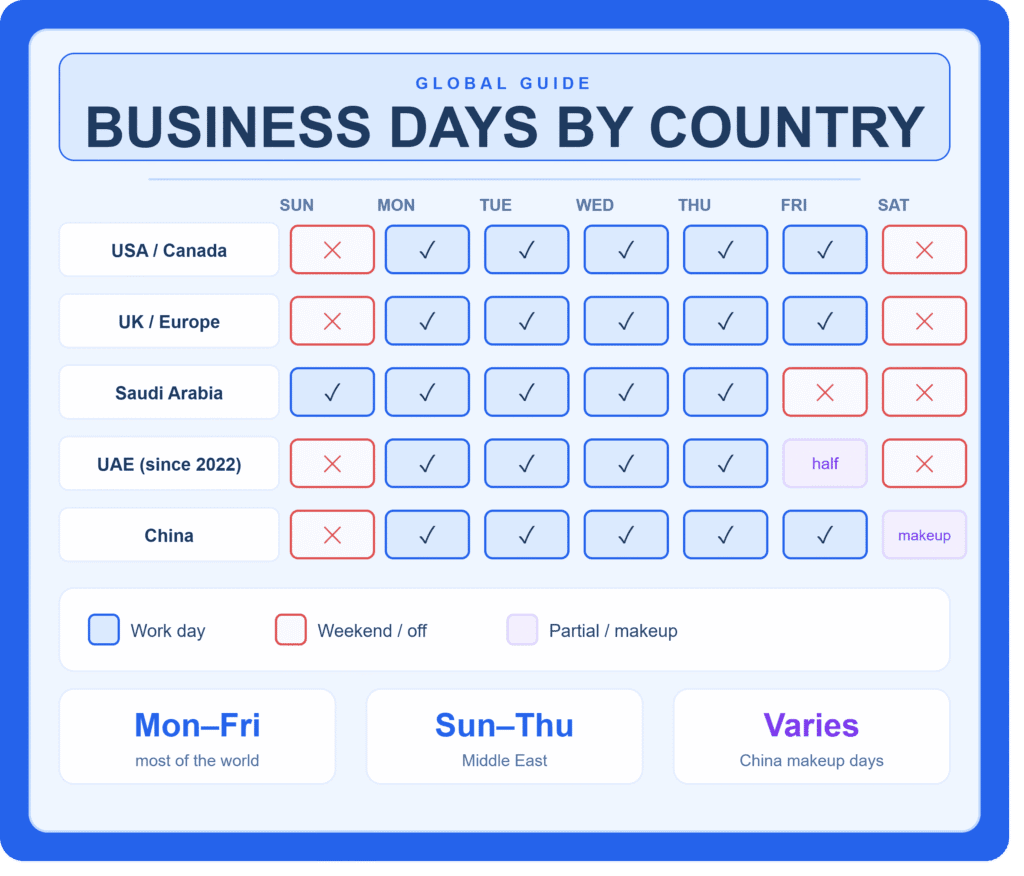
China adds its own twist. Since 2025, it observes 13 statutory holiday days, and it swaps some weekends into official “makeup” workdays around long breaks. So a Saturday or Sunday can legally become a business day there.
Holiday totals change the yearly numbers as well. 2026 holds 261 weekdays before any holidays come out, and most countries land 5 to 13 days below that.
| Country | Public Holidays | Business Days (Approx.) |
| United States | 11 federal holidays | About 250 in 2026 |
| United Kingdom | 8 bank holidays in England and Wales | About 253 in 2026 |
| Germany | 9 to 13, depending on the state | 248 to 254 |
| India | Varies by state; banks close on the 2nd and 4th Saturdays | Varies by state and sector |
| China | 13 statutory days plus makeup workdays | 248 by the official labor count |
Holidays vary by location. The U.S. closes for Memorial Day and Labor Day. The UK adds Boxing Day, as listed on the official GOV.UK bank holidays page. Japan slows down for Golden Week, and France, Italy, and Spain see widespread August shutdowns.
For global companies, these differences create scheduling conflicts in payments, international shipping, and customs clearance. Project deadlines slip when nobody maps the overlapping working days between offices.
The fix is simple. Load a business-day calendar for each country into your HR and project tools before the year starts. For meeting overlaps, pair it with a time zone converter.
How to Calculate Business Days Without Guesswork
Before you count, fix two things: the year and the country. After that, the math takes four steps.
- Start with total days. A common year has 365 days and a leap year has 366. A year is a leap year when it is divisible by 4, except century years, which must also be divisible by 400. So 2000 was a leap year, and 2100 won’t be.
- Remove weekends. Subtract Saturdays and Sundays. That’s usually 104 weekend days, or 105 in years that start or end on a weekend.
- Remove holidays. Take out every public holiday that lands on a weekday. In the U.S., a Saturday holiday moves to Friday, so it still costs you a working day.
- Remove company closures. Cut company retreats, company-wide closure days, and year-end shutdowns between Christmas and New Year’s.
For 2026, 365 total days minus 104 weekend days leaves 261 weekdays. Take out 11 federal holidays, and you get 250 business days on the U.S. federal calendar.
That’s the number of days the office can open. Your personal count drops further after vacations, sick days, and training. A typical full-time worker ends up working 220 to 240 days a year.
Nobody should count this by hand. In Excel or Google Sheets, the NETWORKDAYS function does the job, and NETWORKDAYS.INTL lets you set a Friday and Saturday weekend. The fastest option is the working days calculator, which skips weekends for you.
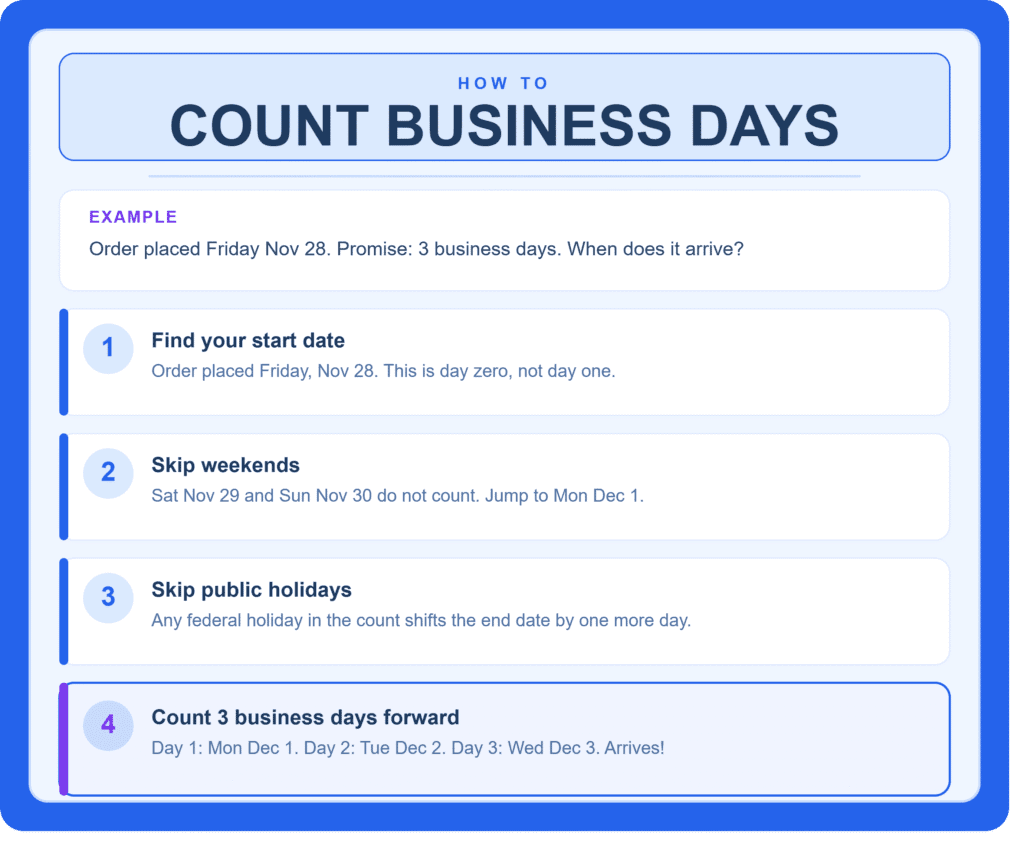
Try a quick delivery example. A product ships Monday with 3 business days to arrive. Tuesday, Wednesday, and Thursday make three, so it arrives Thursday. If Thursday is a public holiday, it moves to Friday.
Ship the same order on a Friday, and it arrives on Wednesday of the following week. If you need to add a set number of days to any start date, the date calculator gives you the exact result.
How Many Business Days Are in a Year
For the U.S., the formula is short: total days, minus weekend days, minus federal holidays. The steps above show the full method.
Most years have 260 to 262 weekdays. Remove the 11 federal holidays and most U.S. offices working Monday to Friday land between 249 and 251 business days, with 250 in 2026.
You’ll often see “260 to 262 business days” online. Those figures are weekday counts before holidays come out, so they overstate the real number by about 11 days.
For distributed teams, keep one shared calendar that marks local holidays as non-business days. Project tools then skip those dates automatically when anyone sets a due date. To track how much of the year is left, use the days left in the year counter.
Business Days in Each Month of 2026
The usual rule of thumb says a month holds 21 to 22 business days. That works as a rough shortcut, but real months swing more than that, as the 2026 counts below show.
Every month below uses the 2026 U.S. federal holiday calendar, so you can plan from real numbers:
| Month | Weekdays | Federal Holidays | Business Days |
| January | 22 | New Year’s Day, MLK Day | 20 |
| February | 20 | Presidents’ Day | 19 |
| March | 22 | None | 22 |
| April | 22 | None | 22 |
| May | 21 | Memorial Day | 20 |
| June | 22 | Juneteenth | 21 |
| July | 23 | Independence Day (observed July 3) | 22 |
| August | 21 | None | 21 |
| September | 22 | Labor Day | 21 |
| October | 22 | Columbus Day (Indigenous Peoples’ Day in many states) | 21 |
| November | 21 | Veterans Day, Thanksgiving | 19 |
| December | 23 | Christmas | 22 |
| Total | 261 | 11 | 250 |
March, April, July, and December each give you 22 business days. June, August, September, and October hold 21. January and May sit at 20, and February and November drop to 19.
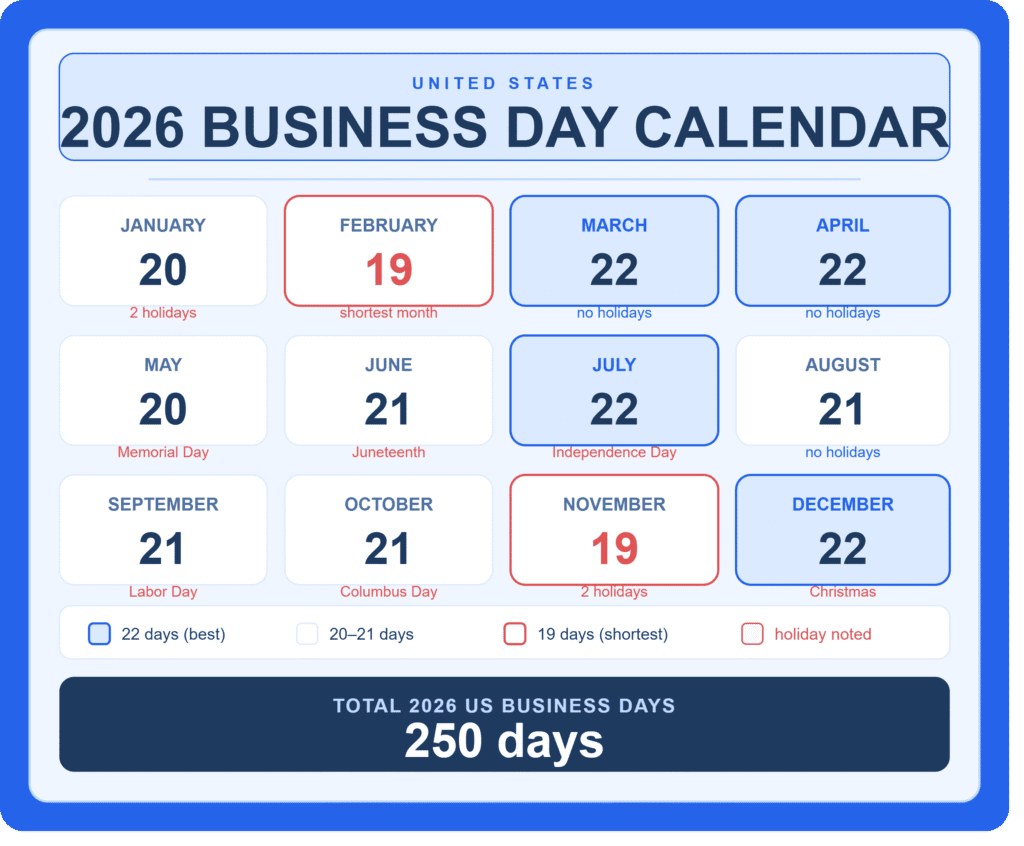
Good Friday isn’t a federal holiday, but U.S. stock markets close for it. If you work with trading desks, mark April 3 on your 2026 calendar.
Short months hurt the most. Sales teams setting quotas and finance teams splitting annual targets into monthly goals should give March more weight than February, instead of dividing by twelve.
Operations teams use the same numbers for capacity planning and forecasts. In supply chain work, losing two days in November can push a full shipment cycle into December.
For distributed teams, build the annual calendar first, then the monthly ones, then add each region’s holidays. That order keeps everyone’s expectations realistic.
Why Your Annual Business Day Count Matters
Too many planning decks treat the yearly business-day count as trivia. In reality, it sits at the center of performance targets in every department.
Finance. Divide an annual revenue target of $1 billion by 260 business days, and the daily benchmark comes to about $3.85 million. Those daily run rates feed budgets, resource allocation, and cash flow projections.
HR and operations. Staffing plans depend on productive days. With 20 paid days off, a 260-day year loses 7.7% of capacity before sick leave, training, onboarding, and compliance work take their share.
Sales and customer success. Quotas only make sense against real selling days. A “reply within 2 business days” promise needs coverage planning for busy holiday periods, especially late December.
Remote and hybrid teams. Asynchronous teams spread across time zones lose shared hours quickly. Every regional holiday cuts that overlap further, so planning has to account for it.
Now picture an implementation project scoped at 90 business days, starting March 1, 2026. Someone reading it as 90 calendar days expects delivery by May 30. On the U.S. federal calendar, the real finish is July 8.
That almost six-week gap turns into shipping delays, missed payment windows, and unhappy clients. One wrong assumption about the unit, and the project looks late from day one.
How to Manage Business Day Expectations
These practical steps work whether you run a business, track an order, or plan a client project. They’re simple, and they prevent most scheduling disputes.
- Ask about the unit every time. When anyone gives a timeline, confirm it with one question: “business days or calendar days?” Put the answer in contracts, vendor SLAs, and shipping policies.
- Let software do the counting. Project management platforms and calendar apps calculate around weekends and holidays automatically. For a single deadline, the days-until calculator gives you a quick answer.
- Add buffer time. Put two extra days around important deadlines. Unexpected delays and forgotten holidays cause most missed deadlines, and a small cushion absorbs nearly all of them.
- Load regional holiday calendars. For international work, add full holiday lists for each country, and note time zones next to every schedule.
- Say it plainly. Tell customers and colleagues exactly which days count. Clear communication is how you manage expectations in any professional setting.
- Work backwards from events. Conferences and internal events involve design approval, production, and shipping. Map those steps against key business dates before you set the event date.
Every total in a project plan should come from a real business-day count. That habit alone makes project deadlines far more reliable.
Frequently Asked Questions
How many business days are in half a year?
Expect roughly 124 to 130 business days. Twenty-six weeks of Monday-to-Friday work gives about 130 weekdays, and holidays bring the number down. In 2026, January to June holds 124 business days and July to December holds 126.
Do company shutdowns between Christmas and New Year’s reduce annual business days?
Yes. Shutdowns come on top of observed holidays. A full closure from December 28 to 31, 2026 removes four more working days, dropping the U.S. count from 250 to 246. Plan year-end closures early.
How do personal vacation days affect the number of business days I work?
They don’t change your company’s count, but they do change yours. Your actual working days equal business days minus vacation and other paid time off. That’s why a full-time worker usually works 220 to 240 days a year.
What happens if a holiday falls on a weekend? Does it change business-day counts?
Usually, yes. For U.S. federal holidays, a Saturday holiday moves to the Friday before and a Sunday holiday moves to the Monday after. Private employers can set their own policy, so check your company handbook.
How can global remote teams stay aligned when their business days differ?
Use one shared calendar that layers in each country’s holidays, so everyone can see who’s available. Plan asynchronous work around time zones, and agree on which country’s calendar governs each deadline before work starts.
Can business days include Saturdays?
For most official and administrative processes, no. Some businesses do work Saturdays, though. USPS delivers mail and some bank branches open for a few hours. In China, government makeup workdays can turn a Saturday into an official business day.
How do holidays affect business day counting?
Holidays drop out of the count. If a deadline lands on one, it usually moves to the next business day. National, federal, and regional holidays can all extend a timeline, so check which ones apply where you work.
Are business days the same worldwide?
No. Business days vary by country. Most Western countries use Monday to Friday, while several Middle Eastern countries use Sunday to Thursday. Culture, religion, and local labor laws explain the difference.
What if I need something processed immediately?
Ask for expedited or rush processing. Same-day service usually means beating a cutoff time and paying an extra fee. For urgent payments, submit early in the day and confirm receipt by phone or email.